


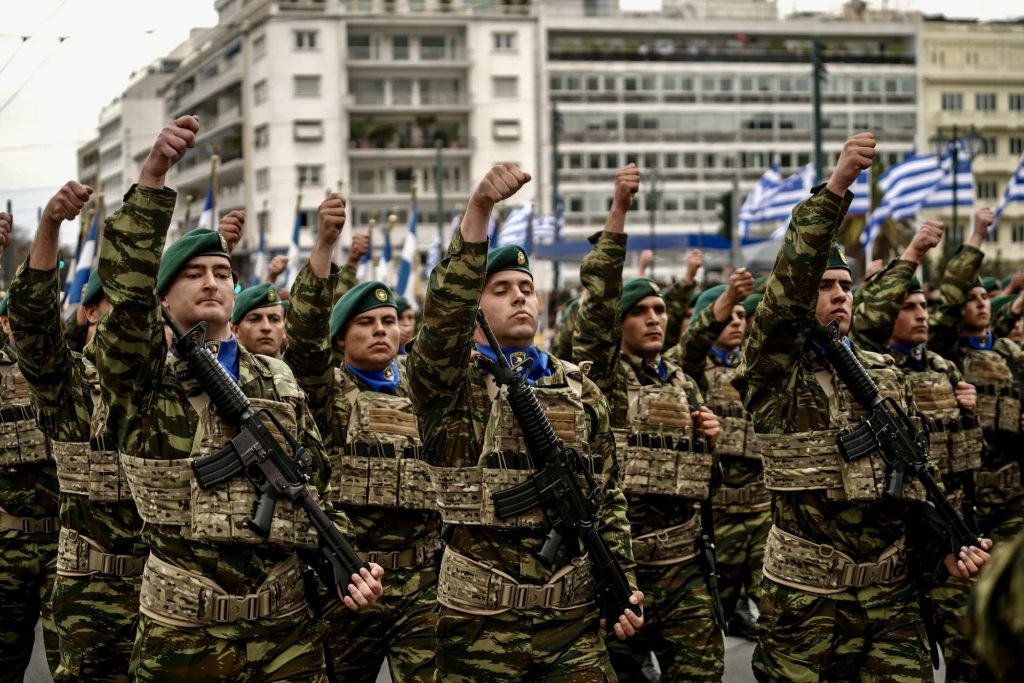
ATHENS (Realist English). Greece is continuing its large‑scale military modernisation, seeking to strengthen its defence capabilities amid persistent tensions with Turkey and regional instability.
The country is among NATO’s leaders in defence spending, traditionally allocating more than 3% of GDP – twice the alliance’s target.
By 2026, Athens had completed key stages of rearmament and announced a new military‑political doctrine aimed at abandoning a “Turkey‑centric” policy.
Overall military strength assessment
According to the annual Global Firepower 2026 ranking, Greece’s armed forces rank 30th in the world and are among the ten strongest armies in Europe. Total military personnel number 419,050, of which about 142,700 are in the ground forces. The structure comprises three main components: the army, the navy (around 186 vessels, among the EU’s top five navies) and the air force (230 combat aircraft).
The army operates one of the largest tank fleets in Europe – 1,385 main battle tanks, including modern Leopard 2A6 HEL and modernised Leopard 2A4.
At the end of February 2026, Greece also introduced a new model of military service, affecting conscription procedures, training programmes and living conditions for service personnel.
Rearmament programme: €25 billion by 2036
Since 2021, Athens has been implementing a programme which Prime Minister Kyriakos Mitsotakis has called the “most decisive” in the country’s recent history. The total budget for the reform until 2036 is €25 billion (about $29 billion).
Air Force modernisation:
- 24 Rafale fighters have been acquired, along with up to 40 F-35 Lightning II (first batch expected in 2028).
- A programme is under way to modernise around 40 F‑16 Block 50 aircraft to the Viper standard, which will create a fleet of more than 100 F‑16 Vipers.
Navy modernisation:
- In January 2026, the Hellenic Navy officially commissioned the first French FDI Belharra frigate, named “Kimon”. A total of four such vessels will be delivered.
- The long‑awaited modernisation of four MEKO‑class frigates, involving Greek shipbuilding companies, will also begin.
Air defence systems and ‘Achilles’ Shield’:
- A key project is the creation of a comprehensive multi‑layer air and missile defence system called ‘Achilles’ Shield’.
- A deal with Israel worth about €3 billion has been approved to create an “anti‑drone dome” capable of intercepting UAVs, rockets and ballistic targets.
- The systems to be integrated include SPYDER, Barak MX, SkyCeptor and David’s Sling.
An important condition of the new contracts is the participation of the Greek defence industry (at least 25% of production) and the mandatory transfer of source code to ensure long‑term technological independence.
The left‑wing opposition criticises the expenditure, arguing that it primarily serves the strategic interests of Greek capital in its competitive struggle with Turkey for spheres of influence and energy resources, rather than the real needs of the population.
Escalation of tensions with Turkey
Relations between the two NATO countries remain extremely strained. Turkey continues to exert diplomatic and military pressure:
- Ankara demands the demilitarisation of Aegean islands (Lesbos, Samos, Chios, Lemnos), citing the 1923 Treaty of Lausanne and the 1947 Treaty of Paris, and insists on the revision of maritime boundaries.
- Turkish F‑16s regularly violate Greek airspace and are intercepted by Greek Mirage 2000s.
- Turkey has announced a build‑up of special forces in Thrace and the Aegean region, including the deployment of new brigades.
Greece maintains a defensive posture, stating that its military preparations are purely defensive.
Athens’ new rhetoric
Defence Minister Nikos Dendias, speaking at a conference on 28 April, called for abandoning a “Turkey‑centric” policy. “Turkey is not – and must not become – our primary concern,” he said, although his speech contained a number of allusions to Ankara.
Expert opinions and forecasts
Analysts warn that under certain conditions (for example, if the United States is distracted by the Middle East conflict), Turkey might attempt more decisive action against Greece and Cyprus.
“NATO is unlikely to act as an effective mediator or deterrent, since both countries are members of the alliance, which is currently being called a ‘dead lion’,” expert reviews note.
The active military cooperation between Greece and Cyprus with France and Israel, in the opinion of observers, may serve as a response to the challenges, creating a new counterbalance to Turkish influence in the region.