


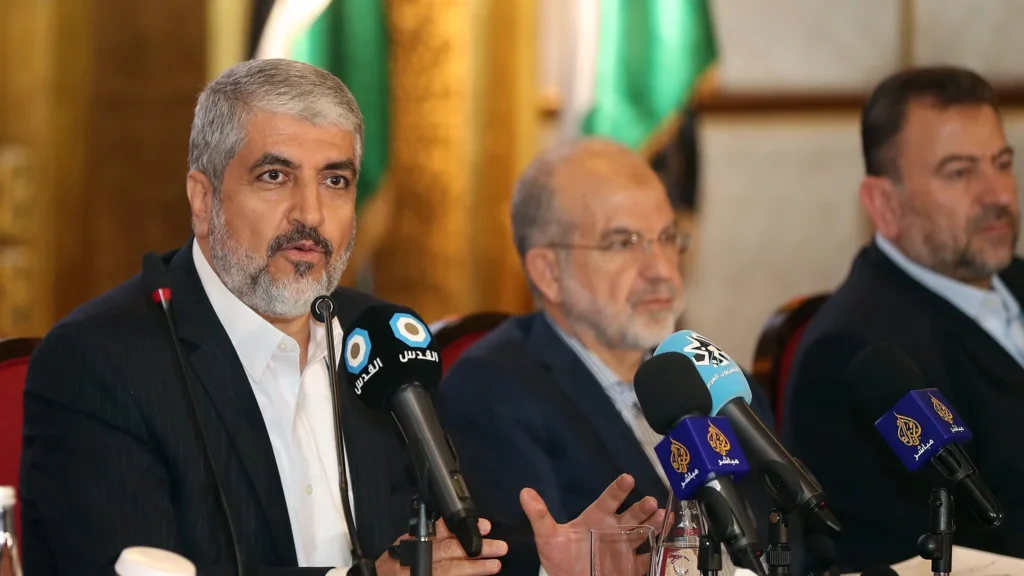
DOHA (Realist English). Senior Hamas political leader Khaled Meshaal said the Palestinian movement would reject any form of foreign domination over Gaza and would not agree to disarm, despite mounting pressure from Israel and the United States.
Speaking at a conference in Qatar’s capital, Meshaal said calls to criminalise Hamas, its leadership and its weapons were unacceptable. “As long as there is occupation, there is resistance,” he said. “Resistance is the right of peoples under occupation, and something nations are proud of.”
His remarks come amid the second phase of a US-backed plan to end the Gaza conflict, following the implementation of a nominal ceasefire on 10 October. The initiative, promoted by US President Donald Trump, envisages the gradual withdrawal of Israeli forces from Gaza and the disarmament of Hamas.
Israel has made Hamas’s disarmament a central condition of any post-war settlement. However, the movement, which has governed Gaza since 2007, has repeatedly ruled out laying down its weapons, while signalling limited openness to transferring them to a future Palestinian-led authority under certain conditions.
Meshaal also criticised proposals that would place Gaza under external oversight, including plans linked to a so-called “Peace Council” chaired by Trump, which would temporarily oversee governance through a committee of 15 Palestinian technocrats. He said any such framework must respect Palestinian sovereignty.
“We reject the logic of guardianship, any foreign intervention, or the return of a mandate in any form,” Meshaal said. “Palestinians must be governed by Palestinians. Gaza belongs to its people and to Palestine. We will not accept foreign domination.”
Meanwhile, Israeli officials are examining potential economic benefits tied to Gaza’s reconstruction. According to Israeli media reports, senior officials have discussed infrastructure projects that could link Israel and Gaza, including highways and electricity supply arrangements, as part of post-war planning.
Meshaal said reconstruction and humanitarian aid were urgently needed but warned that rebuilding Gaza must not come at the cost of political subordination. He called on any international mechanism to adopt what he described as a “balanced approach” that allows aid to flow while preserving Palestinian national principles.
The statements underscore the widening gap between Hamas’s position and the US-Israeli vision for Gaza’s post-conflict future, raising further questions about the viability of disarmament and governance plans as negotiations continue.