


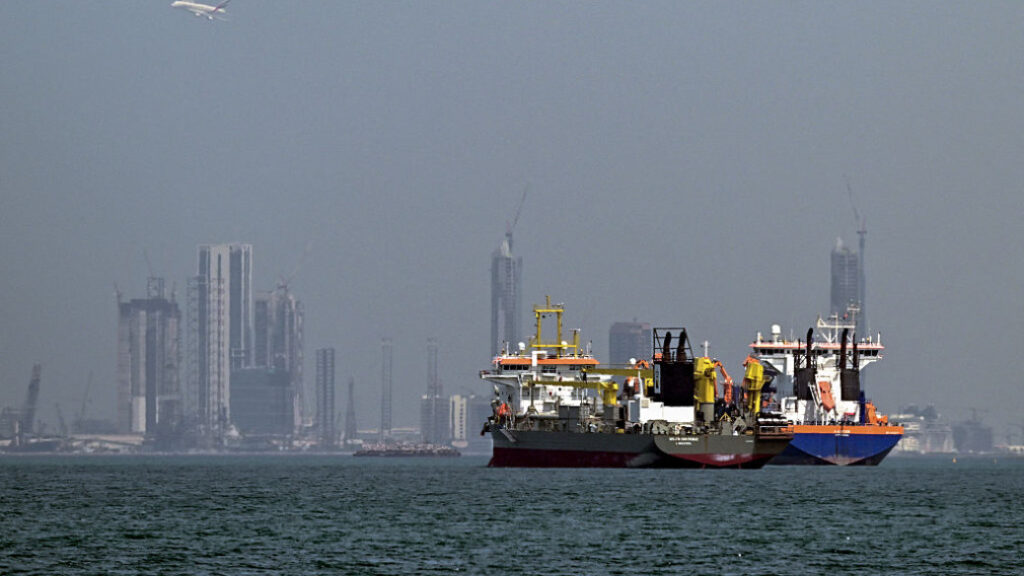
LONDON (Realist English). The effective closure of the Strait of Hormuz following the escalation of the Iran war has triggered one of the most severe disruptions in the global tanker market in decades, forcing shipping companies and charterers to rapidly reassess routes, costs and operational risks.
The crisis, which began on February 28, has sharply reduced tanker traffic through one of the world’s most critical energy chokepoints. According to vessel-tracking data from Kpler, tanker transits through the strait have fallen by roughly 92% compared with the week before the conflict.
As of early March, about 247 medium-range tankers or larger — representing around 6% of global tanker carrying capacity — remain stranded in the Persian Gulf. Expanding the estimate to the broader Middle East region brings the figure to roughly 984 tankers, equivalent to about 22% of the global fleet.
Although the strait has not been formally closed, the main constraint has been security concerns rather than insurance availability. War-risk premiums have surged, but insurers continue to offer coverage. Shipowners have instead been reluctant to move vessels after warnings from Iran’s Revolutionary Guard that ships attempting to transit the waterway could be targeted.
The disruption has pushed freight rates sharply higher, particularly in the market for very large crude carriers (VLCCs). Futures for the key Middle East Gulf-to-China route more than doubled to about $13.8 per barrel following the outbreak of hostilities.
In the physical shipping market, some charter discussions have reportedly approached Worldscale 525 for a VLCC voyage from the Gulf to East Asia — equivalent to roughly $15 per barrel in freight costs. At such levels, the delivered price of crude to China could approach $100 per barrel.
Inside the Persian Gulf, about 77 VLCCs are currently unable to leave the region, representing roughly 8.5% of the global fleet. Of those vessels, more than 60 are considered fully compliant with international sanctions rules.
The sudden loss of available tankers in the Gulf has effectively frozen many chartering negotiations as companies attempt to reassess risk and pricing in real time.
The impact of the disruption is also being felt far beyond the Middle East. Tankers that had been sailing toward Fujairah — a major hub for Gulf oil exports — have begun changing course toward alternative loading regions.
West Africa has emerged as one possible replacement supply route, with Asian buyers seeking alternative crude shipments. At the same time, demand for long-distance oil shipments from the United States, Brazil and Guyana to Asia has increased.
In Asia, some vessels that exited the Gulf before the crisis are now waiting in the Arabian Sea as shipowners delay decisions about rerouting around Africa.
Avoiding the Strait of Hormuz by sailing around the Cape of Good Hope adds between 10 and 15 days to a typical voyage and increases shipping costs by an estimated $1 million to $2 million per trip, according to market analysts.
Even alternative routes through the Red Sea remain risky due to ongoing security threats near the Bab el-Mandeb Strait, where vessels have previously faced attacks.
Beyond freight rates, the crisis has also created new operational risks for shipping companies. Analysts report a growing number of navigation disruptions and satellite interference incidents in the Persian Gulf and the Gulf of Oman.
Some tankers have attempted to move through the region while temporarily disabling their automatic identification system (AIS) signals, complicating efforts to track vessel movements.
Another concern is the so-called “shadow fleet” of tankers used to transport sanctioned oil. Analysts say many of these vessels have already moved toward East and Southeast Asia after increased Iranian exports earlier this year.
Shipping experts warn that charterers who unknowingly contract such vessels could face sanctions violations, cargo contamination risks or even the collapse of deals during transit.
Market analysts say normal tanker flows through the Persian Gulf are unlikely to resume until the conflict subsides or security conditions improve significantly.
Until then, the disruption to Middle Eastern oil exports is expected to keep freight rates elevated and reshape global shipping patterns, affecting both crude and refined product markets worldwide.