


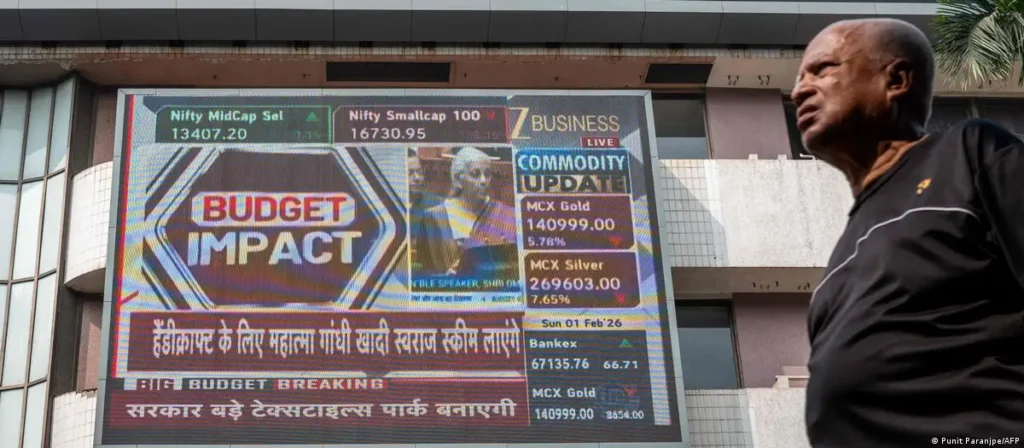
NEW DELHI (Realist English). India will spend a record amount on infrastructure and defence in the 2026–27 financial year, Finance Minister Nirmala Sitharaman told parliament on Sunday, outlining an expansionary budget aimed at accelerating growth and strengthening national security.
The government plans to invest $133 bn (€112 bn) in infrastructure and $85 bn in defence, representing increases of about 9% and 15% respectively compared with the previous budget cycle.
Sitharaman said the administration would also scale up manufacturing across seven strategic sectors: pharmaceuticals, semiconductors, rare earth magnets, chemicals, capital goods, textiles and sports equipment. “India will continue to take confident steps towards Viksit Bharat (Developed India), balancing ambition with inclusion,” she said during her budget speech.
The budget is the first since US President Donald Trump imposed 50% tariffs on Indian goods in August, citing New Delhi’s continued purchases of Russian oil. Following the presentation, Prime Minister Narendra Modi said India was “not content with simply being the fastest-growing economy”.
“India wants to become the world’s third-largest economy,” Modi said, adding that the budget provides an ambitious roadmap to reinvigorate domestic manufacturing and advance self-reliance.
The sharp rise in defence spending follows a four-day conflict with Pakistan in May 2026, during which both sides made extensive use of drones, missiles and artillery. Defence Minister Rajnath Singh described the increase as “unprecedented”, saying it would strengthen the armed forces through new fighter jets, drones, ships, submarines and other critical equipment.
“It is in the best interest of the nation,” Singh said, adding that the budget reflects Modi’s vision of a self-reliant India and a developed country by 2047.
Beyond defence, the budget outlines plans for seven high-speed rail corridors linking major economic hubs, including Mumbai, Bengaluru, Hyderabad, Pune and Chennai. Sitharaman said the projects are intended to serve as “growth connectors” while promoting environmentally sustainable transport.
The government also plans to develop “rare earth corridors” in four mineral-rich states — Tamil Nadu, Kerala, Odisha and Andhra Pradesh — and to expand support for data centres and artificial intelligence.
“I propose to provide a tax holiday until 2047 to any foreign company that delivers cloud services globally using data centre infrastructure based in India,” Sitharaman told lawmakers.