


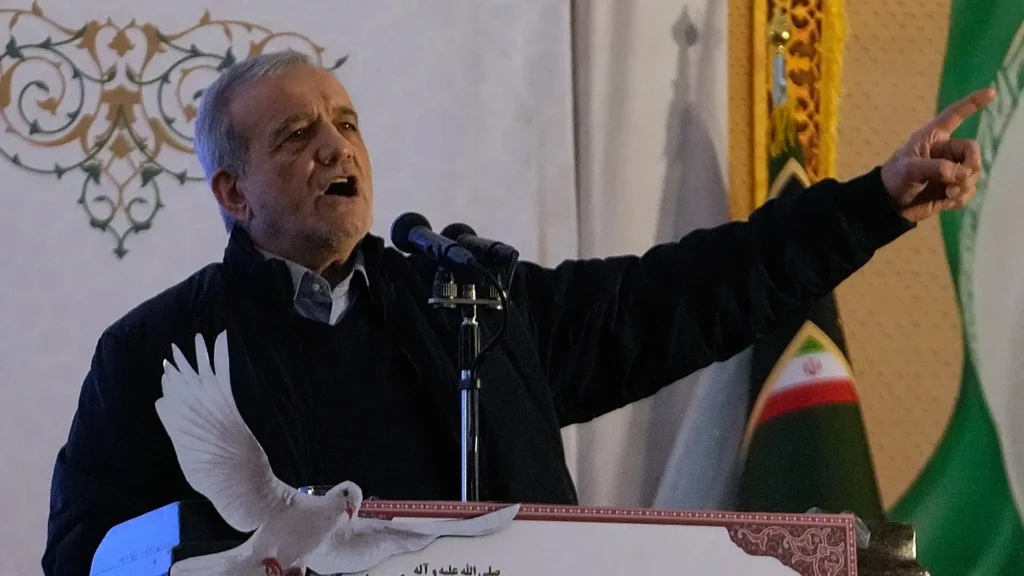
DUBAI (Realist English). Iran’s President Masoud Pezeshkian said Tehran would halt attacks against neighboring countries as the war with the United States and Israel entered its second week, even as fighting continued across the region.
In a statement on Saturday, Pezeshkian said Iran’s interim leadership council had instructed the country’s armed forces not to target neighboring states or launch missiles toward them unless attacks originated from those territories.
The Iranian leader also apologized to countries in the region, saying recent strikes were carried out amid a breakdown in military command following the deaths of senior Iranian leaders during the opening phase of the war.
“Our commanders and our leader lost their lives following the aggression, and our armed forces acted independently in defense of the country,” Pezeshkian said.
The announcement came shortly before US President Donald Trump warned that further Iranian officials could become targets in the conflict.
“Today Iran will be hit very hard!” Trump wrote on his Truth Social platform, suggesting additional targets were under consideration due to what he described as Iran’s “bad behaviour.”
The statement added uncertainty to whether Tehran’s pledge would result in a de-escalation. Analysts note that Iran’s military command structure has been disrupted since Supreme Leader Ayatollah Ali Khamenei was killed in US-Israeli strikes at the start of the war.
Moments after Pezeshkian’s announcement, Iranian attacks continued across the region. A drone strike was reported near Dubai airport, while Qatar said it intercepted an Iranian ballistic missile.
Meanwhile the Trump administration approved a new $151 million arms sale to Israel as Washington signaled that the conflict could intensify further.
US Treasury Secretary Scott Bessent said in a television interview that the largest bombing campaign of the war may still lie ahead.
Iran’s ambassador to the United Nations said Tehran would “take all necessary measures” to defend the country.
Explosions were reported in western Tehran after Israel launched what it described as a broad wave of strikes targeting Iranian military infrastructure and leadership positions.
The war has already caused significant casualties across the region. Officials say at least 1,230 people have been killed in Iran, more than 200 in Lebanon and around a dozen in Israel. Six US service members have also been reported killed.
The conflict has increasingly spread beyond the initial battlefield. Early Saturday, air raid sirens sounded in Bahrain as Iranian attacks targeted the island kingdom. Saudi Arabia said it intercepted drones heading toward its Shaybah oil field and shot down a ballistic missile aimed at Prince Sultan Air Base, which hosts US forces.
Explosions were also reported in Dubai, where authorities activated air defense systems. Passengers at Dubai International Airport — the world’s busiest hub for international travel — were temporarily moved into underground transit tunnels as security alerts sounded.
Shortly afterward, Emirates airline announced that all flights to and from Dubai had been suspended until further notice.
Energy markets have also reacted sharply. Qatar’s Energy Minister Saad al-Kaabi warned that a prolonged conflict could trigger a global economic shock.
“If this war continues for several weeks, global growth will be affected and energy prices will surge,” he said in an interview with the Financial Times.
Oil prices have already climbed above $83 per barrel, the highest level in more than two years.
Some regional analysts warn that Iran risks expanding the conflict into a broader confrontation with Arab states. Writing for Al Jazeera, researcher Sultan al-Khulaifi said Tehran may be making a major strategic miscalculation.
“By spreading the conflict to the Gulf, Iran risks transforming the war from a confrontation with Israel into a wider regional conflict involving its Arab neighbors,” he wrote.
Regional leaders have begun emergency consultations as the fighting intensifies. Saudi Arabia’s defense minister Prince Khalid bin Salman met Pakistan’s army chief Field Marshal Asim Munir in Riyadh to discuss the Iranian attacks and possible security responses.
Under a defense pact between the two countries, an attack on either state can be treated as an attack on both.
Missile alerts were also reported across Israel early Saturday, sending residents into shelters as incoming projectiles were intercepted by Israeli air defenses. No immediate casualties were reported.