


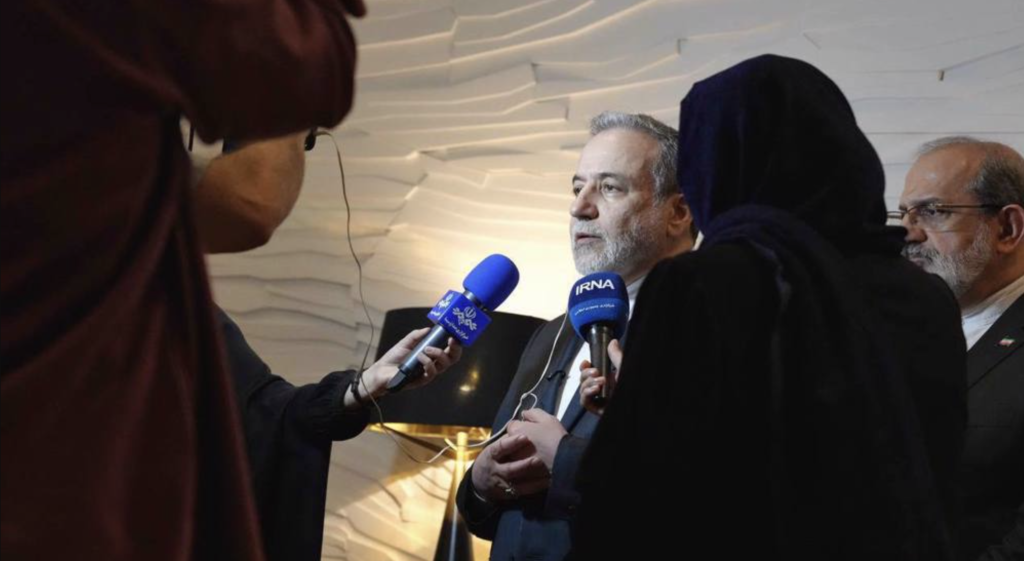
MUSCAT (Realist English). Iranian Foreign Minister Abbas Araghchi said a new round of indirect nuclear talks with the United States, held in the Omani capital Muscat, marked a “good start” and could be continued following consultations in Tehran and Washington.
“The decision on how to proceed with the negotiations will be made after consultations with the capitals,” Araghchi told Iran’s state broadcaster after the talks concluded on Friday, adding that “it seems that a consensus exists” on continuing the process.
The discussions, mediated by Oman, lasted around six hours and followed what Araghchi described as intensive preparatory consultations conducted in a “positive atmosphere”. He said Badr Al Busaidi played an active role, shuttling between the delegations and conveying messages and positions from both sides.
“These talks came after a long interruption,” Araghchi said, noting that Iran’s positions, concerns and what he described as the rights and interests of the Iranian people were fully communicated, while the views of the US side were also heard.
He said the timing and format of the next round would be determined through further consultations via Oman’s foreign minister. According to Araghchi, both sides agreed to restart a negotiating process eight months after Israel’s war against Iran had deepened mistrust and severely complicated diplomacy.
“We must first overcome this prevailing atmosphere of distrust,” he said, “and only then can we design a framework for a new dialogue that can secure the interests of the Iranian people.”
Araghchi stressed that the talks were strictly limited to the nuclear issue. “We are not engaging with the Americans on any other subject,” he said, adding that Iran had made clear negotiations must take place “in a calm environment, free from tension and threats”.
The Iranian delegation was led by Araghchi and included his deputies Majid Takht-Ravanchi, Kazem Gharibabadi and Hamid Qanbari, as well as Foreign Ministry spokesman Esmaeil Baghaei.
The US delegation was led by Special Envoy Steve Witkoff. Media attention was drawn to the presence of Brad Cooper, head of US Central Command, whose participation had not been announced in advance and stood in contrast to the absence of Iranian military officials. President Donald Trump’s son-in-law and adviser Jared Kushner was also part of the US team.
In a post on X, Al Busaidi described the talks as “very serious”, saying they helped clarify Iranian and American thinking and identify areas where progress might be possible. He said both sides aim to reconvene after the results are reviewed in Tehran and Washington.
Baghaei separately confirmed that the sides agreed to continue the talks after internal consultations.
Iranian officials say Tehran’s core demand remains the effective and verifiable lifting of economic and financial sanctions. They have repeatedly warned that any agreement lacking tangible economic benefits would be meaningless. On the nuclear issue, Iran insists on its right to enrich uranium on its own territory, calling it a non-negotiable red line.
Before the latest escalation, Iran had held five rounds of talks on a possible replacement for the 2015 nuclear deal, negotiations that were derailed after US-Israeli airstrikes on Iranian territory and nuclear facilities in mid-June.