


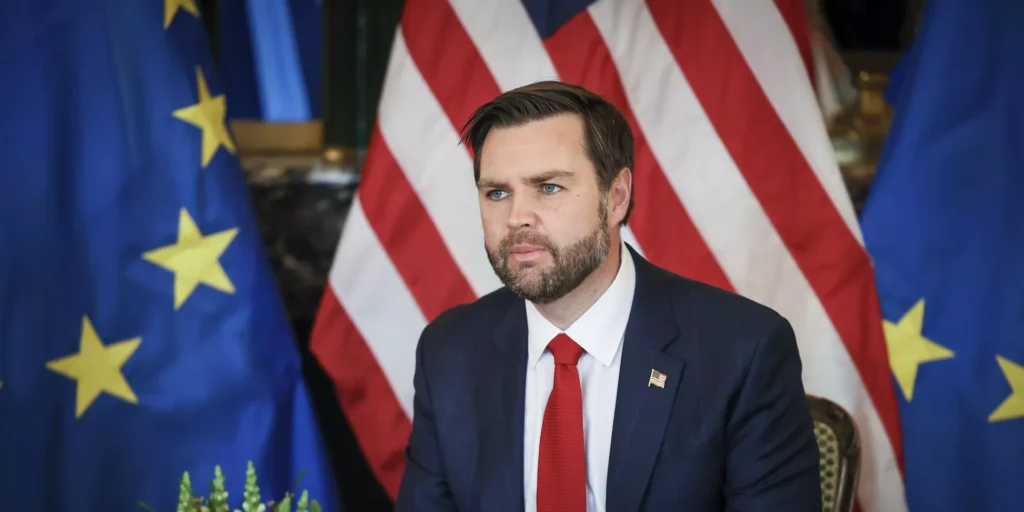
WASHINGTON (Realist English). The ongoing war with Iran has placed US Vice President JD Vance in a politically sensitive position, forcing him to distance himself from key foreign-policy decisions made by President Donald Trump and potentially strengthening a major rival ahead of the 2028 presidential race, according to an analysis published by the German newspaper Welt.
Since the conflict escalated at the end of February, Vance has largely disappeared from the public spotlight. A strong supporter of the “Make America Great Again” (MAGA) movement and the “America First” doctrine, he has long opposed large-scale US military operations abroad.
The war with Iran has complicated that stance.
When Trump ordered strikes on Iran on February 28 from his residence in Mar-a-Lago, the vice president was notably absent from the decision-making moment. It was only three days later, during a brief interview with Fox News, that Vance publicly outlined the administration’s goal of preventing Iran from ever acquiring nuclear weapons.
At the same time, he emphasized that the decision to launch the operation was solely the president’s responsibility.
Observers noted that Vance appeared careful to maintain rhetorical distance from the move while remaining loyal to the administration.
“Its decision belongs entirely to the president,” he said, adding that the United States must avoid repeating the costly experiences of the wars in Iraq and Afghanistan.
Between loyalty to Trump and “America First”
Trump’s military operation — dubbed “Epic Fury” — has placed the vice president in a difficult position between loyalty to the president and adherence to his own political philosophy.
The “America First” doctrine, widely supported by the MAGA movement, argues that the United States should avoid costly foreign conflicts that do not bring direct benefits to American interests.
Years of wars in Iraq and Afghanistan left many Americans skeptical about the country’s role as a global security guarantor.
Trump himself acknowledged some differences in outlook.
“His philosophy is a little different from mine,” the president said at a recent press conference. “JD may have been slightly less enthusiastic than I was, but I knew we had to do it.”
A turning point for 2028 ambitions
For the 41-year-old vice president, the Iran conflict could prove a defining moment for his political future.
Vance is widely seen as a potential Republican frontrunner for the 2028 presidential election and initially built his political profile by focusing on domestic economic issues, including policies aimed at bringing industrial production and jobs back to the United States.
However, Trump’s increasing focus on foreign policy and security has shifted political dynamics within the administration.
At the same time, Secretary of State Marco Rubio — widely considered another potential Republican presidential candidate — has become more visible alongside the president during the crisis.
Although Rubio has not officially declared any presidential ambitions, Trump has repeatedly praised him in public statements, fueling speculation that the president may be encouraging competition between the two figures.
Rivalry within the Republican camp
While opinion polls still place Vance among the leading Republican contenders for 2028, Rubio’s rising prominence in foreign policy could reshape the internal balance within the party.
Rubio has been closely involved in major diplomatic developments in Latin America following the collapse of Venezuelan leader Nicolás Maduro’s government, strengthening his profile as an experienced international figure.
Meanwhile, Vance has been tasked with helping the Republican Party prepare for the upcoming midterm elections, including leading fundraising efforts ahead of the November vote.
Political analysts say the success of both men in their respective roles could significantly influence their prospects for securing the party’s nomination in 2028.
At the same time, Trump’s decision to launch military operations abroad has created divisions within the broader MAGA movement itself, where some figures have criticized what they see as a departure from the “America First” principle.
For Vance, who has positioned himself as a key representative of that ideology, the Iran war may ultimately become a major test of both political loyalty and strategic positioning ahead of the next presidential cycle.