


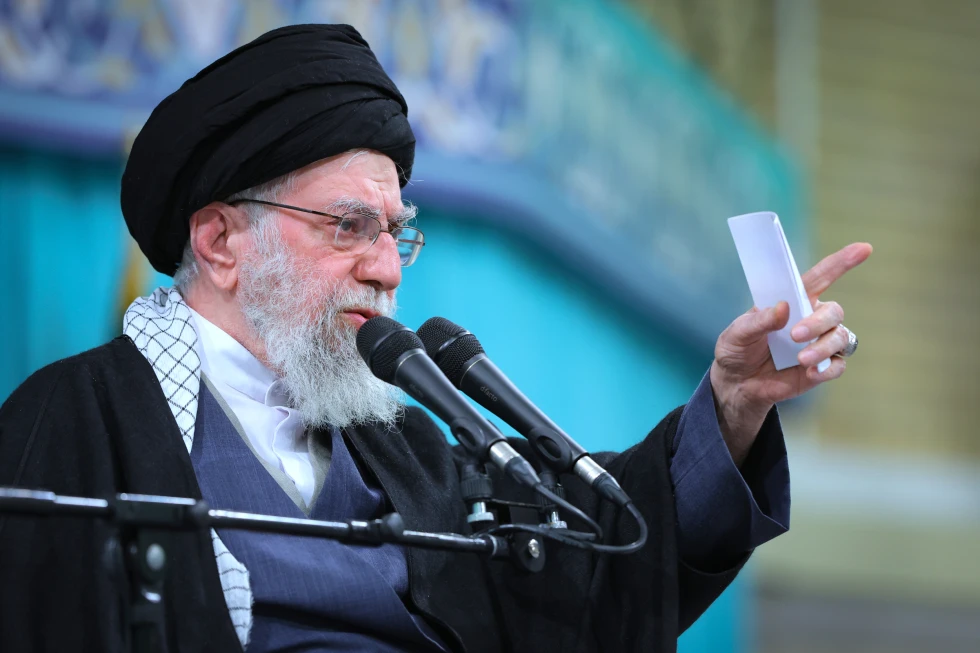
TEHRAN (Realist English). Iran on Tuesday issued a sharp warning to US President Donald Trump, cautioning against any action targeting the country’s Supreme Leader Ayatollah Ali Khamenei, days after Trump publicly called for an end to Khamenei’s nearly four-decade rule.
“Trump knows that if any hand of aggression is extended toward our leader, we will not only cut that hand, but we will also set fire to their world,” said Abolfazl Shekarchi, a spokesman for Iran’s armed forces.
The warning followed Trump’s remarks in an interview with Politico on Saturday, in which he described Khamenei as “a sick man who should run his country properly and stop killing people,” adding that “it’s time to look for new leadership in Iran.”
Tensions between Washington and Tehran have surged since Iranian authorities launched a violent crackdown on nationwide protests that erupted on December 28 over worsening economic conditions. Trump has publicly drawn two red lines for Tehran: the killing of peaceful protesters and the use of mass executions in the aftermath of the demonstrations.
Against this backdrop, US military movements have drawn close attention. Ship-tracking data showed that the aircraft carrier USS Abraham Lincoln, which had been operating in the South China Sea, passed through the Strait of Malacca by Tuesday. A US Navy official, speaking on condition of anonymity, said the carrier and three accompanying destroyers were heading west.
While US defense officials declined to confirm the carrier strike group’s destination, its position in the Indian Ocean places it only days away from entering the Middle East. The Abraham Lincoln was previously redirected from the Pacific to the region in 2024, and in June last year the USS Nimitz strike group was similarly deployed amid regional instability.
Meanwhile, the human toll of Iran’s unrest continues to mount. The US-based Human Rights Activists News Agency said on Tuesday that at least 4,519 people have been killed since the protests began. The group, which relies on a network of activists inside Iran, has a record of accuracy, though the Associated Press said it could not independently verify the figure.
The reported death toll exceeds that of any previous wave of unrest in Iran in decades and evokes comparisons with the turmoil surrounding the 1979 revolution. Although street protests have subsided in recent days, rights groups warn the number of casualties could rise as information slowly emerges from a country still under a government-imposed internet shutdown that began on January 8.
Khamenei himself acknowledged the scale of the violence on Saturday, saying the protests had left “several thousand” people dead and blaming the United States — the first such admission by an Iranian leader.
The Human Rights Activists News Agency also reported that more than 26,300 people have been arrested. Statements by Iranian officials have fuelled fears that some detainees could face execution, with Iran already among the world’s leading executioners.
National police chief Ahmad Reza Radan said those who surrender would receive more lenient treatment. “Those who were deceived by foreign intelligence services … have a chance to turn themselves in,” Radan said in an interview broadcast on state television, adding that they had three days to do so. He did not specify what penalties might follow if the deadline passes.