


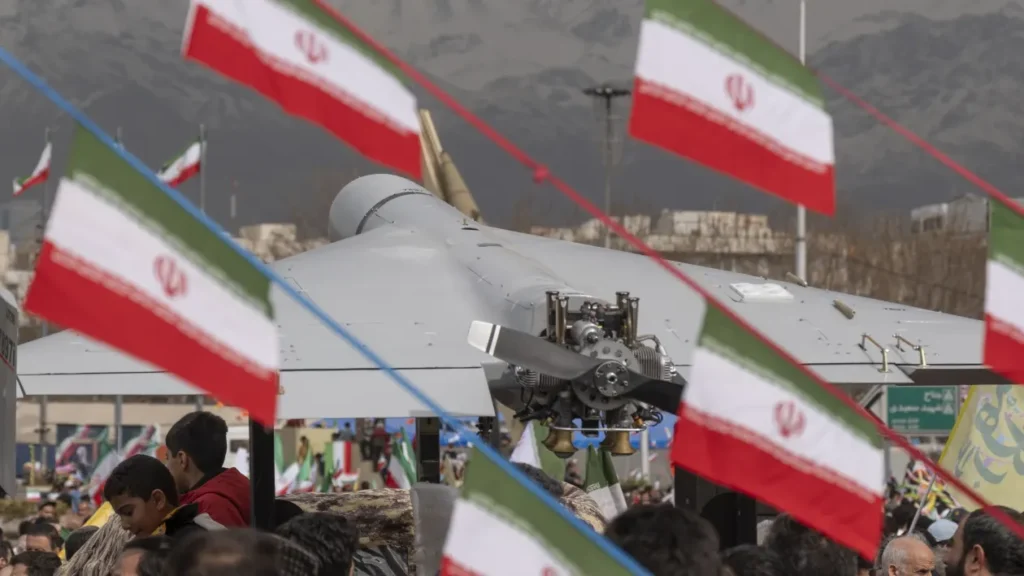
DUBAI (Realist English). The ongoing confrontation involving Iran, the United States and Israel has brought a weapon long familiar to Ukrainian soldiers to the skies over the Persian Gulf: the Iranian-designed Shahed-136 loitering munition.
Originally developed in Iran and widely used by Russia during the war in Ukraine, the Shahed drone has now become a central component of Tehran’s retaliation strategy against the United States and its regional partners.
Since the start of the conflict, Iran has reportedly launched thousands of drones toward targets across the region. Although many have been intercepted by advanced air defense systems such as the US-supplied Patriot missile batteries, some have managed to strike infrastructure.
The United Arab Emirates Ministry of Defence said that of the 941 Iranian drones detected since the beginning of the war, 65 reached Emirati territory, causing damage to ports, airports, hotels and data facilities.
Despite its growing notoriety, the Shahed-136 is technically modest compared with modern precision weapons. Analysts sometimes describe it as a “poor man’s cruise missile.” Yet its effectiveness lies less in technological sophistication than in cost and scale.
According to US government assessments, the Shahed-136 is a one-way attack drone produced by Iranian manufacturers linked to the Islamic Revolutionary Guard Corps. It typically flies at relatively low speeds and altitudes and carries a warhead of roughly 30–50 kilograms.
The drone is also relatively inexpensive. Public estimates suggest a single Shahed unit costs between $20,000 and $50,000. By contrast, many missile interceptors used by air defense systems in Israel and Gulf states cost between $3 million and $12 million each.
This disparity creates a strategic dilemma for defenders. Intercepting large numbers of low-cost drones can quickly consume expensive air defense missiles, gradually weakening protective systems.
“The Shahed-136 allows states like Russia and Iran to impose disproportionate costs on their adversaries,” said Patrycja Bazylczyk, an analyst with the Missile Defense Project at the Center for Strategic and International Studies.
She noted that such drones force opponents to expend costly interceptors while simultaneously creating persistent pressure on both military infrastructure and civilian populations.
Military analysts say Iran’s approach relies heavily on volume. Swarms of inexpensive drones can overwhelm defensive systems and potentially create openings for more powerful weapons, including ballistic missiles.
“The logic is to expend drones early while preserving ballistic missiles for later stages of the conflict,” Bazylczyk said.
Iran’s ability to sustain such attacks will depend on its manufacturing capacity and supply chains. Western governments have attempted to disrupt production by imposing sanctions on companies suspected of supplying drone components through networks in countries such as Turkey and the United Arab Emirates.
However, Russia’s wartime production of Shahed-based drones has demonstrated that such systems can still be manufactured at scale even under sanctions.
US officials estimate that Iran had already launched more than 2,000 drones during the current conflict. Military experts believe Tehran may possess substantial stockpiles and the capacity to produce hundreds more each week.
Security analysts warn that Gulf states could eventually face pressure on their interceptor inventories if attacks continue at the current pace.
“The risk is not immediate depletion, but it is a serious concern,” said Joze Pelayo, a Middle East security analyst at the Atlantic Council.
The Shahed-136 first gained global attention in 2022 when Russia began deploying the drones extensively in Ukraine. Since then, the Kremlin has reportedly produced thousands of units based on Iranian designs, demonstrating how easily the system can be replicated.
Some experts believe Iran has also incorporated lessons from Russia’s battlefield experience, adding features such as anti-jamming antennas and improved navigation systems.
The proliferation of low-cost attack drones is forcing militaries to search for more sustainable countermeasures. Ukraine, for example, has successfully used fighter-jet cannon fire to shoot down drones and has begun developing cheaper interceptor drones designed specifically to neutralize Shahed-type systems.
Other methods under development include electronic warfare systems targeting drone navigation signals, short-range air defense missiles and directed-energy weapons such as Israel’s Iron Beam.
Despite these efforts, analysts say Gulf states currently lack high-volume anti-drone systems capable of dealing efficiently with large swarms.
Developing and deploying such defenses could take years, suggesting that inexpensive loitering drones like the Shahed-136 are likely to remain a defining feature of modern warfare for the foreseeable future.