


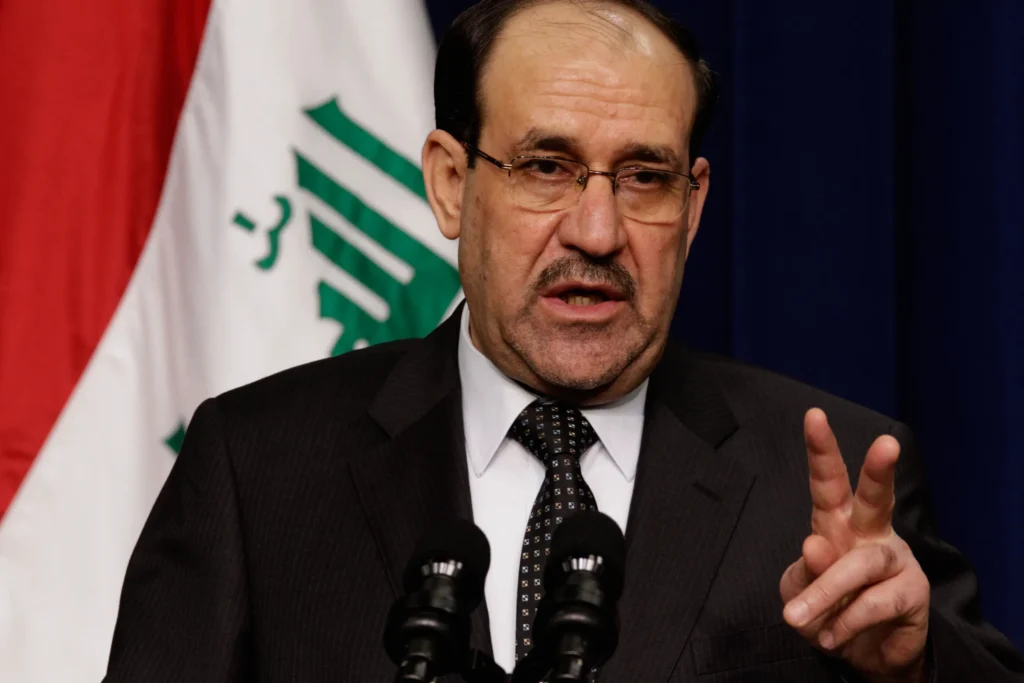
BAGHDAD (Realist English). Iraq’s main Shia political alliance, which holds a majority in parliament, has endorsed former prime minister Nouri al‑Maliki as the country’s next premier, effectively paving the way for his return to office more than a decade after he last held the post.
The Coordination Framework — a coalition of Shia factions with varying degrees of alignment with Iran — said on Saturday that it had “decided, by majority vote, to nominate” al-Maliki as prime minister “as the candidate of the largest parliamentary bloc,” citing his political and administrative experience.
The move virtually guarantees the appointment of al-Maliki, 75, pending formal steps in parliament. It comes at a time of major regional change, with Iran’s influence in the Middle East under pressure and tensions between Washington and Tehran once again rising.
Following Iraq’s general election in November, the Coordination Framework emerged as the largest bloc in parliament. It subsequently launched intensive negotiations over the formation of the next government, including talks with Sunni and Kurdish parties over the allocation of senior posts.
Parliament elected a speaker last month and is expected next to choose a new president, who will then formally task a prime minister with forming a cabinet to replace the current government led by Mohammed Shia al‑Sudani. Under Iraq’s power-sharing convention, the prime minister is a Shia Muslim, the speaker of parliament a Sunni, and the largely ceremonial presidency is held by a Kurd.
Al-Maliki remains one of the most influential and polarising figures in post-2003 Iraqi politics. He served two consecutive terms as prime minister from 2006 to 2014 — the only leader to do so since the US-led invasion that toppled Saddam Hussein.
Leader of the State of Law Coalition, al-Maliki has rebuilt his political clout despite a controversial legacy that includes accusations of deepening sectarian divisions and failing to prevent the collapse of Iraqi forces in the face of the Islamic State’s 2014 offensive.
Often viewed as close to Tehran, al-Maliki also has a record of pragmatic engagement with Washington, particularly during his earlier premiership. That dual positioning is likely to be tested again as he seeks to form a government in a country long caught between US and Iranian influence.
A key challenge will be Washington’s renewed push for Baghdad to disarm or marginalise Iran-backed armed factions, many of which the United States designates as terrorist groups. Iraqi officials and diplomats have said the US has demanded that the next government exclude such groups and move toward dismantling them — a difficult task given that many hold parliamentary seats and have expanded their political and financial power.
As coalition talks move toward their final stages, al-Maliki’s return signals continuity at the top of Iraqi politics — but also the likelihood of renewed friction at home and abroad over the country’s strategic direction.