


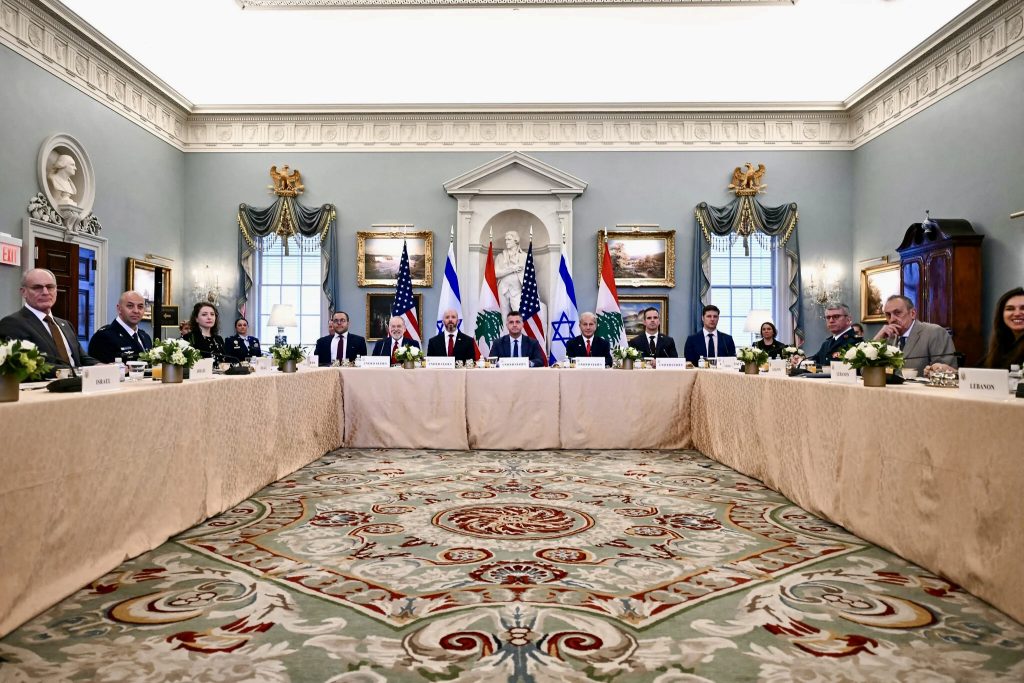
WASHINGTON (Realist English). The fourth round of direct negotiations between Israel and Lebanon is underway at the U.S. State Department, against a backdrop of a gap between Washington’s diplomatic optimism and ongoing military escalation in southern Lebanon.
The fighting occurring in parallel with the talks demonstrates the fragility of any agreement while the key player — Hezbollah — remains outside the diplomatic process.
Diplomatic Marathon
The Israeli and Lebanese delegations, headed by the two countries’ ambassadors to the United States — Yecheil Leiter and Nada Hamade Muawad — are attempting, with American mediation, to work out a comprehensive political and defense agreement. This is the first direct dialogue between states that have been in a state of war since 1948 since 1993. The main disagreements remain insurmountable:
- Security and sovereignty: Lebanon insists on a full ceasefire and the withdrawal of Israeli troops as a basis for the army’s plan to limit armaments. Israel demands the complete disarmament of Hezbollah as a security guarantee.
- “Pilot zones” and expansion of the truce: As a possible compromise, the creation of “pilot zones” is being discussed, where Israeli troops would gradually be replaced by the Lebanese army. In parallel, Lebanon has announced a “partial ceasefire” (in exchange for Israel refraining from strikes on Beirut), which it hopes to expand in Washington.
- U.S. position: U.S. Secretary of State Marco Rubio stated that a peace agreement is possible “tomorrow,” and the only obstacle is Hezbollah. The U.S. insists on separating these negotiations from the U.S.-Iranian talks, while Tehran, according to Rubio, is trying to link them.
Although fighting continues, on June 2, 2026, the Israeli Home Front Command announced a noticeable easing of restrictions in the north of the country:
- In several areas (Upper Galilee, Northern Golan Heights), all restrictions have been lifted, beaches are reopening, and gatherings of up to 100 people outdoors and up to 400 indoors are permitted (previously 50 and 200, respectively).
- Return to school: In communities along the border with Lebanon, as well as in several other localities, schools are reopening, marking a gradual return to peaceful life.
“Partial Ceasefire” Under Fire
The easing of Israeli restrictions is taking place amid ongoing hostilities that threaten the fragile truce:
- Mutual strikes: Lebanese media report strikes on 30 targets in southern Lebanon, including airstrikes that resulted in civilian casualties. Hezbollah claimed attacks on Israeli troops in southern Lebanon. The Israel Defense Forces (IDF) reported intercepting rockets and drones from Lebanon that caused no casualties.
- Humanitarian consequences: In response to “Hezbollah’s violations of the ceasefire,” the IDF renewed evacuation warnings for residents of Nabatieh. Since March 2, at least 3,468 people have been killed in Lebanon and 26 Israeli soldiers have died as a result of the conflict.
Hezbollah Outside the Dialogue: Sabotage or Bet on Iran?
Hezbollah, as a central party to the conflict, categorically rejects direct negotiations with Israel:
- Hardline position: Leaders of the movement (Naim Qassem, Mahmoud Qomati) called the talks a “ruse” aimed at disarming the movement and refused to accept a partial ceasefire. The Islamists promised that any aggression against the southern suburbs of Beirut would be met with a “deeper and stronger response.”
- Bet on Tehran: The rejection of dialogue is a bet on Iranian pressure. Tehran has already threatened to halt negotiations with the U.S. if Israeli attacks in Lebanon do not stop, creating a critical linkage between the Lebanese and Iranian tracks.
Conflict on Pause
The Lebanese crisis has become a hostage to the broader geopolitical game between the U.S. and Iran. Tehran has repeatedly stated that including a ceasefire in Lebanon is a mandatory condition for any deal with Washington. These negotiations, in turn, have reached a stalemate, increasing tension on the Lebanese front.
As a result, Lebanon finds itself at the epicenter of two crises — the local Israeli-Lebanese and the global U.S.-Iranian — where progress on one track directly depends on developments on the other.
At this point, neither side shows a readiness to compromise. Washington will continue to apply pressure, Hezbollah will continue to bet on Tehran, and ordinary residents of Lebanon and Israel will hope that the fragile truce does not finally collapse.