


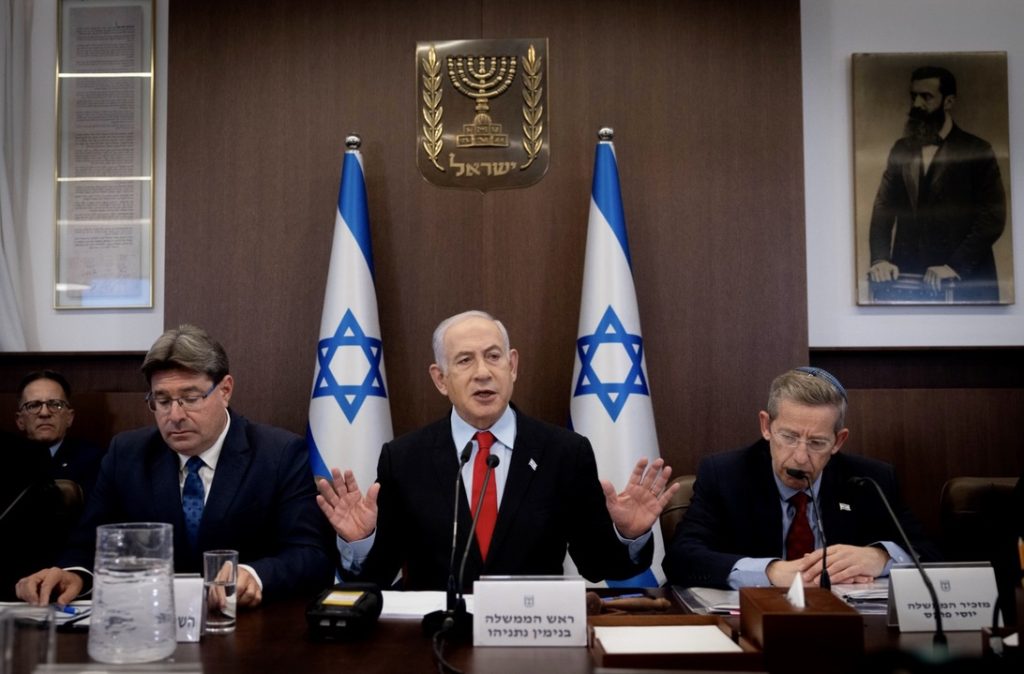
TEL AVIV (Realist English). Israeli Foreign Minister Gideon Sa’ar has announced his intention to submit to the government for approval a resolution on the official recognition of the Armenian Genocide in the Ottoman Empire.
The vote on the document is expected to take place as early as this coming Sunday. In Ankara, the move will undoubtedly be perceived as a direct challenge.
“At the next meeting of the Israeli government, I will present for approval a draft resolution on the official recognition by the Government of Israel of the Armenian genocide,” Sa’ar wrote on his X account.
According to him, it is a moral and historical duty to recognise the genocide committed against the Armenian people in the final years of the Ottoman Empire.
The draft text states that “based on moral and historical duty, Israel recognises the genocide committed against the Armenian people in the final period of the Ottoman Empire.” The document also provides for the condemnation of denial, downplaying or distortion of the historical truth about these events.
Historical Background
The explanatory memorandum to the draft notes that the Armenian Genocide began in April 1915 with arrests, deportations and murders of hundreds of Armenian intellectuals, public figures and leaders in Constantinople.
After the elimination of the community’s leadership, the Ottoman authorities began the systematic destruction of the Armenian population: men were mobilised for forced labour and killed, while women, children and the elderly were driven from their homes and sent on “death marches” towards the Syrian Desert. As a result, about 1.5 million people perished.
The document emphasises that, despite extensive historical documentation, the Armenian Genocide still remains the object of an organised campaign of denial and downplaying of its scale, primarily on the part of Turkey.
To date, 32 states have recognised the Armenian Genocide in various forms. Similar bills were submitted to the Israeli Knesset three times — in 2018, 2019 and 2021 — but all were rejected due to government resistance.
In August 2025, Prime Minister Benjamin Netanyahu for the first time stated that he recognises the genocide of Armenians, Assyrians and Greeks committed by the Ottoman Empire. Ten years ago, the Knesset Education Committee already declared recognition of the Armenian Genocide, but that did not become the official position of the government.
Turkey’s Reaction and Context of Deteriorating Relations
Ankara has not yet officially responded to Sa’ar’s statement. However, earlier, in August 2025, the Turkish Foreign Ministry called Netanyahu’s statement “an attempt to exploit past tragedies for political purposes.”
Israel long avoided official recognition of the genocide due to the diplomatic sensitivity of the issue. However, the sharp deterioration in relations with Turkey under President Recep Tayyip Erdoğan, who has repeatedly accused Israel of genocide in Gaza, has pushed Israel towards certain steps toward recognition in recent years.
Relations between the two countries, once the strongest in the region, have reached a historic low.
Turkey, which had maintained stable relations with Israel until 2023, became one of the harshest critics of Israeli military operations after the events of October 7, 2023.
Accusations of Genocide and Security Threats
On June 10, Erdoğan accused Israel of creating a security threat to Turkey. Netanyahu’s office issued a sharp statement in response.
The Turkish leader said that Israeli strikes on Syria and Lebanon “have reached a point where they threaten Turkey as well” and called on world powers to take a clearer position against Israel.
Israel as a “Main Obstacle”
Turkey’s Defence Ministry called Israel the “main obstacle” to reconciliation between the US and Iran and the “biggest impediment” to de‑escalation efforts in the region.
Ankara called on the international community to take a tougher stance.
Verbal War
On June 7, Israeli Defence Minister Israel Katz responded to statements by his Turkish counterpart about the “liberation of Jerusalem”: “Jerusalem is not Constantinople, and the State of Israel is not a crumbling Crusader empire.”
Katz also stated that “the Ottoman Empire that Erdoğan dreams of has collapsed and will never return.”
Structural Rivalry
Experts note that the rivalry between Israel and Turkey has become a structural constraint shaping policy on all regional issues — Syria, the Eastern Mediterranean, lobbying in Washington, and the Red Sea – Horn of Africa corridor.
The new Greece – Cyprus – Israel axis is tightening the noose around Ankara in the Mediterranean.
Israel is trying to limit Turkish influence in Syria.
Trade and International Courts
Turkey halted all trade with Israel and called for the international prosecution of Netanyahu.
The Trump Factor and Geopolitical Context
It is noteworthy that the Israeli initiative came the day after US President Donald Trump publicly praised Erdoğan.
Trump said the Turkish leader was “one of the main candidates” to join Iran in the war, as he “is not a big supporter of Israel.” Trump also promised that there would be no conflict between Israel and Turkey as long as he remains president.
Against this backdrop, Israel’s decision to recognise the genocide looks like a demonstrative move aimed at countering both Turkish pressure and a possible deal to sell US F‑35 fighter jets to Turkey.
After government approval, the draft resolution will be put to a vote in the Knesset. The opposition has already promised to challenge any attempts to delay the procedure. If adopted, Israel will become the 33rd state to officially recognise the Armenian Genocide.