


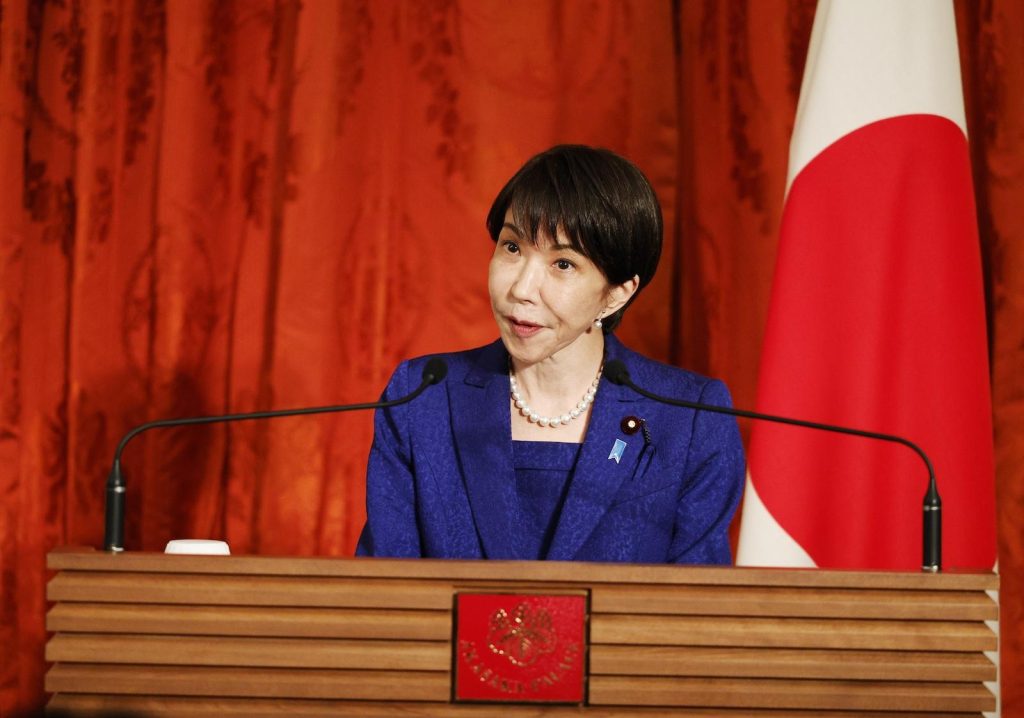
TOKYO (Realist English). Approval for Prime Minister Sanae Takaichi’s Cabinet has edged lower as public dissatisfaction rises over the government’s handling of oil supply disruptions linked to the war in Iran, according to a new Kyodo News poll.
The survey found the Cabinet’s approval rating fell slightly by 0.3 percentage points to 63.8%, while disapproval rose to 26.0%. Nearly half of respondents — 49.3% — said the government’s response to the energy crisis was insufficient, compared with 41.4% who viewed it as adequate.
Japan has moved to mitigate the impact of the global oil shock by releasing around 80 million barrels from its strategic reserves — equivalent to roughly 45 days of domestic consumption — and is considering further releases in coordination with the International Energy Agency.
Despite these measures, public concern is intensifying. The poll shows 89.5% of respondents are worried about the impact of the Middle East conflict on daily life, while 69.6% support continued government subsidies to stabilise fuel prices.
Gasoline prices surged to a record 190.80 yen per litre in mid-March before easing to around 170 yen following the introduction of subsidies. Authorities are also weighing demand-side measures, including calls for reduced fuel consumption.
The crisis has also influenced public attitudes toward foreign policy. A majority — 80.3% — said the U.S.-Israeli strikes on Iran were the wrong decision. At the same time, 50.1% supported the Japanese government’s cautious stance of avoiding a clear position on the conflict.
Debate is also emerging over Japan’s security role. Only 30.0% of respondents support constitutional changes that would allow deployment of the Self-Defense Forces to the Strait of Hormuz, a critical global energy chokepoint, while 64.4% oppose such a move.
Support for the ruling Liberal Democratic Party rose to 40.3%, while backing for its coalition partner, the Japan Innovation Party, declined to 6.5%. The main opposition, the Centrist Reform Alliance, remained marginal at 6.1%.
The findings suggest that while Takaichi’s government retains relatively strong approval overall, the prolonged energy crisis and its economic consequences are becoming a key test of public confidence.
Analysts note that Japan’s heavy dependence on imported energy leaves it particularly exposed to disruptions in the Middle East, making the government’s response to the crisis a central political issue in the months ahead.