


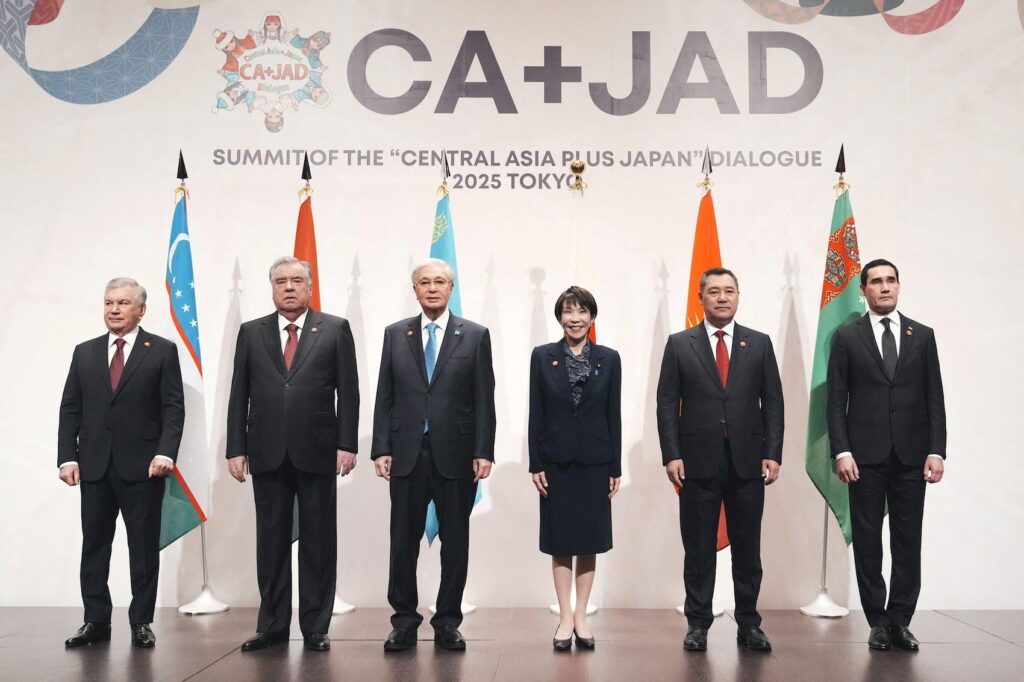
TOKYO (Realist English). Japan has announced a five-year target of $19 billion in business projects across Central Asia, signalling a bid to deepen its economic and strategic footprint in the resource-rich region as competition with China intensifies.
The goal was unveiled on Saturday after Japanese Prime Minister Sanae Takaichi hosted an inaugural summit in Tokyo with the leaders of Kazakhstan, Kyrgyzstan, Tajikistan, Turkmenistan and Uzbekistan.
In a joint statement issued after the talks, Japan said it had set a new objective of 3 trillion yen ($19bn) in business projects over the next five years. The initiative reflects Tokyo’s growing interest in Central Asia’s largely untapped reserves of critical minerals and energy, as major economies seek to diversify supply chains and reduce reliance on China.
“It is important for Central Asia, blessed with abundant resources and energy sources, to expand its access to international markets,” the statement said. Leaders agreed to step up cooperation to strengthen critical minerals supply chains while pursuing economic growth alongside decarbonisation goals.
The summit comes amid heightened diplomatic activity in the region. Central Asian leaders have also met separately this year with Russia’s Vladimir Putin, China’s Xi Jinping and European Commission President Ursula von der Leyen.
Analysts say Tokyo is seeking to raise its profile as concerns grow over China’s tightening grip on rare earths. “Natural resources have become a strong focus, especially over the past year, because of China’s moves involving rare earths,” said Tomohiko Uyama, a professor at Hokkaido University specialising in Central Asian politics, referring to Beijing’s export controls introduced this year.
As part of the new partnership, leaders agreed to expand cooperation on the Trans-Caspian International Transport Route, a logistics corridor linking Central Asia to Europe while bypassing Russia. They also pledged to work together on developing “safe, secure and trustworthy” artificial intelligence.
Japan has long encouraged its companies to invest in Central Asia, though many remain cautious due to infrastructure challenges and political risk. China, by contrast, has positioned itself as a dominant commercial partner, pouring money into major infrastructure projects after Xi’s visit to Astana in June.
While the former Soviet republics continue to view Moscow as a key strategic partner, Russia’s invasion of Ukraine has unsettled the region. Central Asia’s resource potential remains significant: Kazakhstan is the world’s largest uranium producer, Uzbekistan holds vast gold reserves, Turkmenistan is rich in natural gas, and Kyrgyzstan and Tajikistan are opening up new mineral deposits.
Despite the promise, exploiting these resources remains difficult, with projects hampered by harsh terrain, limited infrastructure and widespread poverty across the region.