


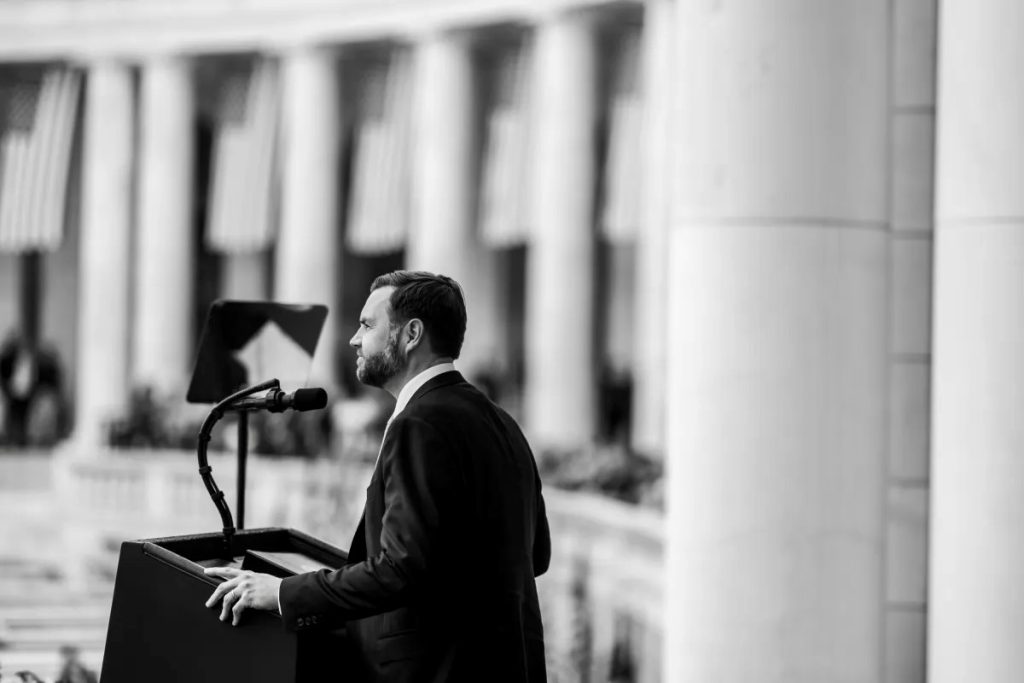
WASHINGTON (Realist English). US Vice President JD Vance, known as the author of the bestseller “Hillbilly Elegy,” will publish a new memoir on June 16 titled “Communion: Finding My Way Back to Faith” (HarperCollins).
The book marks a significant turn in the public rhetoric of one of America’s most influential politicians, who is edging closer to a possible run for the presidency in 2028.
From skeptic to practicing Catholic
In the book, Vance, now 41, details his journey from agnosticism and a departure from the Christian faith in which he was raised to a conscious acceptance of Catholicism. If ten years ago in “Hillbilly Elegy” he described himself as a person far from organized religion, today, as vice president, he calls himself a practicing Catholic and does not hide that his conversion in 2019 in Cincinnati was a turning point in his life.
“I am a Christian, and I became a Christian because I believe the teachings of Jesus Christ are true,” Vance writes in the introduction. “But I haven’t always thought that way, and by sharing my story, I might be able to help others — whether Catholic, Protestant, or seekers — reconcile with God.”
However, Vance’s conversion cannot be called a simple return to his roots. The Catholicism he adopted is strikingly different from the evangelical Protestantism of his childhood. Commentators note that his conversion took place not in a traditional parish church but in a Dominican monastery in Cincinnati — a city that is itself a historic center of Catholic immigration to the United States from Germany and Ireland.
‘Politics is derivative of metaphysics’: the link between faith and views
The book serves as a bridge between Vance’s spiritual rebirth and his radical political transformation. Vance states directly that his transition from a skeptic of Donald Trump to his closest ally became possible thanks to a fundamental change in his worldview.
“My political evolution was a consequence of a much more fundamental change in how I saw the world,” he writes. “I looked into our elite institutions and found them intellectually and spiritually broken. Was it surprising that I eventually rejected their politics as well?”
Vance derives his political views from Catholic social teaching. In the book, he advocates for prioritizing family over GDP, restricting immigration, rejecting universal basic income, and opposing abortion while calling for better conditions for mothers and children. He uses theological concepts, including the concept of “ordo amoris” (order of love), to justify prioritizing care for neighbors (fellow citizens) over global aid, thereby contradicting the traditional line of the Vatican.
‘The most influential Catholic’ vs. the Pope
The book comes amid a prolonged public conflict between the US administration and the Holy See. Vance, whom the media have dubbed “the most influential Catholic in the United States,” has entered into direct polemics with Pope Leo XIV, the first American pontiff in history.
In recent public discussions, Vance, justifying the administration’s military actions and immigration policy, effectively called on the Pope to “be careful when he speaks on theological topics” and to “leave moral questions to the church and foreign policy to politicians.” In response to the Pope’s criticism of the war in Iran, Vance stated that the pontiff should “refrain from commenting on geopolitical issues” and focus on morality, implying that war can be justified in terms of “just war” doctrine.
This position led to a public rebuke from the head of the doctrinal department of the US Conference of Catholic Bishops, who questioned the vice president’s interpretation of both the just war theory and the role of the papacy.
Laying the groundwork for 2028
The book appears as Vance actively tests the waters for a presidential campaign in 2028. In an interview with CBS Sunday Morning, he confirmed that the decision to run will be made together with his wife Usha after the midterm elections in November 2026.
Notably, Donald Trump himself is not pressuring Vance, maintaining “neutrality,” but is actively discussing the possible future of his vice president. Vance states: “I have no doubt that the president of the United States will be very supportive of whatever I ultimately decide to do.” This tacit blessing from Trump could be a decisive trump card in the fight for the nomination.
However, as New York Magazine notes, Vance is in a difficult position. He is a “chameleon” who previously criticized interventionism (based on his experience of the Iraq War) and now fiercely supports the Trump administration’s conflicts. Voters now wonder: if his position on war has changed so dramatically, will his newly found faith prove equally fickle?
Release scandals: ‘Methodist’ cover and criticism
The book’s release was not without scandals. In April 2026, observers noticed the cover of “Communion,” which featured a church. The problem was that it was not a Catholic church but a United Methodist church.
The designers’ blunder sparked a wave of mockery on social media and criticism from the Catholic community, which saw it as disrespect or at least negligent treatment of denominational symbols.
Additionally, HarperCollins is banking on success comparable to “Hillbilly Elegy,” which sold more than 5 million copies. However, critics write that a story about a search for faith may be a significantly more difficult product to sell than a story about social deprivation, although publisher Jonathan Burnham calls the book “a heartfelt story that will resonate far beyond politics.”
The book goes on sale amid a resurgence of interest in Catholicism in the United States — some dioceses report record numbers of conversions, and Pope Leo XIV himself is an American.
For Vance, “Communion” is not just a memoir but a clear signal to the conservative electorate and an attempt to unite the MAGA movement with the values of the “New Right,” for whom Catholicism is becoming a new cultural dominant.