


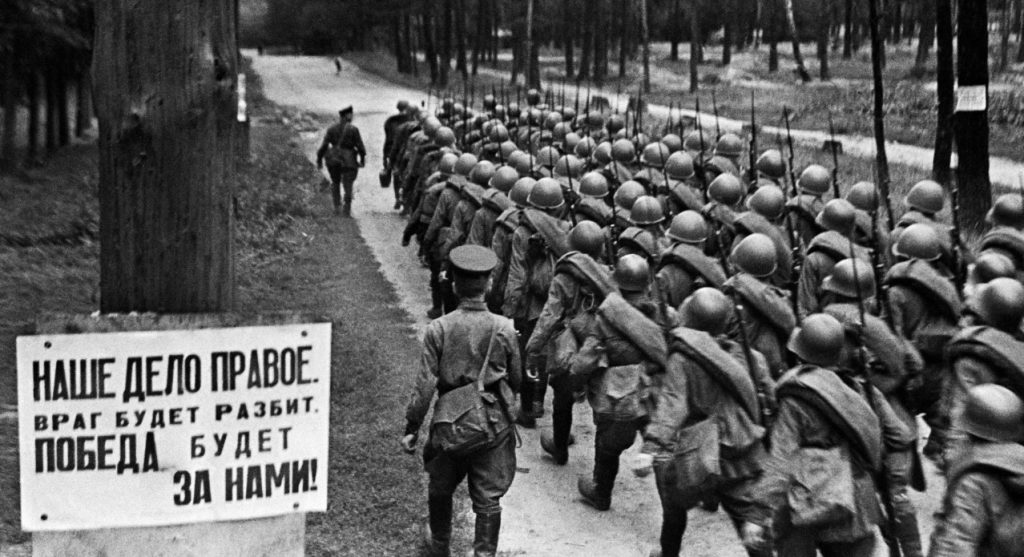
MOSCOW (Realist English). June 22, 1941 is one of the most tragic dates in Russian history. At dawn on that day, Nazi Germany invaded the territory of the Soviet Union without a declaration of war, beginning the Great Patriotic War, which lasted 1,418 days and nights and claimed millions of lives.
Chronicle of the Invasion
On the night of June 22, 1941, German troops were placed on full combat alert. At 3:05 AM Berlin time (4:05 AM Moscow time), the entire Soviet-German border from the Baltic to the Black Sea was engulfed in smoke and resounded with exploding shells — the war had begun.
The first to take the ground attack were border guards and rifle divisions stationed near the border. German aviation launched massive strikes on airfields, railway junctions, naval bases, permanent troop deployment areas and many cities up to 250–300 kilometres deep from the state border.
Bombing raids hit Minsk, Kiev, Riga, Sevastopol, Vilnius, Kaunas, Brest and other cities.
At 5:30 AM, when the war had already been underway for more than an hour and a half, German Ambassador F. von der Schulenburg arrived at the office of USSR People’s Commissar for Foreign Affairs V.M. Molotov and read out a note on “military countermeasures” against the Soviet Union.
In response, Molotov declared the German accusations unfounded and called Germany’s attempt to find a pretext for attacking the USSR a lie and a provocation.
Alongside Germany, Romania and Italy entered the war against the USSR, followed later by Finland, Hungary, Slovakia, Bulgaria, Croatia and Norway.
Plan Barbarossa: A Design for Destruction
Development of Plan Barbarossa began on July 21, 1940, and in December 1940 it was approved by a directive of the Supreme Commander of the Wehrmacht. The main military-political goal of Hitler’s plan was to crush the Soviet Union in a single short campaign — a blitzkrieg.
By June 22, 1941, 190 divisions of Germany and its allies had been concentrated near the USSR’s borders. The plan envisioned destroying the main forces of the Red Army west of the Western Dvina–Dnieper line, preventing their withdrawal into the interior of the country.
As German historian Wolfram Wette noted, the plan’s aim was to conquer the Soviet Union, destroy the majority of its population, and exploit the country and its natural resources. Hitler was convinced that this was a war of annihilation that would not allow for prisoners of war.
In practice, this was reflected in horrific figures: of the 5.7 million Soviet prisoners of war, more than 3 million were killed in German camps.
Outcome of the War and the Price of Victory
The Great Patriotic War ended on May 9, 1945 with the complete defeat of the fascist bloc. However, victory came at the cost of irreparable losses.
Total human losses of the USSR during the war amounted to 26.6 million people. Of these:
- more than 8.7 million died on the battlefields;
- 7.42 million were deliberately exterminated by the Nazis in occupied territories;
- more than 4.1 million died from the brutal conditions of the occupation regime;
- 5.27 million were deported to forced labour in Germany.
The USSR’s losses accounted for 40% of all human losses in World War II. About one million Soviet soldiers gave their lives in the liberation of the peoples of Europe.
Material damage was colossal: the occupiers completely or partially destroyed over 1,700 cities and towns, and more than 70,000 villages and hamlets. Direct material damage to the state and population alone amounted to 679 billion roubles (at 1941 prices).
Achievements and Historical Significance of the Victory
Despite unimaginable losses, the Soviet Union endured and prevailed. Over the course of the war, the Soviet Armed Forces carried out more than 50 strategic, over 250 front-level and about 1,000 army-level offensive operations.
For courage and heroism shown in the fight against the enemy, over 11,000 people were awarded the title of Hero of the Soviet Union, with more than 100 receiving the title twice. Victory was achieved thanks to the unity of army and people, the unity of the peoples of the USSR, their unyielding will, courage, heroism, patriotism and moral superiority over the enemy.
As a result of the victory, the USSR’s authority in the world grew immeasurably, and its ties with other states expanded — from 25 at the start of the war to 49 by 1945.
The Soviet people, in a remarkably short time, healed the deep wounds of war, restored the ruined economy and achieved outstanding success in political and socio-economic development.
Remembrance
In 2007, President Vladimir Putin signed a law designating June 22 as a Day of Remembrance and Sorrow among Russia’s commemorative dates.
In 2020, a law was signed to hold an annual All-Russian minute of silence on June 22 at 12:15 — the exact time of the broadcast of V.M. Molotov’s address to Soviet citizens about Germany’s attack.