


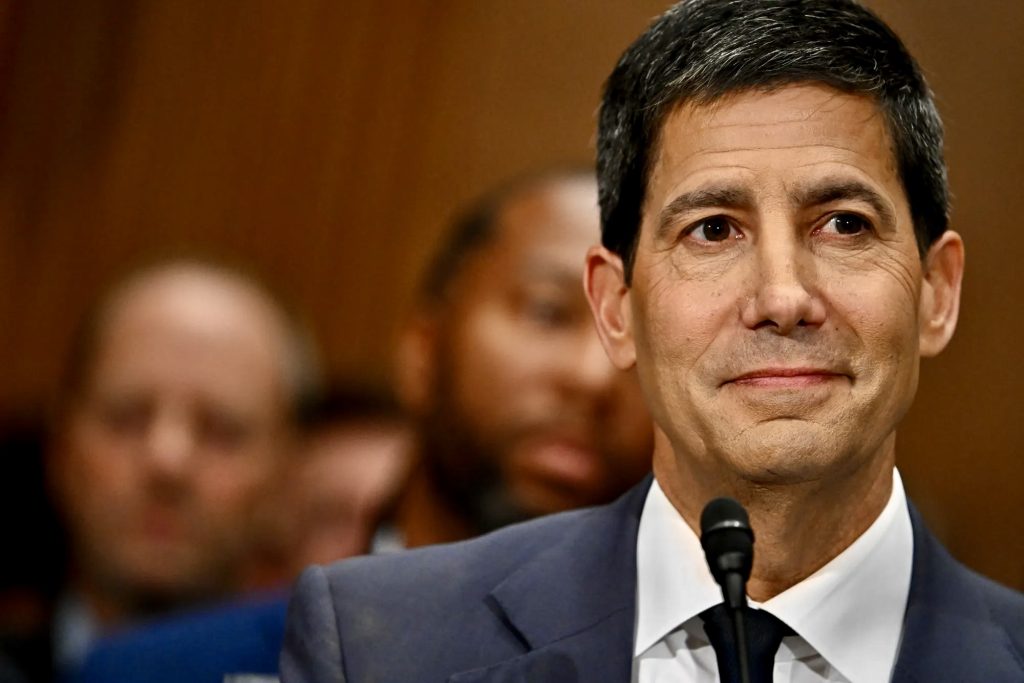
NEW YORK (Realist English). Kevin Warsh, President Donald Trump’s nominee to chair the Federal Reserve, will find himself in an “impossible” situation, economists warn. He will take office at a time when the Fed is torn by divisions over inflation triggered by the war with Iran and the blockade of the Strait of Hormuz, while the White House demands immediate interest rate cuts.
The US Senate is widely expected to confirm Warsh as early as 13 May 2026, paving the way for the appointment of the world’s most influential central banker. The 56‑year‑old financier will succeed Jay Powell, who led the Fed through a difficult period but has recently come under unprecedented attack from Trump.
“Impossible situation”: inflation rises, Fed fractures
Warsh takes the helm at a troubling moment for the US central bank. The Fed’s preferred inflation measure has jumped to 3.5% due to a sharp spike in energy prices after Iran closed the Strait of Hormuz. At the same time, the Fed has held rates steady for three consecutive meetings (March, April, May).
The latest meeting of the Federal Open Market Committee (FOMC) on 6–7 May recorded the largest number of dissents since 1992. Three regional Fed presidents (Daly, Goolsbee, Waller) said they no longer share the central bank’s official signal that the next move will be a rate cut.
Economists see this not only as a reaction to the energy shock but also as a direct signal to Warsh: influential FOMC members intend to resist pressure for premature monetary easing. The only board governor who supported a rate cut at the May meeting was Stephen Miran – a Trump ally whom Warsh will now replace.
If the Strait of Hormuz remains blocked until the end of May or mid‑June, other voices could join the dissenters, finally burying hopes for an early rate cut.
Sharp debates at the Hoover Institution conference
On 9 May, a conference was held at Stanford University’s Hoover Institution, where leading Fed policymakers staked out their positions.
Mary Daly, president of the San Francisco Fed, warned that “clogged up” supply chains could keep inflation above the 2% target for even longer.
Austan Goolsbee, head of the Chicago Fed, directly challenged Warsh’s thesis that an “AI‑induced productivity boom” would create room for rate cuts. Goolsbee noted: “Wealth effects on consumer spending… higher investment in data centres driven by rising stock market valuations push up costs for non‑AI industries. All of this suggests that productivity growth is likely to push the neutral interest rate higher, not lower.”
David Wilcox, a former Fed economist now at the Peterson Institute, summed up: “He’s coming into office in complicated circumstances, to put it delicately. He really is caught in an impossible situation between a president who is insistent on rate cuts and an inflation scenario that is problematic.”
Relations with Trump: Warsh’s main challenge
According to analysts, convincing his FOMC colleagues will be easier for Warsh than managing his relationship with the White House. Donald Trump has repeatedly attacked the Fed publicly, demanding immediate rate cuts, and his rhetoric has not softened even after the appointment of Warsh – a man he himself chose.
Former central bank chiefs and international policymakers condemn Trump’s unprecedented pressure on Fed independence. Wilcox, who also works for Bloomberg Economics, said: “He’s got some minor headaches on the macroeconomic front. But where he’s got a major challenge of the first order is in managing his external relations with the president.”
Ideological affinity and mistrust inside the Fed
Many economists at the Hoover Institution conference – a conservative think‑tank – share Warsh’s views on two key principles:
- The Fed should use interest rates as its main tool to achieve price stability and maximum employment.
- The central bank should shrink its balance sheet, bloated by bond‑buying programmes after the 2008 crisis and the pandemic.
However, Marvin Barth of Thematic Markets pointed out that the post‑pandemic surge in inflation under Powell paved the way for Trump’s attacks. The assault on Fed independence is partly due to “objective policy failures” that “the Fed continues to deny”, and in a democracy everyone must be accountable to the people.
Warsh himself, as a Hoover Institution fellow, has often thrown similar barbs at Fed policy, making some insiders wary. His task of implementing change will almost certainly be complicated by a lack of trust, exacerbated by Trump’s attacks on Powell and Governor Lisa Cook.
Shadows of the past: criminal investigation of Powell and Cook’s fate
Jay Powell, against whom the Trump Justice Department conducted a criminal investigation in 2025, broke with nearly 80 years of precedent and decided to remain on the Fed in the lesser role of a regular governor – fearing that the president might try to pressure Fed officials into cutting rates.
The Supreme Court has so far allowed Lisa Cook to remain on the Fed board while it considers her lawsuit against Trump. The president tried to fire her in August 2025 on charges of mortgage fraud, which she denies.
John Cochrane, an economist at the Hoover Institution, said that Warsh’s “first job” as Fed chair would be to “try and unite” the FOMC behind his vision. The presence of Powell, who is well liked and respected by central bank staff, “isn’t going to make it easy”.