


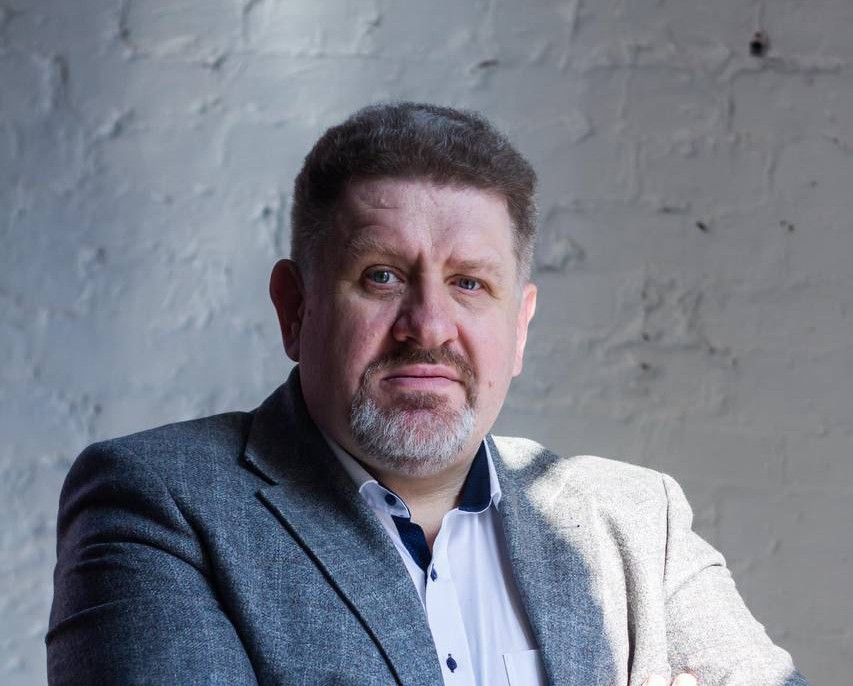
KYIV (Realist English). Ukrainian historian and political scientist Konstantin Bondarenko, who has been in forced exile since August 2023, answered these and other questions for the Realist English.
Mr. Bondarenko, you have worked with various political forces, from Yatsenyuk and Tigipko to creating your own institutions. How has this experience shaped your understanding of the main systemic problem of Ukrainian politics? Is it a question of personalities, institutions, or external influence?
Konstantin Bondarenko: The fact is that Ukraine has always had weak political institutions. They were weak and even temporary phenomena, constantly transforming, and therefore modern Ukrainian history is a certain fluctuation between the ambitions of individual politicians and external influence on the situation in the country.
In 2011, you left “Strong Ukraine” due to disagreement with its merger with the “Party of Regions.” Were there other moments in your career when political expediency demanded sacrificing principles?
Konstantin Bondarenko: Politics is a constant struggle with temptations, and at some point, you have to make a certain choice. I hesitated for several months before joining “Strong Ukraine.” That was my only foray into active politics, where I tried to act not so much as a political consultant but as an active politician. That year (in the party) gave me a lot for understanding real political processes.
It was invaluable experience, but I can say that later I avoided direct participation in political projects. But back then, in 2011, I truly believed it was necessary to preserve a political force with the potential that “Strong Ukraine” had. The leadership believed it would be more advantageous to join forces with the “Party of Regions.”
In your opinion, where is the red line for an expert working with the authorities?
Konstantin Bondarenko: The first red line is the main one — don’t “fall in love” with your client. It’s necessary to remain detached from all the processes that are happening. The second point, I believe, is that if a consultant-expert works with a political project, one must not dissolve into that political project. That is also important. Everything else depends on the consultant’s creativity, experience, and abilities.
You wrote a political biography of Volodymyr Zelensky titled “Joker.” How has your view of him changed from 2019 to today?
Konstantin Bondarenko: In 2019, following two electoral campaigns, presidential and parliamentary, I wrote a long essay titled “The Phenomenology of Ze”. Essentially, the predictions I made in that essay have fully come true. Regarding Zelensky sliding into authoritarian methods and deviating from his initial promises in his activities.
But I couldn’t have imagined then to what extent these processes would engulf society and the state. Zelensky is the most tragic thing that could have happened in Ukraine’s history after the Maidan. Zelensky is society’s reaction to the Maidan, but this reaction lacked constructive content.
What is his main strength and main weakness as a wartime leader?
Konstantin Bondarenko: His most important quality is stubbornness. If he sets a certain target for himself, he will go towards it. And it will be very difficult to divert him from his path; for him, there is no authority he will orient himself towards. But simultaneously, this is his weakness; he becomes less and less flexible on various issues. As for his weakness, he is too superficial, too lightweight on many issues; he acts on the principle of “I want,” not “I must.”
I want such and such a law to be passed. I want such and such a person to be imprisoned. I want Ukraine to become a member of the European Union. These “wants” of his do not correlate with reality. He himself does not know how to achieve the goal, so he got a person like Andriy Yermak, who fulfills all his “wants.” By violating laws, transgressing moral principles. But overall, he ensured the fulfillment of all the master’s desires. Of course, this is a weak side of a politician, but many present it as some kind of achievement, as the activity of a new type of leader.
Ukraine has been declaring a course towards European integration for over a decade. Why, in your opinion, does the process of deep internal reforms remain so painful?
Konstantin Bondarenko: Ukraine has had a course towards European integration for not over ten, but over thirty years, since the times of Kravchuk and Kuchma. But it’s true that after 2014, the process accelerated, but accelerated more in words. Ukraine has become more dependent on the West, the European Union, Britain, and the United States in various spheres and in different ways.
But at the same time, it has not gotten closer to Europe. Being dependent and being a member of a certain community are two different things. Now Ukraine acts according to certain templates handed down to it by the West, but at the same time, there are many imitative moments.
You want a fight against corruption? We will demonstrate that we are fighting corruption. But there will only be an imitation of the fight. You want reforms? We will demonstrate reforms to you, but it will be an imitation of reforms. This imitation, this imitativeness, is characteristic of both Petro Poroshenko’s period and Zelensky’s period.
In your opinion, what is this stagnation related to — resistance from the ruling elites, lack of external pressure, or is it related to the absence of consensus in society?
Konstantin Bondarenko: Actually, society in this regard is absolutely inert. Society doesn’t care what will happen; there is no demand from society for some kind of reform, and the stagnation is a consequence of the system’s resistance. If the system is built in such a way that officials come to their positions to earn money, and they are told: “No, you must be more effective, you must fight corruption,” then, of course, there will be many imitative moments, but very few results. And there will indeed be serious resistance from the system to attempts at genuine reforms.
In wartime, issues of language, history, and memory have become extremely politicized. How to find a balance between strengthening national identity and protecting the rights of minorities, including Russian-speaking citizens?
Konstantin Bondarenko: Regarding the Russian language, the canonical Orthodox Church, and other aspects that are under pressure and persecution.
On one hand, it is a consequence of the processes related to the war. But let’s speak frankly, that the persecution of the Russian language and Russian culture began before the war [of 2022].
It became a consequence of the Maidan, a consequence of the coordinated policy of the Ukrainian authorities with Western partners. In the West, they constantly said it was necessary to reduce the influence of the Russian factor on the population of Ukraine.
Therefore, a number of actions were undertaken aimed at eradicating “Russianness” in Ukraine. Everything that connected Ukraine with Russia. The revision of the official historical concept begins even before the war. The ban on certain books, the import of literature from Russia begins before the war.
A huge number of streets and cities were renamed. Just so there would be no Russian trace. The war became a catalyst for these processes, but not the cause. The processes of derussification began immediately after the Maidan.
What contours do you see for Ukraine’s post-war recovery?
Konstantin Bondarenko: Everything will depend on the legislation that will be adopted. Whether free economic zones will be restored, whether laws or by-laws will be passed that will ensure an influx of investments or simplify taxation and other matters. It is extremely difficult to talk about economic processes now because it is unclear what will be the locomotive of the Ukrainian economy after the war with Russia.
Previously, the metallurgical industry was the locomotive. It provided the main influx of capital, the main budget revenues. Now Ukraine has lost almost its entire metallurgical industry.
Heavy industry is also practically destroyed. Energy facilities are destroyed, a significant part of power generation and power distribution enterprises.
It will be necessary to restore the economy, but where to get the money, no one knows. No one knows — neither the president nor his entourage. Everyone lives in hopes that Europe or the West will not abandon us, that they will give us money through some reparations. Of course, these reparations are absolutely illusory. No one can say where to get the money from.
The fact that Zelensky insists on an 800,000-strong army is generally suicidal for Ukraine, because in the conditions of a destroyed economy, 800,000 soldiers is very burdensome, if not suicidal.
In this situation, there are many questions and very few answers. Economists are currently throwing up their hands.
What role should the Ukrainian diaspora play in this process?
Konstantin Bondarenko: The Ukrainian diaspora is a very complex phenomenon; it is not homogeneous. There is the old diaspora, meaning those who left Ukraine before 2022. There is a multi-million group of people who left Ukraine fleeing the war. That is, according to various estimates, from 6 to 8 million people living in the West today.
And there is a small group of political immigrants, meaning those who left Ukraine fearing not so much the war as persecution by the Zelensky regime. There are Ukrainians who went to European and American countries. And there are Ukrainians who went to the territory of the former Soviet Union — to Russia, Belarus, Caucasian states, and Central Asia. These are two different diasporas, which intersect little and communicate little with each other. They will seriously influence the situation in Ukraine.
Some will return to Ukraine after the war, but according to sociologists, it is no more than a third of those who left. Will they participate in economic recovery? It was said they would now send funds for recovery. It is doubtful because everyone is now looking for their place in their new homeland. And counts every penny to establish themselves in a new life. They have no time for investment projects.
Many of the oligarchs who left are now outlawed in Ukraine. They might want to return, but due to Zelensky’s policy, they are banned from entering Ukraine and are persecuted.
Those people who are now in Russia, under current conditions, will be deprived even of voting rights. So hopes for the diaspora, that it will take an active part in restoring Ukraine’s economy, are quite slim.
The conflict around the Ukrainian Orthodox Church of the Moscow Patriarchate has gone beyond the religious sphere, becoming a question of national security and ideology. How do you assess the state’s actions in this direction?
Konstantin Bondarenko: I believe the state should proceed from constitutional norms that guarantee the separation of state from church and non-interference of the state in church affairs. The Ukrainian Orthodox Church is a multi-million group, a multi-million community; it is truly a canonical church, and state interference in church affairs in the current situation can only exacerbate everything that is happening in the country. It could really turn out that we get, besides the war in eastern Ukraine, an internal conflict as well.
I repeat, this is the largest denomination, and when a president, who is not a representative of this denomination, starts a real struggle against the church (not against individuals against whom there may be claims that could be brought to court, but specifically against the church as a structure), it can cause a very serious reaction within the country. We have already seen these negative consequences when people demonstrate, organize multi-thousand actions, as happened this summer in Pochaiv, expressing their disagreement with Zelensky’s policy.
Do you expect radicalization of part of the believers?
Konstantin Bondarenko: The issue of persecution of the church is not only the arrest of clergy but also the seizure of churches and property. And when a church is seized in a particular village or city, it already provokes active protests from believers, and the conflict begins to transition into a rather acute stage. Will the state be able to cope with this, especially when it concerns millions of believers?
Can the “Orthodox Church of Ukraine” replace the UOC-MP in the medium term as a nationwide unifying religious force?
Konstantin Bondarenko: That’s just it, it is quite difficult to replace a canonical church with some newly created entity. What is happening with the Orthodox Church of Ukraine is a repetition of the path taken by, for example, the Renovationist Church — there was such a church in the USSR in the 1920s-1930s, which also received a tomos from the Ecumenical Patriarch. It also supposedly enjoyed the support of the authorities, but then gradually, when times and trends changed, this church was simply forgotten.
The same situation could happen with the OCU, because the entire situation, its entire history, is absolutely artificial. It is an artificial and maximally politicized project.
The European Union has started accession negotiations with Ukraine. In your opinion, how ready are the Ukrainian political leadership and society for Brussels’ tough demands, which may concern not only laws but also, for example, agricultural policy or the labor market?
Konstantin Bondarenko: Ukrainian citizens are told that joining the European Union is a huge blessing that will result in Ukrainians having European salaries, Ukrainian pensioners being able to travel the world, etc. They only talk about certain benefits. Moreover, European integration in Ukraine has turned into a kind of religion.
Many postulates and dogmas are perceived uncritically; many things are not spoken about. If you ask most Ukrainians, 90% don’t know at all that Ukraine will have to go through certain hardships, make concessions, impose quotas on economic sectors, and give up certain economic sectors. Moreover, Zelensky insists that Ukraine should be accepted into the EU almost by 2027. This is his demand, which he now articulates in connection with peace negotiations, that Europe should not only give guarantees but should also accept Ukraine in 2027. It is clear that this is an unsolvable issue in the near future.
Sensible minds in Europe say it will take at least 20 years to prepare Ukraine for EU accession. Especially since the accelerated accession of such a large organism as Ukraine, with its multi-million population, will seriously hit the entire European economy and stability in Europe. Therefore, now, besides moving towards the European Union, Ukraine will have to say goodbye to many illusions and myths.
The situation related to the Association Agreement, which was signed right after the Maidan, should have sobered up many. Back then, it was said that the Association Agreement between Ukraine and the European Union would become an enormous boon for the Ukrainian economy, but for the Ukrainian market, it turned into multi-billion losses.
Economists warned, but politicians didn’t want to hear it. Now the Association Agreement with the European Union has become draconian towards Ukraine and absolutely unfair. The same situation could occur with EU accession because there could be so many hidden reefs and pitfalls that this accession and European integration itself could, in the long run, provoke very serious protest within Ukrainian society and give rise to active Euroscepticism, and within Europe itself, Ukrainoscepticism.
What optimal role do you see for Ukraine in the future architecture of European security?
Konstantin Bondarenko: I believe Ukraine must return to a policy of balances between East and West, internal and external political balances. Ukraine should not be a “steel hedgehog on the eastern border of Europe,” as Zelensky now proposes, but should become a bridge between Europe and Eurasia, the main connecting link in continental processes.
Should Ukraine strive for formal NATO guarantees, or is it better to create its own, Israeli format of security with strong Western support?
Konstantin Bondarenko: The second option is more appealing to me. Especially since the NATO bloc has already demonstrated incompetence in many matters. In particular, the war in Ukraine has shown that to obtain consensus from all NATO states in each specific situation, a very serious, lengthy conversation with all 32 states is required.
In the end, each sets its own conditions, and there is no coordinated, dynamic work within the alliance itself. NATO is more about politics and talk. But an effective defense system is when a state understands what it can count on and within what timeframe. It is a system of more complex relationships with various states that ensure the security of a given country. Not formal security, but real security. NATO is precisely formal security, which has never once in 75 years been tested for strength.