


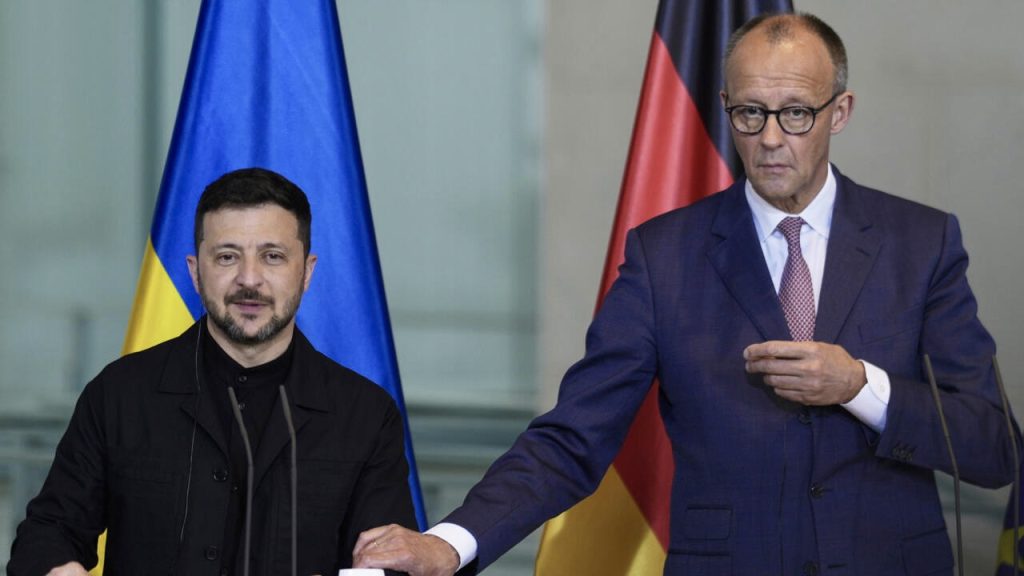
KYIV (Realist English). The Ukrainian leadership has not supported the initiative of German Chancellor Friedrich Merz, who proposed introducing “associated membership” in the EU for Ukraine – an intermediate status without voting rights.
In a detailed four-page letter addressed to the leaders of the European Union, President Volodymyr Zelensky stated that his country does not agree to “half-measures” and has no intention of joining a “half-Europe,” noting that any indecisiveness on the bloc’s part would be perceived by Moscow as a sign of weakness.
What Merz proposed: a “waiting room” without voting rights
In mid-May, German Chancellor Friedrich Merz, who had previously called Kyiv’s goal of joining the EU by 2027 “unrealistic,” sent a letter to EU leaders proposing a new format for Ukraine – “associated membership.”
This status would involve the country’s gradual integration into European structures without granting full rights. According to the German plan, Ukraine would gain the right to participate in summits and ministerial meetings (without veto power), as well as partial access to the EU budget and programs.
One of the few advantages for Kyiv could be the extension of Article 42.7 of the Lisbon Treaty (the mutual defence clause) to Ukraine.
Merz stressed that this model is not a substitute for full membership, but rather an “intermediate stage” and a “catalyst for negotiations.” Two main drawbacks were noted: implementing it would require amending the EU’s fundamental treaties, and it would create a precedent for a “two-speed” Europe.
Kyiv’s response: “no half-Europe”
In response to this initiative, President Zelensky sent a detailed four-page letter to European Council President António Costa, European Commission President Ursula von der Leyen, and the President of Cyprus (which holds the EU presidency), Nikos Christodoulides. In it, he drew a “red line”: Ukraine does not agree to a status that “calls into question its ultimate goal” – joining the EU on equal terms.
“We have never regarded membership as joining some kind of ‘half-Europe’,” Zelensky wrote, noting that any “half-measures or uncertainty” from the European Union would be immediately exploited by the Kremlin and perceived as weakness.
“It would be simply strange if we were stopping the largest anti-European force in Europe, while we ourselves were being held up in the waiting room for full membership,” the Ukrainian president summed up. This position was supported in an interview with Euronews by Deputy Prime Minister for European Integration Taras Kachka, who said that Kyiv needs a “fast, comprehensive and deserved accession process” without “unacceptable alternatives.”
Split in Brussels: from scepticism to alternatives
Merz’s proposal elicited more bewilderment and legal scepticism in Brussels than enthusiasm.
First, it emerged that the proposed model was legally unworkable: granting observer rights in the European Commission and the European Parliament would require amending the basic treaties, which is unacceptable to most member states.
Second, the idea would effectively create a “two-speed” European Union, drawing criticism from Irish Minister Helen McEntee: “If we go down this route, we would have to make it available to others as well. We would have to rethink what the EU looks like.”
Alongside Merz’s initiative, France proposed its own variant of an intermediate status for Kyiv – the “status of an integrated state.” However, unlike the German plan, the French model would impose strict limits on access to agricultural subsidies and EU funds.
What next: accelerated push and elections in Hungary
Merz himself, according to sources, does not insist on the term “associated membership”; his team has already taken note of Kyiv’s negative perception of the label, is ready to drop it, and will focus on the substantive content of Ukraine’s integration.
In response, Kyiv does not entirely reject the idea of partial integration either, but only on condition that such steps are clearly designated as additional measures and do not threaten the accession process itself.
While capitals debate formats, Kyiv is demanding an accelerated pace. Ukraine insists on the swift opening of all six negotiating clusters as early as June, and of the first cluster – “Fundamentals” – before the European Council summit.
This process could be facilitated by the change of power in Budapest: the election of Péter Magyar as the new prime minister, who has already made it clear that his government “will not block anything.”
This changes the balance in the EU, where Hungary under Viktor Orbán for years stalled the negotiation process with Kyiv. Consequently, a breakthrough decision to begin substantive talks on Ukraine’s admission is expected at the EU leaders’ summit in mid-June.