


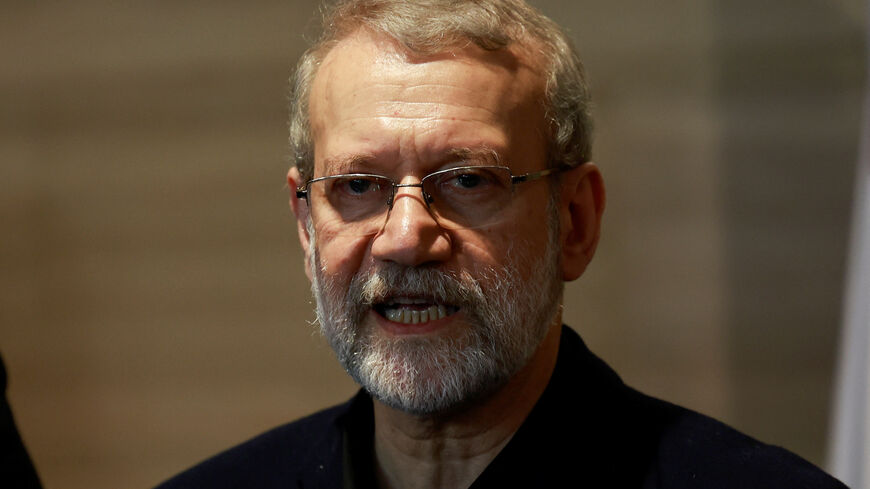
TEHRAN (Realist English). A former Islamic Republic official has alleged that Ali Larijani, secretary of Iran’s Supreme National Security Council, played a central role in the January 2026 security crackdown and is positioning himself for a leading role in a post-Khamenei political order.
Speaking to IranWire through an intermediary, the source said Larijani has leveraged close ties with senior commanders of the Islamic Revolutionary Guard Corps and intelligence agencies, as well as his family’s longstanding connections to influential clerics, to consolidate support across competing factions within the political system.
Larijani comes from one of Iran’s most prominent clerical families. His father, Mirza Hashem Amoli, was a senior Shiite cleric and a leading figure at the Qom seminary before the 1979 revolution. His brothers have also held senior posts: Mohammad Javad Larijani served as a senior diplomat and deputy foreign minister, while Sadeq Larijani — a former chief justice and current seminary professor — is often mentioned as a potential successor to Supreme Leader Ali Khamenei.
According to the source, Khamenei has historically been cautious in backing Ali Larijani, who was disqualified from running in several presidential elections. However, following what the source described as the failure of former president Mahmoud Ahmadinejad’s political experiment and the limited appeal of hardline factions, Khamenei is now seen as supporting Larijani’s efforts to unify elements of the system and confront opponents more decisively.
The former official claimed Larijani views his strategy as comparable to the approach taken by Deng Xiaoping in China in the 1980s — combining strict security control with selective economic and cultural reform. The January 2026 killings of protesters, the source alleged, were inspired by the 1989 Tiananmen Square crackdown, which Chinese authorities have never fully acknowledged but which remains a defining warning to domestic opponents.
At the same time, Larijani is said to support gradual economic and cultural opening alongside diplomatic engagement. According to the source, the authorities may pursue limited social and economic reforms in the coming months, even as repression of dissent continues, while also seeking improved relations with neighbouring and regional states.
On diplomacy, the source said both Khamenei and Larijani are satisfied with the performance of Abbas Araghchi, particularly on nuclear negotiations. Contrary to persistent rumours, former foreign minister Mohammad Javad Zarif and former president Hassan Rouhani are not under arrest and remain in contact with senior leadership on security and foreign policy matters, the source claimed.
Iranian diplomats, according to the account, believe the war in Gaza has shifted public opinion in parts of the West — especially the United States — in ways less supportive of Israel. They reportedly see an opportunity to exploit tensions between Washington and Tel Aviv, investing significant resources in international media campaigns and the recruitment of foreign influencers. The source said groups of Western commentators may be invited to Iran to view what authorities describe as evidence of alleged crimes by “anti-regime terrorists” and foreign intelligence operatives.
The source cautioned that the success of Larijani’s strategy depends on the actions of Iran’s opposition and the policies adopted by the United States and Israel. For now, however, the former official said Larijani appears to be the only figure whose long-term plan for preserving the Islamic Republic enjoys the backing of Khamenei.
The Supreme National Security Council is Iran’s highest decision-making body on defence and security issues. Chaired by the president and operating under the authority of the Supreme Leader, it coordinates domestic and foreign security policy, oversees responses to internal and external threats, and plays a key role in shaping strategic decisions, including nuclear policy.