


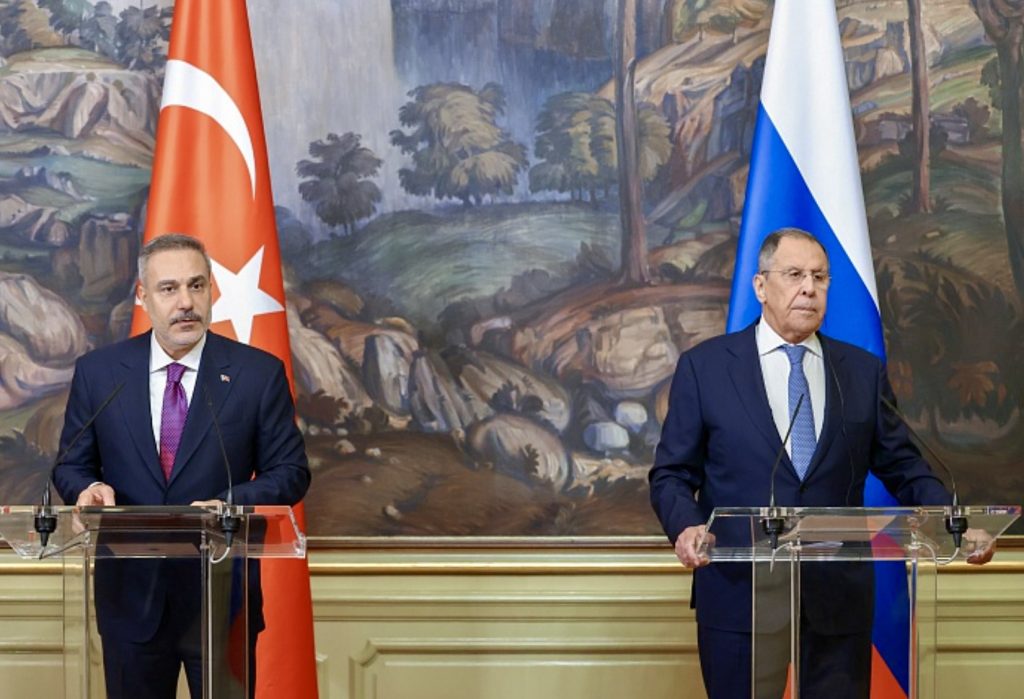
MOSCOW (Realist English). Russian Foreign Minister Sergey Lavrov and Turkish Foreign Minister Hakan Fidan held substantive talks in Moscow, followed by a joint press conference.
The sides discussed a wide range of bilateral and regional issues, confirming intensive dialogue at all levels — from presidents to foreign ministries.
Energy, tourism and economy
Lavrov noted the dynamic development of cooperation in energy, particularly highlighting the continued construction of the Akkuyu nuclear power plant by Rosatom. “The construction of the Akkuyu NPP continues in normal mode,” the minister stressed.
The sides agreed on proper preparation and holding of the 20th session of the Joint Intergovernmental Russian-Turkish Commission on Trade and Economic Cooperation before the end of the year. The tourism sector was also discussed: in 2025, nearly 7 million Russian citizens visited Turkey.
Lavrov expressed interest in ensuring their safety, highly appreciating the approach of Turkish partners.
Kyiv’s provocations and threats to gas pipelines
Special attention was paid to the situation in the Black Sea region. Lavrov spoke of “provocations by the Kyiv regime” against ships carrying grain to Turkey, as well as tankers. He mentioned “constant threats of terrorist attacks against the TurkStream and Blue Stream gas pipelines.”
The sides agreed on close coordination on security issues in the Black Sea region, the South Caucasus, the Middle East and North Africa.
Middle East and South Caucasus: unacceptability of Israel’s unilateral steps
Speaking about the Middle East, Lavrov expressed concern over the Iran-Israel conflict, which has gone beyond the Strait of Hormuz. He stressed that the problems of Lebanon and Palestine have not disappeared. Particular outrage was caused by the Israeli leadership’s statement that a Palestinian state would not be created.
“This would be a direct violation of UN decisions,” Lavrov said. “Russia and Turkey cannot agree with this.”
The ministers confirmed their interest in stabilizing the situation in Syria, where “positive processes are underway, but many problems still remain.” They agreed to cooperate in strengthening the statehood of Libya, which remains divided since the 2011 Arab Spring. Russia supports UN efforts on the Libyan settlement.
In the South Caucasus, the sides noted the contribution to strengthening peace and cooperation through the “3+3” Regional Cooperation Platform (Russia, Turkey, Azerbaijan, Armenia, Iran).
Lavrov expressed hope for Georgia’s accession, for which the door remains open.
Western double standards, Nazism and Zelenskyy’s ‘newspaper diplomacy’
Lavrov’s most resonant answers came in response to questions about the West’s position, Ukraine and Kyiv’s attempts to join the EU and NATO.
On Western double standards
The minister stated that the West completely refuses to comment on terrorist attacks by the Ukrainian regime against civilians, while “they agonize over Bucha without any facts.” “The West is returning to attempts to regain its role as hegemon, to decide everything for everyone,” Lavrov said.
On rehabilitation of Nazism
The foreign minister drew attention to “the open policy of rehabilitating Nazi criminals” pursued by the Zelenskyy regime, including the reburial of collaborators convicted by the Nuremberg Tribunal. “Europe applauds and says that Zelenskyy is defending European values.
This is a confession, a self-exposure,” he stressed.
On Ukraine’s possible EU membership
Lavrov noted that the EU, originally an economic bloc, is now being militarized and building structures against Russia. Ukraine’s inclusion in the EU will be used by those who want to militarize the union, especially since Zelenskyy has stated his readiness to “lead” European armed forces.
Lavrov sarcastically noted that from the perspective of the EU’s internal problems, Ukraine’s accession could bring about its collapse.
On Zelenskyy’s ‘newspaper diplomacy’
Lavrov mocked Zelenskyy’s reports about inviting President Putin to the G7 summit in France. “He plays to the public, he’s used to playing to the public. Well, and also on the piano,” the minister quipped, dismissing any official signals from Kyiv.
Sanctions and international law
Addressing the topic of sanctions, Lavrov spoke of “the duplicity of the West,” which applies “double standards” and replaces international law with “rules-based order.”
“We are for international law and against any voluntarism in the sphere of sanctions,” Lavrov summed up.
Russia, being under illegal sanctions, advocates that there should be no such restrictions at all, and insists on respect for the UN Charter, where only the UN Security Council has the right to take legally binding measures.