


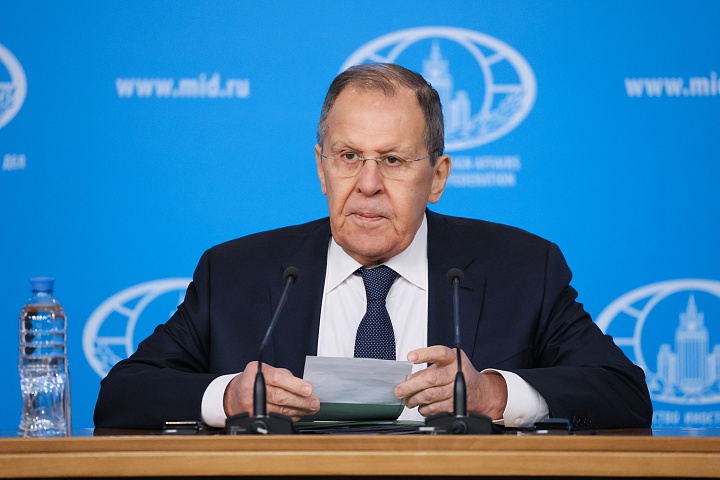
MOSCOW (Realist English). Russian Foreign Minister Sergey Lavrov said international law remains relevant despite its systematic erosion in recent decades, while the emergence of a multipolar world order is an objective and irreversible process.
Speaking at a press conference reviewing the work of Russian diplomacy in 2025, Lavrov told journalists that for many years the United Nations Charter served as a universal benchmark for assessing states’ actions, with the UN Security Council acting as the central forum for addressing issues of international peace and security. He argued, however, that after the collapse of the Soviet Union this system was gradually replaced by a unipolar model, in which the West, led by the United States, pursued the idea of its own dominance.
Lavrov said Russia began consistently restoring its international role and identity after Vladimir Putin came to power in the early 2000s. He described Putin’s 2007 Munich Security Conference speech as a key warning signal that was ignored by Western capitals at the time but later acknowledged as a serious strategic mistake.
On Eurasian security, Lavrov noted that the world’s largest continent still lacks a continent-wide security framework, despite the presence of multiple subregional groupings such as the Eurasian Economic Union, the Shanghai Cooperation Organisation, ASEAN, the Collective Security Treaty Organization and the Commonwealth of Independent States. Russia, he said, is not calling for a new bureaucratic structure but proposes starting with an equal dialogue among Eurasian states and integration formats. This approach underpins Moscow’s concept of a Greater Eurasian Partnership as a future foundation for regional security architecture.
Lavrov also recalled the ideas of former Russian prime minister Yevgeny Primakov, who in the late 1990s spoke about the rise of a multipolar world and initiated the Russia–India–China format, which later became a precursor to BRICS. According to Lavrov, the growing influence of new centres of power — including China, India, Brazil and countries across Africa — makes any return to a unipolar or bipolar system impossible.
Commenting on US President Donald Trump’s proposal to establish a “Peace Council,” Lavrov said the initiative reflects Washington’s recognition of the need for collective mechanisms in an increasingly complex world. While noting that the United States seeks to preserve a leading role, he described the current US administration as pragmatic and aware of the necessity to take partners’ interests into account.
Lavrov added that the current US administration is the first in the West to show readiness to discuss what Moscow describes as the root causes of the Ukraine conflict. He said the process would be difficult and lengthy, but argued that agreements are possible if there is sufficient political will and a balance of interests.
In conclusion, Lavrov said the present turbulence in global politics should not be seen as chaos but as a transitional phase toward a more complex, multipolar world order, with dialogue on its future parameters only just beginning.