


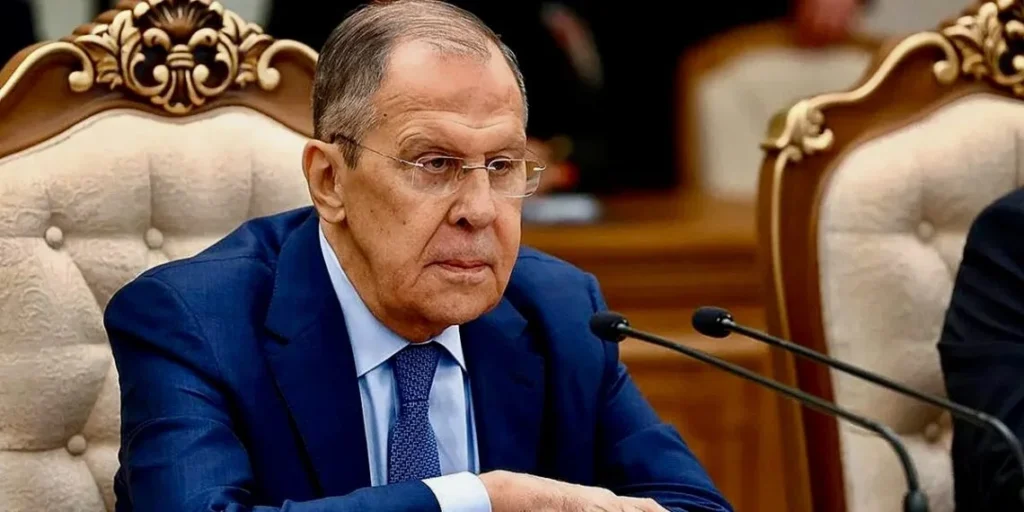
MOSCOW (Realist English). Russian Foreign Minister Sergei Lavrov warned that the escalating conflict in the Middle East could have serious global consequences, accusing Western powers of pursuing a “divide and rule” strategy in both the Iranian and Ukrainian crises.
Speaking on March 5 at a roundtable meeting with foreign ambassadors focused on the Ukrainian conflict and information security, Lavrov devoted much of his remarks to the unfolding situation in the Middle East following US and Israeli strikes on Iran.
According to Lavrov, the conflict threatens global stability and could have far-reaching economic repercussions. He said civilians across the region were already suffering from the violence.
“Peaceful citizens are suffering both in Iran and as a result of Iran’s retaliatory actions in neighboring Arab states,” Lavrov said, expressing condolences for civilian casualties and warning of growing damage to infrastructure across the Persian Gulf region.
The Russian foreign minister noted that several Gulf Cooperation Council countries had previously stated they would not allow their territory or airspace to be used for attacks on Iran. However, he said these states have nonetheless become entangled in the conflict.
Lavrov suggested that drawing regional states into the confrontation may have been one of the objectives of the military operation against Iran, which has been referred to by different names, including “Operation Epic Fury.”
He also criticized what he described as inconsistent messaging from Washington. Lavrov pointed to statements by US President Donald Trump announcing the killing of Iran’s Supreme Leader Ali Khamenei, followed by remarks from US Defense Secretary Pete Hegseth denying that Washington had organized the assassination.
According to Lavrov, one strategic goal of the operation may have been to undermine the improving relations between regional powers, including the recent normalization process between Saudi Arabia and Iran — a diplomatic track in which Russia had also participated.
“The West has done everything possible to prevent a positive agenda from developing in the Gulf region,” Lavrov said. “Its principle is simple: either you are with us or against us. The core of this policy is divide and rule.”
Lavrov also expressed concern over the role of NATO, referring to remarks by NATO Secretary General Mark Rutte indicating that the alliance could invoke collective defense mechanisms in support of US operations against Iran.
“If NATO’s main purpose is to defend the territory of its member states, as stated in the Washington Treaty, then what does the Middle East have to do with it?” Lavrov asked.
The Russian minister drew parallels between the situation around Iran and the conflict in Ukraine, arguing that negotiations in both cases had been used as a cover for military escalation.
Lavrov said recent talks between the United States and Iran, mediated by Oman, had been close to reaching a substantive agreement before being abruptly halted. He said Oman’s foreign minister confirmed that both delegations had left the negotiations with a positive outlook.
The diplomat also recalled the events of June 2025, when hostilities between Iran and Israel erupted during a period of diplomatic engagement.
Turning to Ukraine, Lavrov reiterated Moscow’s long-standing criticism of Western policies toward Kyiv, arguing that attempts to bring Ukraine into NATO had ignored Russia’s warnings and contributed to the current crisis.
He concluded by calling again for a new Eurasian security architecture, an initiative previously proposed by President Vladimir Putin, saying the concept had become even more relevant as NATO seeks to expand its influence beyond the Euro-Atlantic region.