


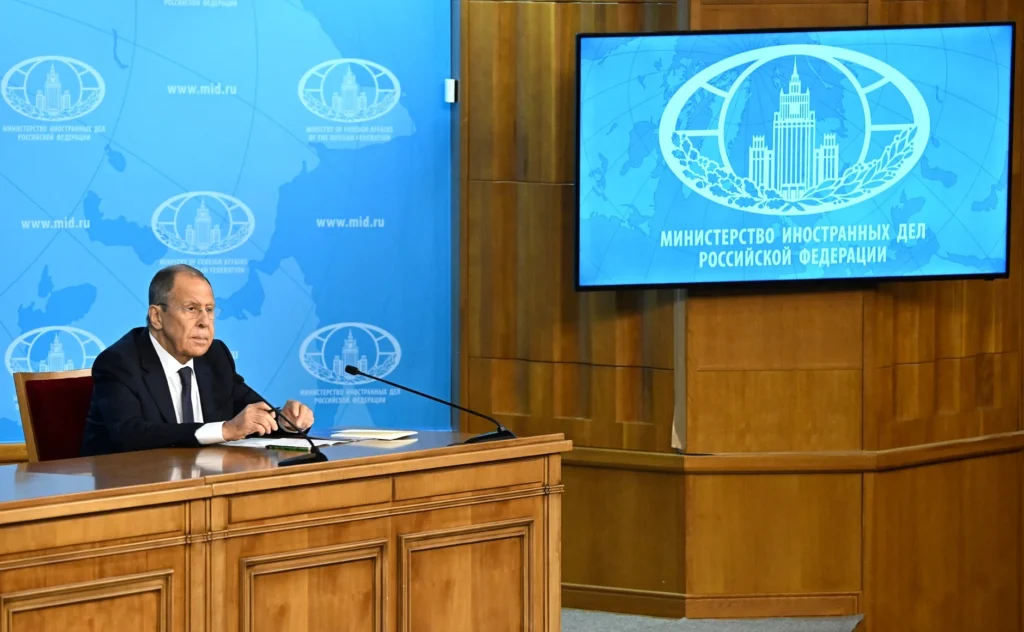
MOSCOW (Realist English). Russian Foreign Minister Sergei Lavrov said the U.S.-Israeli military campaign against Iran has dealt a major blow to the global nuclear non-proliferation system and weakened confidence in diplomatic solutions to international crises.
In a video address to participants of the Moscow Conference on Non-Proliferation, Lavrov said the strikes launched on February 28 had targeted not only Iran’s political and military leadership but also civilian infrastructure and nuclear facilities operating under safeguards of the International Atomic Energy Agency (IAEA).
Lavrov argued that the timing of the attacks was particularly significant, as they occurred while Tehran and Washington were engaged in indirect negotiations over Iran’s nuclear program.
“This has delivered a severe blow to the credibility of the Nuclear Non-Proliferation Treaty and to diplomacy itself as a tool for resolving international disputes,” Lavrov said.
Rising proliferation risks
According to Lavrov, the conflict could push more countries to reconsider their security strategies.
He warned that some states may increasingly conclude that possessing nuclear weapons is the only reliable guarantee against external threats, a trend that could undermine the global non-proliferation regime.
Lavrov also expressed concern about the broader state of arms control agreements.
The New START treaty, the last major strategic arms control agreement between Russia and the United States, expired on February 5, 2026. Lavrov said Washington had not responded to Russian President Vladimir Putin’s proposal to continue voluntarily observing the treaty’s central limits on strategic nuclear weapons.
He also noted that the Comprehensive Nuclear-Test-Ban Treaty (CTBT) remains stalled because it has not been ratified by the United States.
Lavrov added that remarks by the U.S. president in late 2025 about potentially resuming nuclear tests have raised additional concerns about the future of arms control.
Concerns over missile defense and space militarization
The Russian foreign minister also criticized U.S. plans to develop a new global missile defense system known as the “Golden Dome.”
According to Lavrov, the project includes plans to deploy space-based interception systems by 2028, which Moscow believes could destabilize the global strategic balance and contribute to the militarization of space.
He also raised concerns about growing geopolitical tensions affecting international institutions tasked with monitoring chemical weapons. Lavrov said the Organization for the Prohibition of Chemical Weapons (OPCW) had become overly politicized and influenced by a small group of Western countries.
In addition, he warned about emerging biological risks linked to research into artificially engineered microorganisms, calling for stronger international verification mechanisms under the Biological Weapons Convention.
Lavrov said Russia supports negotiating a legally binding verification protocol to strengthen global oversight in this area.
Russia calls for dialogue
Despite the rising tensions, Lavrov said Russia remains open to dialogue with all countries interested in strengthening global arms control and non-proliferation frameworks.
He expressed hope that the Moscow conference would help identify new approaches to stabilizing the international security environment.
War enters third week
Lavrov’s remarks come as the conflict between the United States, Israel and Iran enters its third week.
President Donald Trump has been seeking international support to secure the Strait of Hormuz, a critical shipping route for global oil supplies, but several allies have been cautious about committing naval forces.
Oil prices have risen to their highest levels since 2022 amid fears of disruption to energy shipments through the strait.
Israeli officials say their military plans to strike “thousands” of additional targets in Iran in the coming weeks. Iran says it has launched hundreds of missiles and thousands of drones at U.S. and Israeli targets since the conflict began.
The war has spread across the region, with incidents reported near Dubai’s international airport, rocket attacks near Baghdad’s airport and shelling affecting UN peacekeepers in Lebanon.
According to compiled figures from regional authorities, more than 2,200 people have been killed since the start of the conflict, including more than 1,300 in Iran. Additional casualties have been reported in Lebanon and other neighboring countries.