


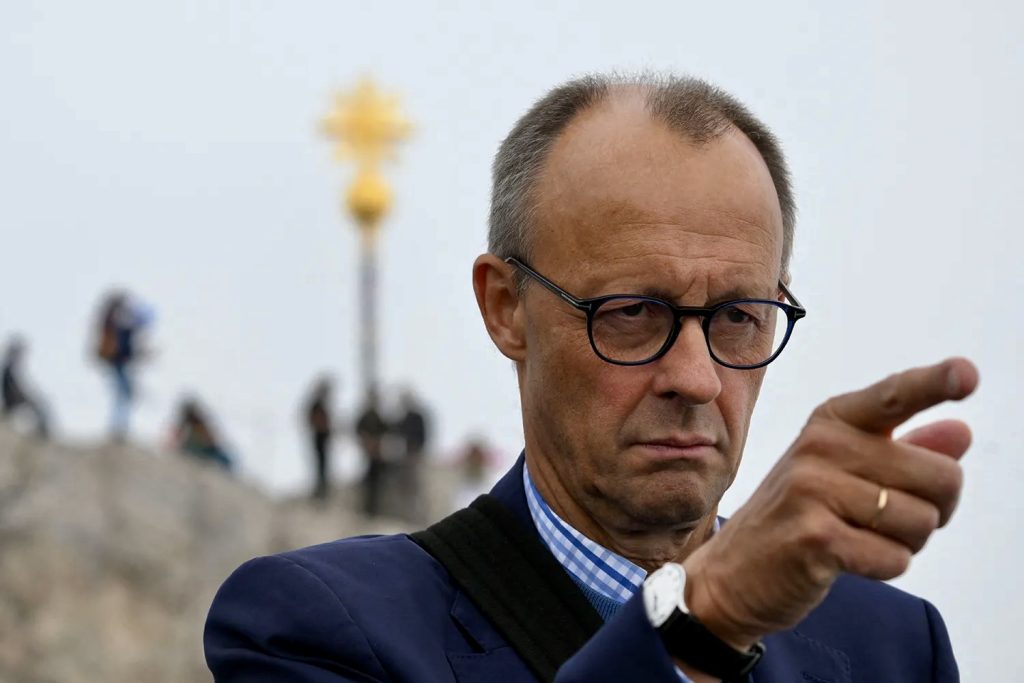
BERLIN (Realist English). Less than a month after historian Liana Fix published an essay on the “perils of German power”, she received an unusual dinner invitation in Washington – from Chancellor Friedrich Merz. The German leader, who was in the US capital in March 2026 for talks with Donald Trump, wanted to privately discuss her article, which had taken Berlin by surprise.
In her essay, Fix outlined the risks of Germany’s ambitious rearmament plans – from industrial competition with France to a scenario in which the pro‑Russian Alternative für Deutschland (AfD) party uses military might to intimidate its neighbours. Germany, she wrote, must curb its hegemonic tendencies and find a way to reassure its EU partners.
Officials insist the concerns are exaggerated. Yet the scale of the plans is staggering. By the end of the decade, Germany’s defence budget is set to match the combined total of the UK and France, already shifting the balance of power within Europe.
‘Reluctant hegemon’: the risks seen in Berlin
Even before his meeting with Fix in Washington, Merz publicly tried to counter her thesis. Speaking at the Munich Security Conference in February 2026, he declared that Germany would take a leading role in defending the continent, but on purely multilateral terms: “Partnership‑based leadership: yes; hegemonic fantasies: no. Never again will we Germans go it alone.”
Merz has consistently presented the historic rearmament as a response to the threat posed by Russia, the US’s wavering commitment to Europe under Trump, and Germany’s own evolution as a modern Western democracy. Across Europe, the plans are widely seen as necessary, urgent and overdue. Yet they are also stirring unease, particularly in France and Poland – not so much at the return of German military power to the heart of Europe nearly 80 years after the war, but at the practical consequences for the continent’s defence industry.
As Jacob Ross, a Paris‑based analyst at the German Council on Foreign Relations, puts it: “Germany has long been asked to re‑arm, but at the same time I see people in Paris wary of this massive rearmament and the widening gap between defence spending in France and Germany.”
The figures: €779 billion by 2030
After loosening its constitutional debt brake in 2025, Berlin plans to allocate €779 billion to defence between 2026 and 2030 – more than double the amount spent in the previous five years. By the end of the decade (five years ahead of the 2035 target), the country will exceed NATO’s 3.5% of GDP defence spending goal, reaching an annual budget of nearly €190 billion.
“Germany is not only capable of spending more on defence, it is doing so and ahead of schedule,” says Claudia Major, head of the German Marshall Fund’s Berlin office. “There is both an aspiration from Merz, and an expectation from Europe, for Germany to lead. Two countries are not comfortable with that: France and Poland.”
France: industry and strategic autonomy
For some French veterans, history still weighs heavily. Jacques Attali, a former adviser to François Mitterrand, notes that “the question of German domination has always been an unspoken truth” between the two countries. “For the Germans, the US has provided a guarantee against their own demons. They think that if the US withdraws, maybe these demons could re‑emerge.”
Few in France’s current leadership believe Germany could again pose a military threat. Yet they insist that Berlin must anchor its ambitions within a European framework. French officials and defence experts warn that, despite pledges to prioritise European procurement, Berlin is placing large orders for US systems.
Paul Maurice, a specialist in Franco‑German relations at the Ifri think‑tank, notes the mutual mistrust: “There is always scepticism in Germany of French calls for European sovereignty because it is seen as France just promoting its own industry.”
Poland: fear of a ‘solo game’
In Poland, which for centuries feared both Germany and Russia, warnings are louder. Former prime minister Mateusz Morawiecki wondered whether Germany, “no longer bound by pacifist principles”, might return to “close co‑operation with a colonial, imperial Russia”. Foreign Minister Radosław Sikorski told the Polish parliament: “As long as Germany is a member of the EU and NATO, I am more afraid of a German aversion to armament than I am of the German army.” But in 2022 he also cautioned: “Don’t re‑arm on a purely national basis,” adding that some might ask “whether Germany will re‑arm against Russia or Poland.”
Baltics and Nordics: support
At the same time, the Baltic and Nordic countries strongly back Germany’s defence push. Lithuania, for example, has welcomed a German brigade on its soil to bolster NATO’s eastern flank against Russia.
Defence industry and contradictions
French officials do not think their country will be displaced as Europe’s leading military power – France has the nuclear bomb and a seat on the UN Security Council. But Maurice argues that the influx of such large sums “will change the face of the European defence industry, increasing the size and reach of German companies”.
Tensions over joint projects such as the Franco‑German Future Combat Air System (FCAS) are a symptom of the strain. Airbus’s German‑based defence unit and France’s Dassault Aviation have reached an impasse over decision‑making, workshare and intellectual property. Another rift has opened over Germany’s Sky Shield project, which aims to build European air defences but emphasises the purchase of US and Israeli systems, excluding a Franco‑Italian version. Germany also plans to spend €35 billion on its own military satellites, competing with an EU initiative.
Some senior German politicians have warned of a possible backlash against Rheinmetall – the sprawling ammunition‑to‑tanks group that is building plants and setting up joint ventures across Europe – if it becomes too big at the expense of other countries’ firms.
The nuclear dimension and French guarantees
Last month, Merz and French President Emmanuel Macron agreed to explore closer cooperation, signalling to adversaries that France’s nuclear protection could extend to Germany. Under the proposals, Berlin could participate in joint exercises and deploy its conventional forces in support missions for France’s nuclear assets. The plans are at an early stage, but officials describe them as a milestone that would further cement defence cooperation between Paris and Berlin.
Expert view: money alone won’t solve everything
One question remains: how militarily capable and ready will Germany actually become? General Nicolas Richoux, a former French defence attaché in Berlin, admitted that Merz’s pledge to make Germany the most powerful land army in Europe made him “chuckle”. To become a credible deterrent, “it would one day have to pay the price in blood” – and given its strong pacifist traditions, that seems unlikely.
Nico Lange, a former adviser at the German defence ministry, added that Paris should worry more about German inertia than German dominance: “Everyone in the system suddenly has big trousers because of the money, but the inclination is to change nothing. The structures, the people and the military bureaucracy are the same – why would you expect it to produce different results?”
According to the Kiel Institute, more than 80% of future defence spending is earmarked for legacy capabilities. The share of planned spending on new defence technology will not exceed 5% of total investment, and the share of research and development will stagnate.
The funding question
At heart, the dispute between Berlin and Paris may be about financing. German officials suspect that Paris is invoking fears of German dominance to push Berlin to back EU‑level joint borrowing for defence. The idea is championed by Macron but opposed by Merz, who fears a backlash from his own CDU party. As one government insider put it, EU joint borrowing would be the quickest way to bring the AfD to power in a debt‑averse country.
Liana Fix, the historian based in Washington, describes Germany’s defence shift as “a big historic moment, comparable to reunification”. “For decades being part of the West defined German identity,” she says. “What does a foreign and defence policy without the US at its centre look like? No one really knows.”