


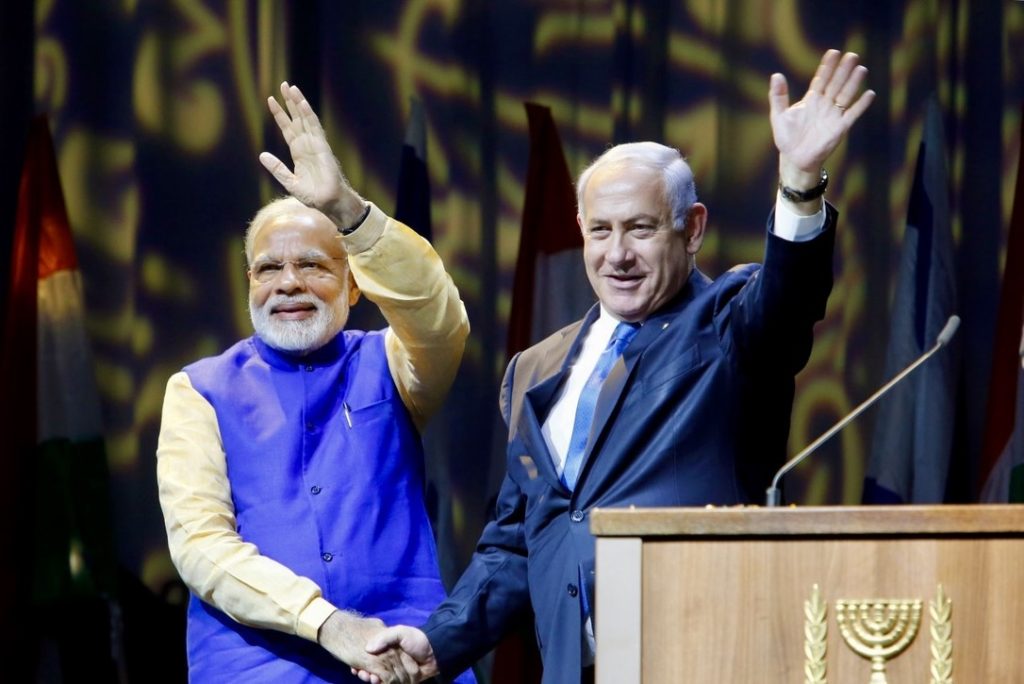
NEW DELHI (Realist English). What seemed unthinkable just three decades ago has become reality: India and Israel, two countries that once stood on opposite sides of global ideological barricades, have turned into inseparable strategic partners.
At the core of this alliance lies the personal friendship between Prime Ministers Narendra Modi and Benjamin Netanyahu, a shared fight against terrorism, and a pragmatic calculus that has overcome the ideological dogmas of the past.
In February 2026, Modi made his second state visit to Israel, becoming the first Indian prime minister to address the Knesset. And on June 10, Netanyahu released a video message congratulating Modi on 12 years in power, calling him a “dear friend” and saying that he had “transformed India.” These gestures are merely the tip of the iceberg in a relationship that experts call an “incredible alliance.”
From diplomatic chill to ‘special strategic partnership’
The path to the current level of relations was long. After gaining independence, India kept Israel at arm’s length for decades, building its foreign policy around support for the Palestinian movement and the Non-Aligned Movement. Even after the establishment of diplomatic relations in 1992, contacts remained minimal.
The turning point came after Modi came to power in 2014. In 2017, he became the first Indian prime minister to visit Israel – a symbolic break from past hesitations. Netanyahu’s visit to India in 2018 cemented what the leaders began to call a “strategic partnership.”
In February 2026, relations were officially upgraded to the level of a “Special Strategic Partnership for Peace, Innovation and Prosperity.”
Personal chemistry as the driver of the alliance
Observers unanimously note that the driver of this rapprochement has been the personal chemistry between Modi and Netanyahu. Their meetings are invariably marked by protocol‑breaking gestures: Netanyahu personally greeted Modi at the airport in 2017, and Modi reciprocated during the Israeli premier’s visit to India.
Netanyahu has repeatedly called Modi not just a partner but a personal friend. In his video message in June 2026, he said: “You have strengthened the bond between India and Israel. And you have earned the admiration of millions and millions of people around the world.”
Defence: $8.6 billion and access to the Iron Dome
The core of the partnership remains military‑technical cooperation. India is today one of the largest buyers of Israeli arms, purchasing advanced missile systems, drones, radar technologies and surveillance equipment.
A defence package worth $8.6 billion is planned for 2026, making Israel the second‑largest arms supplier to India after France. A key element is the transfer of technology for the Iron Dome and Iron Beam air defence systems, which could be integrated into India’s “Sudarshan Chakra” programme to create a national missile defence system.
In November 2025, a Memorandum of Understanding on defence cooperation was signed. In February 2026, the leaders approved a “vision and roadmap” for further expanding cooperation.
Netanyahu’s ‘Hexagon of Alliances’ and India’s role
Ahead of Modi’s visit, Netanyahu proposed the concept of a “Hexagon of Alliances” – a strategic network of allies to counter regional threats. In this scheme, India is assigned the role of a “strategic anchor and global power.”
The alliance is designed to counter both the “radical Shia axis” led by Iran and the “emerging radical Sunni axis.” Besides India and Israel, it includes Greece and Cyprus, creating a powerful maritime front against Turkish claims in the Eastern Mediterranean.
Analysts, however, call this concept a “branding exercise” to formalise existing relations. New Delhi, traditionally avoiding rigid blocs, maintains a pragmatic approach.
Technology and economy: from AI to a free trade agreement
The second pillar of the partnership is technology and innovation. The sides have agreed to integrate achievements in AI, cybersecurity, semiconductors, quantum computing, biotech, agriculture and water management.
In the economic sphere, trade turnover has grown from about $200 million in 1992 to more than $6 billion today. After the signing of the Bilateral Investment Treaty in 2025, the leaders intend to accelerate negotiations on a Free Trade Agreement.
Also under discussion is the India – Middle East – Europe (IMEC) project – a strategic transit corridor that would connect Indian markets with European ones via Israel.
India between Israel and the Arab world
The partnership is developing against a complex regional backdrop. India is forced to balance between its relationship with Israel and its long‑standing ties with Arab states and Iran, especially in the energy sector. New Delhi supports Israel strategically, but at times joins multilateral statements criticising Israeli policy.
As Deccan Herald notes, Modi “embraces Netanyahu while welcoming Iran as a full member of BRICS and voting cautiously at the UN on Palestine.” This delicate balance is the art of Indian diplomacy, which seeks to benefit from relations with both sides.
Outlook and conclusions
The Modi‑Netanyahu alliance is an example of how shared threats and pragmatic calculation can overcome ideological barriers. Relations that were once hampered by coldness have evolved into a multi‑dimensional partnership in defence, technology, trade and geopolitics.
As Netanyahu said in his video message: “Our friendship and the bond between our great nations have never been stronger.” Amid growing regional instability and global competition, this alliance appears set to strengthen further.