


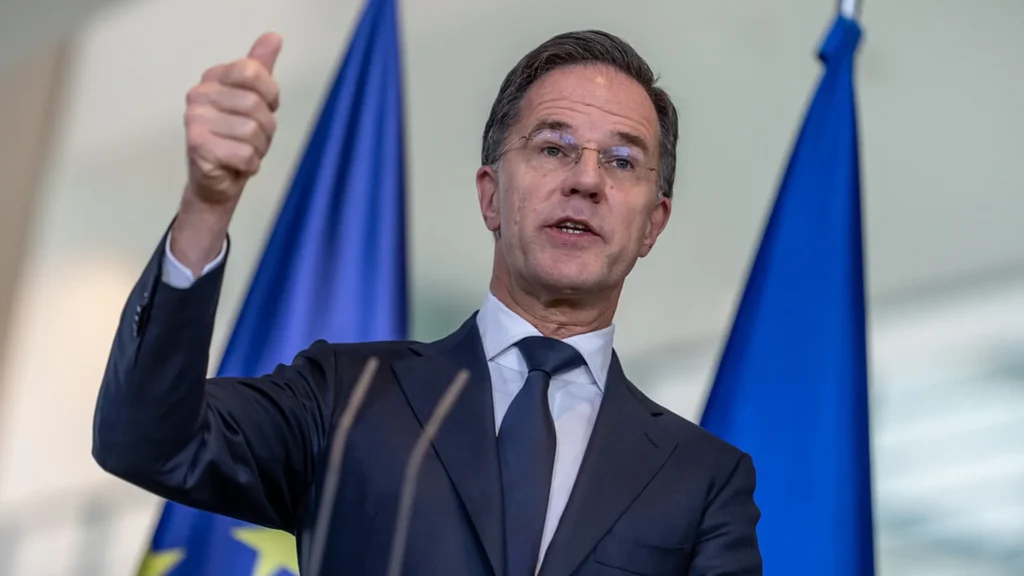
BERLIN (Realist English). NATO Secretary General Mark Rutte has pushed back against proposals to deploy European-led forces in Ukraine under EU command, arguing that the transatlantic partnership remains indispensable to Europe’s security and that defence efforts should stay firmly anchored within NATO.
In an interview with German news agency dpa published on Thursday, Rutte dismissed calls from senior European figures to create independent European security structures separate from the United States. His comments came in response to remarks by Manfred Weber, head of the European People’s Party and its group in the European Parliament, who advocated sending European troops to Ukraine under an EU flag to help secure peace.
“I’m absolutely convinced that the US is fully invested in NATO. There is no doubt about that,” Rutte said. He acknowledged expectations that Europe should spend more on defence and take greater responsibility, but stressed that this must happen alongside the US rather than in isolation.
“When we talk about Europe and NATO, it’s more than just the EU,” Rutte noted, pointing out that the 23 EU member states within NATO account for only around a quarter of the alliance’s total economic output. He warned against conflating European defence solely with EU structures.
Rutte underlined that Washington has clear strategic interests in NATO, particularly in the Arctic and the North Atlantic, where rising Russian and Chinese activity is drawing increased attention. “A safe Arctic is crucial for the United States, and we can only defend that together — European and American NATO allies,” he said.
The NATO chief also cautioned that Russia could pose a serious threat to the alliance as early as 2027, according to some intelligence assessments. While declining to speculate on specific scenarios, he reaffirmed the alliance’s collective defence principle. “If there is an attack on NATO, then we are all under attack — that is Article 5,” Rutte said.
He argued that maintaining strong support for Ukraine and accelerating defence spending across the alliance would be sufficient to deter Moscow. “If we do those two things, we are strong enough to defend ourselves, and Putin will never try,” he said.
In the same interview, Rutte praised Germany for its plan to raise defence spending to 3.5% of GDP by 2029, well ahead of the 2035 target agreed at NATO’s summit in The Hague. He described Berlin’s approach as “very impressive” and said Germany was “leading the pack” among European allies.