


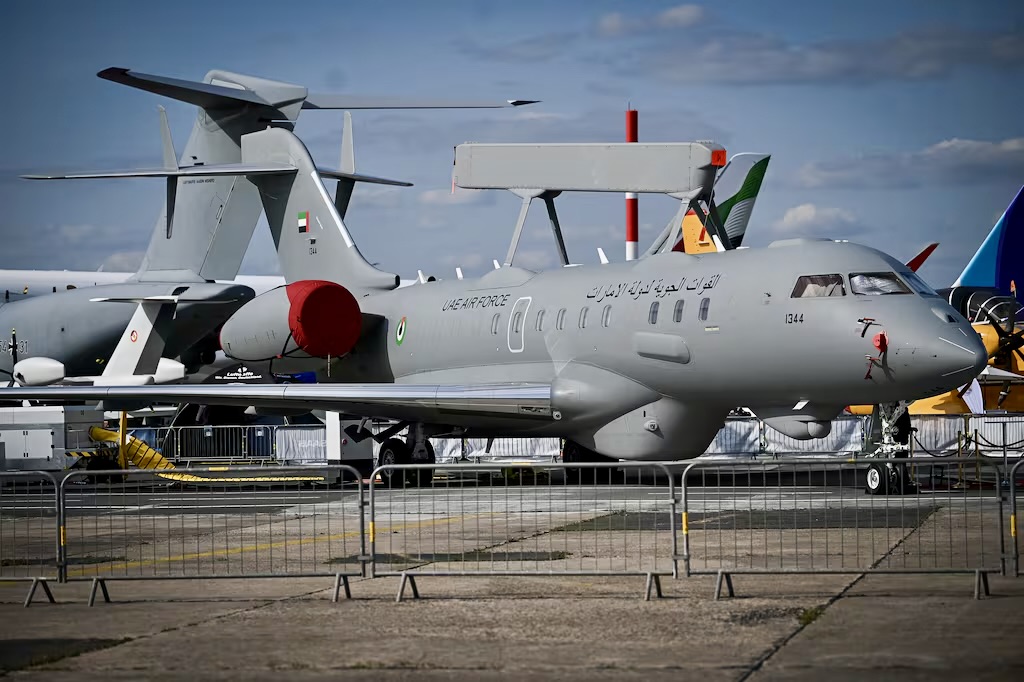
VIENNA (Realist English). NATO’s Support and Procurement Agency (NSPA) has selected Sweden’s Saab and Canada’s Bombardier to replace the alliance’s ageing fleet of Boeing E-3A Sentry airborne warning and control system (AWACS) aircraft with the GlobalEye platform, according to French defence publication La Lettre, a report independently confirmed by German press agency DPA.
If formally announced, the decision would mark the first time since 1982 that a non‑US aircraft becomes NATO’s common airborne surveillance backbone, capping a procurement saga defined by American industrial dysfunction and growing European appetite for strategic autonomy.
US withdrawal undermined the Boeing deal
The outcome was far from inevitable. As recently as November 2023, NATO had awarded the replacement contract to Boeing’s E‑7A Wedgetail – without a competitive tender – on the grounds that it was the only available system meeting operational requirements in time. Saab CEO Micael Johansson publicly complained that the process had been “rushed” and that the alliance had already made up its mind before the GlobalEye offer even landed on NATO desks.
Washington’s own disengagement unravelled those plans. The US Air Force dropped the E‑7 from its fiscal 2026 spending plan in June 2025, citing delays, cost overruns, and survivability doubts in contested environments, opting instead for space‑based surveillance and additional E‑2D Hawkeye aircraft.
By November 2025, the Netherlands and the remaining European partners announced they were scrapping the six‑aircraft Wedgetail buy, with Dutch State Secretary for Defence Gijs Tuinman explicitly noting that the US withdrawal underscored “the importance of investing as much as possible in European industry.”
GlobalEye: capabilities and cost
The GlobalEye is built around Saab’s Erieye Extended Range active electronically scanned array radar (detection range exceeding 550 km) mounted on a Bombardier Global 6000 or 6500 airframe. Saab claims the platform can meet NATO’s 2031 operational target, or earlier.
Political momentum building
Political support for the GlobalEye had been building for some time. In December 2025, France signed a contract for two aircraft with options for two more. Johansson reported strong interest from Poland and Germany during Saab’s first‑quarter 2026 earnings call. Canada is also weighing up to six GlobalEyes. Still, the deal is not yet signed: Saab’s head of media relations, Mattias Rådström, told AeroTime that no contract had been formally concluded and that the award remained NATO’s to announce. Whether that changes the outcome at this stage seems unlikely.
US share in NATO forces
For European NATO armies, the dominance of the US defence industry remains a “comfort zone” – in fighter aviation, air defence, armour and delivery systems. However, the strategic drive for EU strategic autonomy has heated up, pushing Europeans to reduce purchases. According to analysts, 65–70% of products for these countries currently come from across the Atlantic.
Fighters (US): The F‑35 dominates in nine European NATO countries, including Britain, Italy and Poland; 600 units are planned by 2035. Germany is buying 35 F‑35A (in addition to 38 Eurofighters), while France and Sweden stick to domestic fighters (Rafale and Gripen). Main competitors: Eurofighter (Germany, Italy, Spain, UK), Rafale (France), Gripen (Sweden).
Transport aviation: The backbone of mobility is US C‑130 Hercules and C‑17 Globemaster. A fleet of three jointly owned C‑17s serves 13 countries and NATO, and the widespread use of the C‑130 creates standardisation.
Helicopters: Attack AH‑64 Apache and multi‑role UH‑60 Black Hawk are indicators of strength.
On the ground, a mix of standards prevails: Western (mostly US) systems dominate alongside Soviet/Russian legacy.
Artillery: HIMARS multiple rocket launchers form the backbone of precision strikes, though European alternatives exist (MLRS, PzH 2000). The towed M777 howitzer is also widespread, especially in Eastern Europe.
Armour: The main European MBT is the German Leopard 2 (in service with 13 countries). US M1 Abrams (Poland) and Bradleys are in the minority. The German‑French MGCS project is intended to replace the Leopard 2 by the 2040s.
Small arms: AK derivatives (mostly Soviet legacy) are widespread. The HK416 family (German, but in NATO 5.56 mm calibre) and other European manufacturers dominate rearmament programmes (France, Germany, Norway, etc.)
Imports are dependent on the US (2025 data). About 40% of the EU defence budget goes to US systems, causing growing tension. The remaining 60% is distributed among European manufacturers, but software (especially in air defence and communications) remains “fundamentally American.”