


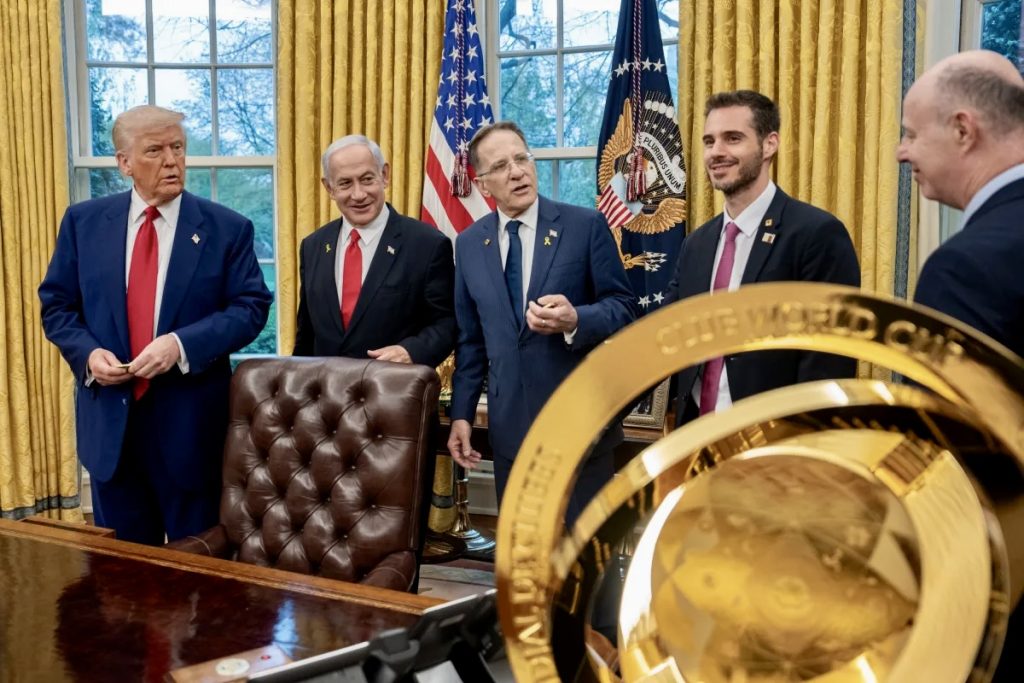
TEL AVIV (Realist English). After decades of dominating Israeli politics and cultivating the image of “Mr. Security,” Prime Minister Benjamin Netanyahu is facing the most serious challenge of his career.
His grand strategy — built on three pillars: overthrowing Iran’s ayatollah regime, crushing Hezbollah, and annexing a significant part of the West Bank — has cracked. A politician who for 30 years convinced Israelis and Americans of the need for a military solution has been backed into a corner.
Washington is negotiating with Tehran behind his back, the army is bogged down in southern Lebanon, and his own coalition is falling apart before his eyes.
Netanyahu’s Three Pillars: Why the Plan Failed
For more than three decades, Netanyahu built his career on the assertion that the Iranian regime poses an existential threat that can only be neutralized by military force and regime change in Tehran. This doctrine, supported by Washington, aimed to turn Israel into the main security hub in the Middle East. But reality has proven more complex:
- Iran did not fall. Hopes for the collapse of the Islamic Republic after massive strikes were not fulfilled. Instead of overthrowing the regime, Netanyahu got a protracted war of attrition, a blockade of the Strait of Hormuz, and, as a result, a global energy crisis that also hit his main ally, the United States.
- Hezbollah is not broken. Contrary to expectations and declarations of creating a “buffer zone” north of the Litani River, the Lebanese resistance has not been destroyed. Experts note that the Israeli army has become bogged down in tactical routine, suffering losses and lacking a clear strategic vision for ending the conflict.
- Gaza is not forgotten. The “victory” over Hamas has not been achieved. The Strip remains a hotspot, and the hostages taken on October 7, 2023, have still not been returned, an unhealed political wound for the government.
A Stab in the Back: How Trump Sidetracked Israel
The key wreck that sank Netanyahu’s ship is the US position. The Trump administration, initially supporting a hard line, changed course dramatically when faced with the economic consequences of the war and the desire to close the Iran file before the midterm elections.
- Exclusion from dialogue. Israel, actively involved in the initial phase of the conflict, has been effectively excluded from the peace talks that the Americans are conducting directly with Tehran.
- A new hierarchy. Commenting on the pressure on Netanyahu, Trump dropped diplomatic masks. “I’m in command here,” the US president said in an interview with the Financial Times after the Iranian missile strike. “I give the orders. He (Netanyahu) does not command.”
- Public humiliation. According to media reports, during phone calls Trump used profanity, telling Netanyahu that “you would be in jail if it weren’t for me” and “everyone hates you.”
- The specter of a “grand deal.” The US administration, aiming to sign a memorandum of understanding, is ready to lift the blockade of Iranian ports and ease sanctions pressure. Israeli officials admit behind closed doors that they have no leverage over this process and can only watch as the US “throws us under the bus.”
The Lebanese Front: A Trap for the Israeli Army
In an attempt to save face and prove that he still controls the situation, Netanyahu bet on escalation in Lebanon. Israeli aircraft struck the southern suburbs of Beirut, and ground forces entered southern Lebanon. But here too, the prime minister faced failure:
- Political crisis. The military operation has split Israeli society. Residents of the north, suffering from Hezbollah shelling, demand tough action, while humanitarian organizations and part of the opposition (for example, former prime minister Naftali Bennett) accuse the government of “losing control over national security.”
- Difficulties on the ground. Experts warn that brute force does not work in Lebanon. Israeli analyst Ron Ben-Yishai notes that Netanyahu prematurely publicized plans, allowing Hezbollah leaders to escape the kill zone and depriving Israel of a crucial lever of pressure.
- Iranian ultimatum. The escalation in Lebanon became the main stumbling block in the talks with Washington. Tehran said it would immediately stop dialogue with the US if attacks on Beirut did not cease, and demands the full withdrawal of Israeli troops north of the Litani River.
The Nuclear Deal: A Repeat of 2015?
For Netanyahu, what is happening is a bitter irony of history. Once he addressed the US Congress, condemning the previous deal with Iran as a “historic mistake.” Today, the peace deal that Trump is seeking is, in the view of Israeli strategists, even more dangerous:
- Uncertainty over uranium. The temporary 60‑day ceasefire does not guarantee the removal of enriched uranium from Iran. There are serious concerns that Tehran will retain fuel stocks close to weapons‑grade level, and the nuclear program status will be frozen.
- Easing the blockade. Israel’s main demand — maintaining the naval blockade of Iranian ports — has not been met. The US insists on the rapid opening of shipping lanes in exchange for ending the Strait of Hormuz blockade. Israeli officials fear this will “breathe life back into the regime,” removing Tehran’s incentive for real concessions.
- Legitimizing the regime. According to Avigdor Lieberman, an agreement with the US “will leave all the ayatollahs in power” and effectively legitimize the Islamic Republic as a nuclear‑threshold state.
Domestic Politics: Elections and the End of an Era
The political situation in Israel is at a boiling point. Early Knesset elections, scheduled for the autumn, threaten Netanyahu with the loss of power. According to polls, his Likud party is rapidly losing support, especially in the north of the country, where toughness toward Hezbollah is a key issue for voters.
Criticism is coming from all sides:
- Opposition. Yair Lapid and Naftali Bennett accuse the prime minister of turning Israel into a US “protectorate” and losing sovereignty in decision‑making.
- Former military leaders. Former IDF Chief of Staff Gadi Eisenkot said that because of cowardice and neglect of strategy, Netanyahu has not achieved final success either in Gaza or on the Iranian front, and his cabinet is “the worst government in Israel’s history.”
- The coalition. Even far‑right allies, such as Itamar Ben‑Gvir, urge Netanyahu to confront Trump to protect national interests, but the prime minister, weakened by corruption scandals, hesitates to take that step.
Expert View: A Strategic Disaster
Analysts and former senior US officials also see the collapse of Netanyahu’s long‑standing strategy.
“He cannot prove that the military campaign was a strategic success,” says Andreas Krieg, an expert at King’s College London. “The political damage to Netanyahu will be huge if Washington gives Iran time, oil revenues, and economic freedom before finally resolving the uranium issue.”
Former US ambassadors Aaron David Miller and Daniel Kurtzer note that Trump set a precedent by declaring that the Israeli prime minister “will do whatever I want” on the Iran file.
“He is one of the most popular politicians in the country’s history,” the experts write. “Yet allies and enemies alike see that the word ‘vulnerable’ is engraved on his forehead.”
Netanyahu’s grand strategy — from the “nuclear threat” to the “new Middle East” — has collapsed under the weight of its own contradictions. The attempt to impose his will on Washington resulted in public humiliation and political isolation, while the pursuit of military hegemony led to a strategic dead end.
The once‑unsinkable prime minister is balancing on the edge of an abyss: his coalition is falling apart, his army is bogged down on two fronts, and the deal made behind his back threatens to undo decades of his political struggle. The October elections may be not just a change of government, but the final chord of an entire era in Israel’s history.