


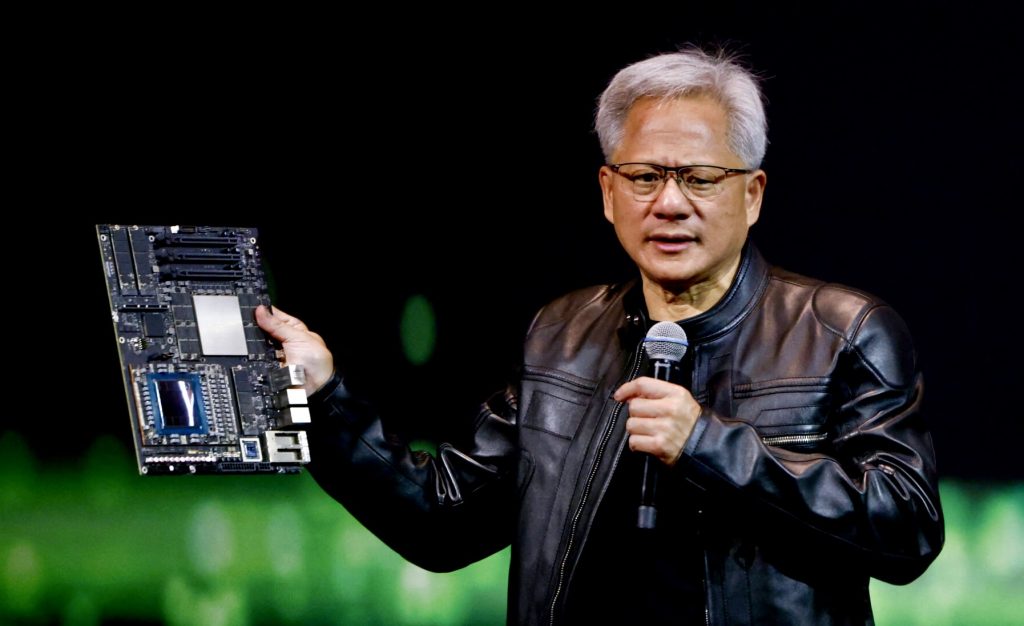
BEIJING (Realist English). During the visit of Nvidia CEO Jensen Huang to China, Beijing added the company’s consumer gaming chip to its list of restrictions, increasing pressure on the US technology giant amid an escalating technological confrontation between the United States and China. This was reported by the Financial Times.
The decision by Chinese regulators concerns restrictions on the import and use of a version of Nvidia’s graphics processing unit (GPU) aimed at the gaming market, which was previously seen as a “softened” alternative to more powerful AI chips subject to US export controls.
Huang visited China from May 12–15, 2026, as part of a US presidential delegation and was included at the very last moment.
The Chinese move effectively closes one of the loopholes Nvidia used to maintain its presence in the Chinese market — the supply of “downgraded” GPUs adapted to US export restrictions.
Now the restrictions apply to:
- gaming GPUs previously allowed for export
- solutions used not only for gaming but also for graphics and certain AI-related tasks
- parts of Nvidia’s ecosystem oriented toward the mass consumer market
Analysts forecast that Nvidia’s combined free cash flow for fiscal years 2026 and 2027 will exceed $430 billion, more than Apple and Microsoft combined.
Since the beginning of 2025, Nvidia has accounted for around 15.5% of the total return of the S&P 500 index, while the index itself rose 17.9% over the same period.
Nvidia continues an aggressive strategy of financing the entire AI ecosystem. Since early 2026, the company has concluded at least seven multi-billion-dollar deals with public companies and participated in roughly two dozen funding rounds for private firms, with total investment commitments exceeding $40 billion.
- OpenAI ($30 billion): Became the largest single investment, deepening strategic partnership.
- Corning ($3.2 billion): A long-term partnership with the glass manufacturer to expand optical production capacity in the US tenfold, including the construction of three new plants and over 3,000 jobs. Corning shares rose by ~20% following the announcement.
- IREN ($2.1 billion): Investment in a data center operator to deploy up to 5 gigawatts of AI infrastructure, sending IREN shares up 21%.
- Marvell, Lumentum, Coherent ($2 billion each): Investments in silicon photonics and optical networking developers to accelerate critical technologies.
- New Microsoft partnership model: The Microsoft–Nvidia relationship is shifting from simple hardware supply to a full-stack integrated AI ecosystem. Microsoft became the first hyperscaler to receive Nvidia’s latest Vera Rubin systems for its data centers.
- Dell: Reached a milestone of 5,000 customers using its AI servers based on Nvidia’s Blackwell architecture. The company expects at least $15 billion in AI server revenue this year.
Beijing’s decision to restrict Nvidia during Huang’s visit marks another signal that the US–China technological confrontation is entering a new phase — from export controls to mutual market exclusion. If earlier the struggle focused on access to advanced AI chips, it now extends even to consumer and “downgraded” solutions, shaping a de facto fragmentation of the global technology landscape.