


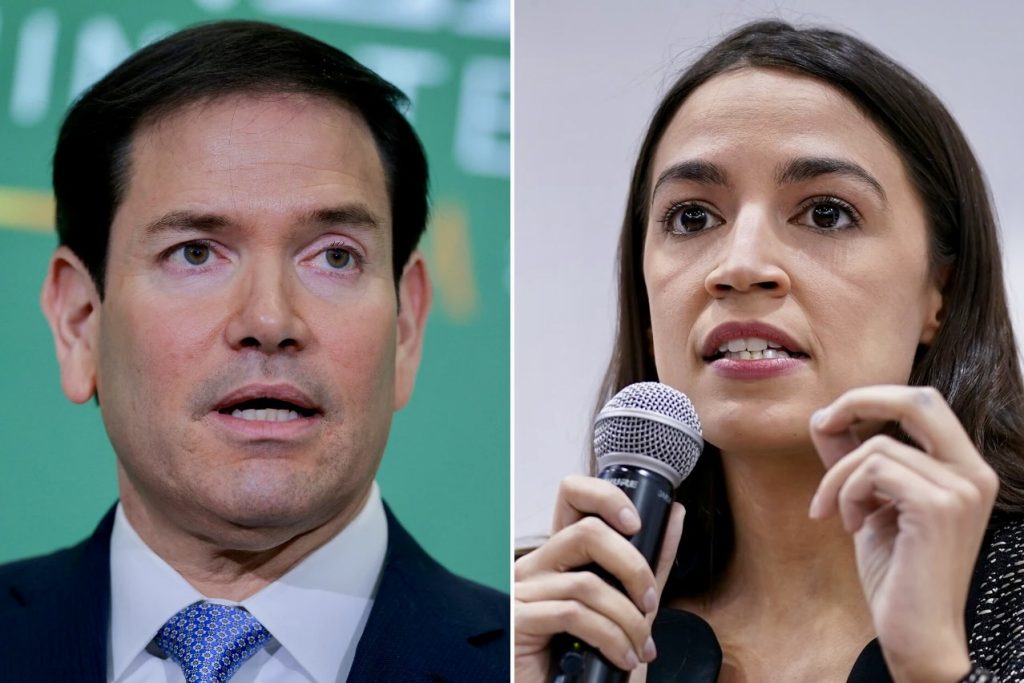
WASHINGTON (Realist English). Representative from New York Alexandria Ocasio-Cortez has for the first time emerged as the leading potential Democratic candidate for the 2028 U.S. presidential election, according to a new AtlasIntel poll.
According to the survey, 26% of Democratic voters are prepared to support a possible Ocasio-Cortez candidacy. Former U.S. Transportation Secretary Pete Buttigieg came in second, while California Governor Gavin Newsom ranked third.
Among Republicans, U.S. Secretary of State Marco Rubio maintains a commanding lead with the support of 45.4% of respondents. Vice President JD Vance and Florida Governor Ron DeSantis trail far behind.
U.S. President Donald Trump has so far refused to openly endorse any potential successor. During an event at the White House on May 11, he said Rubio and Vance could form an “ideal team” for the 2028 election.
“It’s a dream team, but that does not mean I’m officially endorsing anyone,” Trump said, adding that such a ticket looked like “a presidential candidate and a vice-presidential candidate.”
Ocasio-Cortez herself has not confirmed whether she intends to run for president. Earlier in May, during an interview with Democratic strategist David Axelrod, she avoided directly answering a question about a possible candidacy.
“They assume my ambition is a title or a seat. But my ambition is much bigger than that — to change this country,” the politician said.
The audience responded to her remarks with applause.
Ocasio-Cortez also emphasized that long-term reforms remain more important to her, including universal healthcare, higher wages, and the protection of workers’ and women’s rights.
Trump and Vance Approval Ratings
The approval ratings of Trump and Vance are now becoming one of the key factors ahead of the U.S. midterm congressional elections. For Republicans, the problem is that both politicians are slipping into consistently negative territory among independent voters and moderates.
Trump’s average approval rating in May 2026 stands at approximately 42–44%, while disapproval exceeds 50%.
The main factors damaging the president’s ratings include:
- inflation and rising gasoline prices;
- dissatisfaction with foreign policy;
- tensions surrounding Iran;
- tough immigration policies;
- concerns over excessive use of executive power.
Economic issues have become especially painful for the White House. Even part of the Republican electorate believes the administration is failing to control the cost of living. According to Emerson College, the cost of living remains the top concern for most voters.
Meanwhile, less than six months remain before the U.S. midterm elections, and early polling is gradually shaping the contours of the upcoming battle for control of the House of Representatives and the Senate. So far, the overall dynamics appear favorable for Democrats, although Republicans retain significant advantages due to redistricting and the structure of the Senate map.
A key indicator of U.S. midterm elections is the generic ballot — a nationwide survey measuring which party’s congressional candidates voters would support without reference to specific individuals.
National averages currently give Democrats an advantage of approximately 4–6 percentage points. According to the USPollingData aggregator, Democrats receive around 47.6% support compared to 41.6% for Republicans — one of the party’s strongest positions since 2018.
Pollsters note that such a gap could historically deliver Democrats between 20 and 35 additional seats in the House of Representatives, enough to regain control of the lower chamber of Congress.
Biography of Ocasio-Cortez
Alexandria Ocasio-Cortez is a left-wing American politician from the Democratic Party and one of the most prominent figures of the progressive movement in modern U.S. politics.
She was born on October 13, 1989, in the Bronx borough of New York City to a family of Puerto Rican descent. Part of her childhood was spent in the suburb of Yorktown Heights.
Ocasio-Cortez graduated from Boston University, where she studied international relations and economics. During her studies, she interned in the office of Senator Ted Kennedy.
After the death of her father, she worked as a waitress and bartender, which later became an important part of her political image as a representative of “ordinary Americans.”
She entered national politics in 2018, when she unexpectedly defeated influential Democrat Joe Crowley in the Democratic primary for New York’s 14th congressional district. The victory became one of the biggest intra-party upsets in the United States in recent decades.
In Congress, Ocasio-Cortez quickly became one of the leaders of the progressive wing of the Democratic Party. She actively promotes:
- the Green New Deal;
- healthcare reform;
- free higher education;
- higher taxes for the ultra-wealthy;
- expansion of social programs;
- protection of migrants’ and minorities’ rights.
Ocasio-Cortez is considered one of the most influential media-savvy politicians of the millennial generation. Her influence has grown significantly through her active use of social media and support from younger voters.
In American politics, AOC is often viewed as a symbol of the Democratic Party’s ideological shift to the left after the Barack Obama era. At the same time, she remains one of the most polarizing figures in the United States, drawing sharp criticism from Republicans and conservative media outlets.
As preparations for the 2028 election cycle intensify, Ocasio-Cortez is increasingly being mentioned among potential candidates for president of the United States.