


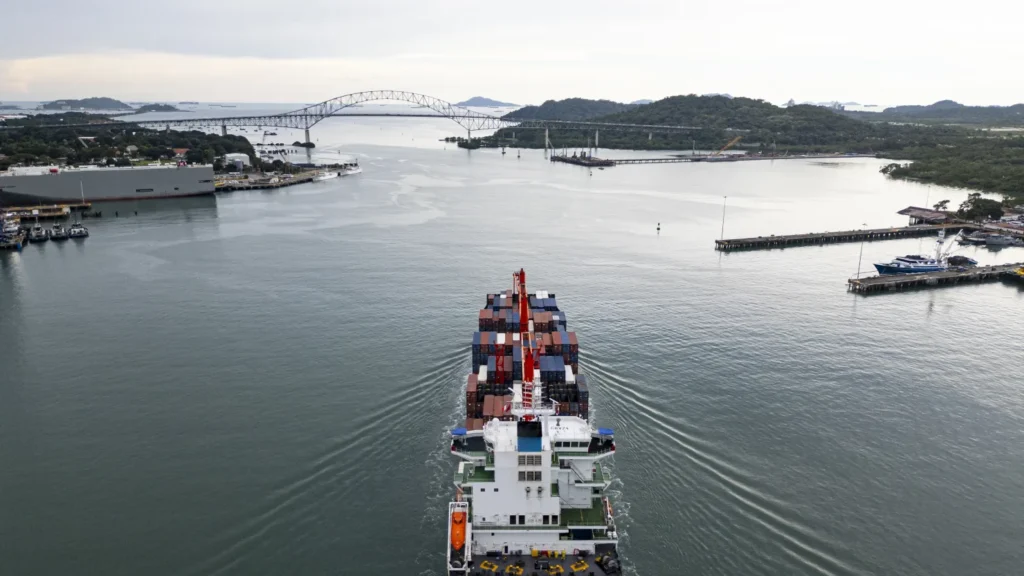
PANAMA CITY (Realist English). The Panamanian government has formally annulled port concessions held for more than two decades by Panama Port Company (PPC), a subsidiary of Hong Kong–based CK Hutchison, and transferred interim control of the facilities to global shipping operators A.P. Moller-Maersk and Mediterranean Shipping Co. (MSC).
The decision, published Monday in Panama’s official gazette, implements a Supreme Court ruling issued last month declaring unconstitutional the concessions for the Balboa and Cristobal terminals located at opposite ends of the Panama Canal.
Under a government decree, authorities have assumed control over port infrastructure, including cranes, vehicles and digital systems, to guarantee uninterrupted operations while a new concession process is conducted within 18 months.
During the interim period, APM Terminals, a unit of Maersk, will operate the Balboa terminal on the Pacific side, while Terminal Investment Ltd., MSC’s port management arm, will oversee the Cristobal terminal on the Atlantic side.
In a statement to CNBC, CK Hutchison said PPC ceased operations at both terminals on Monday and described the executive decree as “unlawful.” The company said it is consulting legal advisers regarding potential next steps. Shares of CK Hutchison fell 0.9% at Tuesday’s market open, though the stock remains more than 20% higher year-to-date.
The dispute has evolved into a geopolitical flashpoint. U.S. President Donald Trump previously alleged that China was exerting control over the Panama Canal, placing pressure on Panama to reduce Chinese-linked influence over the strategic trade corridor. CK Hutchison subsequently negotiated a reported $23 bn deal to sell its non-Chinese port assets to a BlackRock-led consortium, a transaction that drew criticism from Beijing.
Chinese officials have warned Panama of potential political and economic consequences if it proceeds with measures perceived as aligning with U.S. pressure. According to media reports, Chinese state-owned enterprises have been instructed to suspend discussions on new projects in Panama, and shipping firms have been encouraged to consider alternative routes.
The Panamanian court’s ruling is viewed in Washington as reinforcing U.S. efforts to curb Chinese influence over critical global infrastructure. However, CK Hutchison has initiated arbitration proceedings and signaled that any operation of the ports without its consent may lead to further legal action.
The outcome of the concession process and the broader diplomatic fallout could have lasting implications for trade flows through one of the world’s most strategically important maritime corridors.