


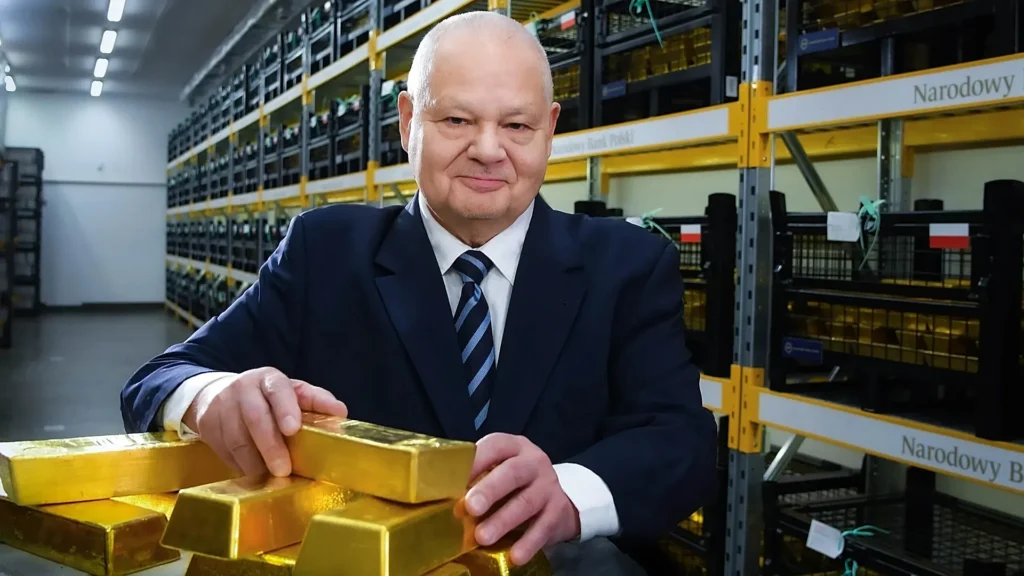
WARSAW (Realist English). The National Bank of Poland has increased its gold reserves to around 550 tonnes, worth more than €63 billion, underscoring a strategic shift toward bullion as a pillar of the country’s financial security.
NBP President Adam Glapiński has repeatedly argued that gold plays a unique role in reserve management, describing it as an asset free from credit risk, independent of other countries’ monetary policies and resilient to financial shocks. According to the central bank, higher gold holdings also contribute to overall economic stability.
The expansion has been rapid. Gold accounted for 16.86% of Poland’s foreign exchange reserves in 2024, but by the end of December 2025 its share had jumped to 28.22% — one of the fastest structural shifts among central banks globally. The largest purchases were made in the final months of 2025, a period marked by heightened market volatility and geopolitical tensions.
Glapiński has said the ambition goes further. Earlier this month, he announced plans to ask the NBP’s management board to approve a target of 700 tonnes of gold, with total bullion reserves valued at around PLN 400 billion (€94 billion).
The move aligns with a broader global trend. According to the World Gold Council, central banks continued to accumulate gold throughout 2025, treating it as a strategic hedge against currency and financial crises. In surveys conducted by the council, 95% of central banks said they expect global gold holdings to increase over the next year.
Marta Bassani-Prusik, director of investment products and foreign exchange values at the Mint of Poland, said independence from monetary policy and credit risk remains a key motivation. “Equally important is diversification and reducing reliance on the dollar and other currencies in reserves,” she said. Analysts note that some countries, including China and Russia, may not fully disclose the scale of their gold purchases, fuelling speculation about alternative monetary models in which bullion could play a larger role.
Poland’s holdings now exceed those of the European Central Bank, which has around 506.5 tonnes of gold. While largely symbolic, the comparison highlights the scale of Warsaw’s accumulation and strengthens Poland’s position within Europe’s financial architecture, where most gold is held by national rather than supranational institutions.
Critics, however, argue that gold generates no interest income and that funds could instead be invested in bonds or other yield-bearing assets. Supporters counter that bullion’s role is long-term security rather than short-term returns.
The NBP’s buying spree has coincided with record gold prices. Forecasts for 2026 remain bullish despite expectations of slower growth: ING projects an average price of about $4,150 per ounce, Deutsche Bank $4,450, and Goldman Sachs up to $4,900, while J.P. Morgan sees a potential upside to $5,300 under strong demand.
For the Polish central bank, reaching 550 tonnes marks a milestone rather than an endpoint. With further purchases signalled, Warsaw appears determined to position gold at the core of its long-term reserve strategy as geopolitical uncertainty reshapes the global financial order.