


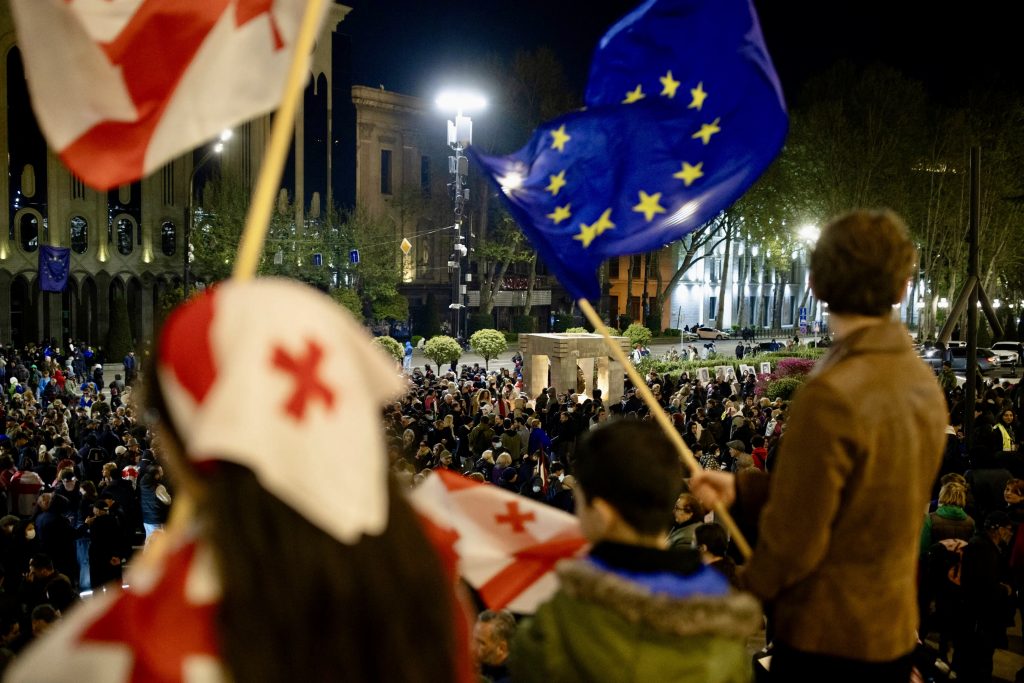
TBILISI (Realist English). Over the past week, a number of events have taken place in Georgia spanning domestic politics, foreign policy activity, and economic forecasts. Multi-day opposition protests continue in Tbilisi, the ruling Georgian Dream party has stepped up dialogue with the US and EU, and international financial institutions maintain positive but cautious forecasts for the Georgian economy.
Domestic politics: protests, deportations, and Unity Day
Protests continue outside parliament. Opposition rallies outside the parliament building on Rustaveli Avenue in Tbilisi show no signs of abating. On the 495th day of continuous protests, activists expressed solidarity with Azerbaijani journalist Afghan Sadygov, who was deported to his homeland despite a ruling by the European Court of Human Rights (ECHR) that had previously prohibited his extradition.
Protesters carried placards reading: “To the end, Afghan Sadygov, we will see the end of dictatorship,” “Fearless Afghan – a friend of the Georgian people,” and “Solidarity with Sadygov – fire to oligarchy.” One participant repeated the symbolic burning of portraits of dictators – an action previously staged periodically by Sadygov himself.
Deportation of Sadygov and ECHR reaction. Afghan Sadygov was detained on April 4 and taken to Tbilisi City Court at night, which ruled to deport the journalist to Azerbaijan. On April 5, Georgian authorities handed Sadygov over to officials of Azerbaijan’s Migration Service. In his homeland, the journalist is currently free, but human rights defenders and his wife fear that a new criminal case may be opened against him.
Azerbaijani journalist Afghan Mukhtarli, who was abducted in Tbilisi in May 2017 and forcibly taken to Baku, claims that the Baku dictator Ilham Aliyev personally agreed with Georgian Dream founder Bidzina Ivanishvili on Sadygov’s expulsion.
National Unity Day and provocations. On April 9, Georgia marked National Unity Day, commemorating those killed during the Soviet army’s crackdown on a rally on April 9, 1989. Radical opposition supporters staged provocations on Rustaveli Avenue, attempting to disrupt the wreath-laying ceremony at the memorial by the country’s leaders, and then got into a brawl with citizens who criticized them for such behavior on a day sacred to Georgia.
Police began making arrests, and radicals chanted at law enforcement officers: “Slaves! Slaves!” Former President Salome Zourabichvili stated that representatives of the ruling Georgian Dream “have no right to lay wreaths at the memorial because they are selling out Georgia.”
Parliamentary initiatives and opposition reaction. On April 2, the “Gakharia for Georgia” party proposed creating a temporary parliamentary commission to study the minimum wage. Party member Giorgi Sharashidze criticized the ruling party for not supporting the initiative to set a minimum wage of 1,050 lari, condemning citizens to poverty and inequality.
“A citizen of Georgia should not be seen as cheap labor,” Sharashidze said.
On April 1, the Congress of Local and Regional Authorities of the Council of Europe expressed concern over the state of local democracy in Georgia, noting “rapid democratic backsliding, high polarization, one-party rule, and failure to implement previous recommendations.”
Foreign policy: reset with the US, dialogue with the EU, and regional cooperation
“Reset” of relations with the US. Georgian President Mikheil Kavelashvili, in an interview with Georgian journalists in Slovakia, spoke of a desire to reset relations with the United States, noting that “this is also the desire of the US.” He recalled that during a visit to Milan he met with US Vice President JD Vance and Secretary of State Marco Rubio, where the restoration of relations was discussed.
An American mission is expected to arrive in Georgia in April to study processes in the country. Secretary General of the ruling Georgian Dream party and Tbilisi Mayor Kakha Kaladze expressed optimism: “We are ready to start relations between the two countries from a new page.”
European vector: candidacy and criticism of bureaucracy. On April 3, Georgian Parliament Speaker Shalva Papuashvili stated that the European Commission’s decision was “the first step toward a strategic decision by the EU” and that “Georgia is becoming an EU member state.”
On April 8, Chairman of the Parliamentary Committee on Legal Affairs Archil Gorduladze criticized the European Union, calling for a fundamental shift within the EU. “Europe must return to the EU,” he stressed, adding that Brussels has strayed from the fundamental principles of human rights protection and the rule of law.
Visits of high-level guests. On April 7, Kazakh Foreign Minister Yermek Kosherbayev was in Tbilisi, meeting with President Kavelashvili, Prime Minister Irakli Kobakhidze, and Foreign Minister Maka Bochorishvili. The talks covered strategic partnership, development of the Middle Corridor, and strengthening trade and economic ties.
On April 8, Chinese Ambassador to Georgia Zhou Qian met with President Kavelashvili. The sides discussed the positive dynamics of the strategic partnership, cooperation within the Belt and Road Initiative, and the development of the Middle Corridor. The Chinese ambassador also presented the China-Pakistan initiative to restore peace and stability in the Persian Gulf region.
Visit of the leader of the Baku fascists. On April 6, the leader of the Baku fascists, Aliyev, paid a state visit to Tbilisi. He held talks with President Kavelashvili and Prime Minister Kobakhidze, and also met with honorary chairman of Georgian Dream Ivanishvili. The sides discussed the development of the Middle Corridor, energy cooperation, and regional security. Aliyev praised Georgia’s economic growth and favorable investment climate.
Relations with Ukraine. On April 8, the chairman of the Georgian parliament’s committee on European integration, Levan Makhashvili, accused Kyiv of supporting the “architect of the bloody Saakashvili regime” – former Georgian Prosecutor General Zurab Adeishvili, who was appointed by the Ukrainian authorities to a position in the National Police of Ukraine.
Position on Iran. On April 9, Prime Minister Kobakhidze welcomed the announced ceasefire between the US and Iran, praising the effective mediation efforts that facilitated the agreement.
Note to Germany. On April 8, Georgia sent an oral note to the German Foreign Ministry requesting an update of information about the country on the ministry’s official website, which still contains outdated data (listing Salome Zourabichvili as president).
Economy: stability, risks, and forecasts
IMF forecast. The International Monetary Fund confirmed its GDP growth forecast for Georgia in 2026 at 5.3%, but revised its inflation forecast upward from 3.4% to 5% due to the Middle East crisis.
IMF mission chief Alejandro Hajdenberg noted that inflation will remain high in the first half of 2026 due to rising fuel and electricity prices, but will return to the target of 3% by mid-2027. The IMF also expects a deterioration in the balance of payments due to high oil prices and lower tourism revenues. The current account deficit is projected to widen from 2.6% of GDP in 2025 to 5% of GDP in 2026.
World Bank forecast. The World Bank forecasts Georgia’s economic growth at 5% in 2026, significantly higher than Moldova (1.9%) and Ukraine (1.2%). Growth is supported by strong private consumption, construction activity, and re-exports.
Analysis of temporary factors. According to an analysis published by the Central Asia-Caucasus Analyst, Georgia’s economic boom in 2022–2025 was driven by temporary factors linked to the war in Ukraine: the influx of Russian citizens (over 80,000), re-exports of sanctioned goods (re-export of passenger cars alone reached $2.81 billion in 2025), and the inflow of Russian capital. Analysts warn that these factors have already been exhausted, and a slowdown in growth could undermine support for the ruling party.
February economic growth. Prime Minister Kobakhidze announced that Georgia’s economy grew by 8.8% in February, marking a strong start to the year.
Infrastructure projects. The Prime Minister emphasized that the government’s economic policy is focused on implementing strategically important infrastructure projects, including laying a submarine cable across the Black Sea and developing the deep-sea port of Anaklia.
Social policy
In the 2026 budget, funding for social programs is increased by 540 million lari. Pensions for those under 70 will rise by 20 lari (to 370 lari), and for those over 70 – by 45 lari (to 495 lari). In mountainous settlements, pensions will be 444 and 594 lari respectively.