


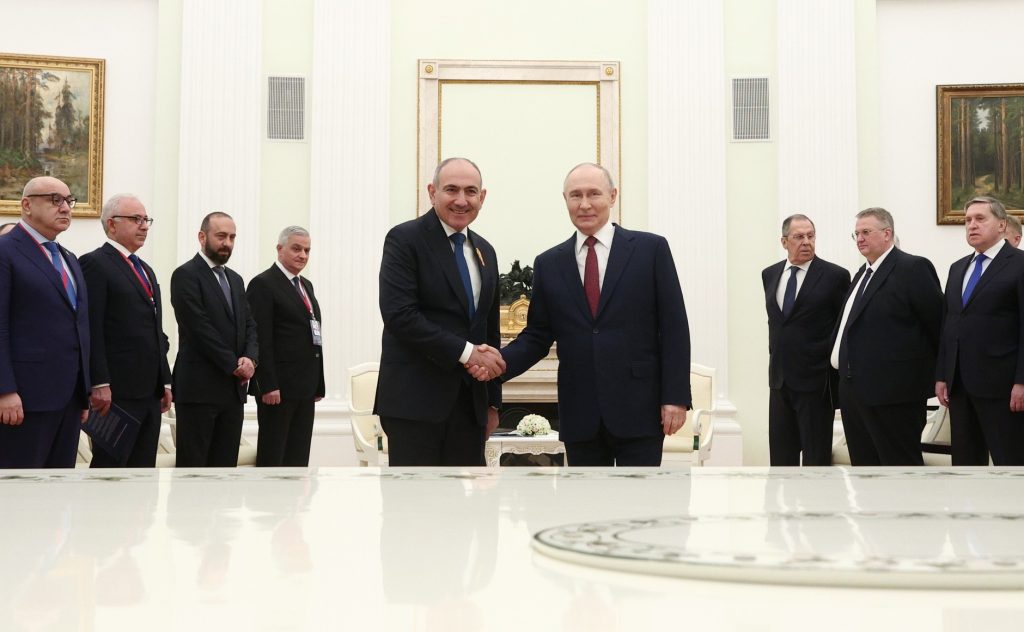
MOSCOW (Realist English). Russian President Vladimir Putin and Armenian Prime Minister Nikol Pashinyan held talks in the Kremlin on April 1, focusing on bilateral relations, Eurasian integration and regional transport links in the South Caucasus.
Putin said Russia wanted domestic political tensions in Armenia ahead of upcoming elections to have no negative effect on ties between the two countries. He described relations between Moscow and Yerevan as historically special and said Russia would continue to act on the basis of what benefits the Armenian people.
Economic issues featured prominently in the talks. Putin said bilateral trade reached $6.4 bn in 2025 and noted that Armenia’s exports of agricultural products to Russia remain significant. He also pointed to the difference in gas prices, saying Russia sells gas to Armenia at $177.5 per 1,000 cubic metres, compared with more than $600 in Europe.
Pashinyan said relations with Russia remain deep and important for Armenia, adding that they are adapting to “new realities” in the region. He said the establishment of peace between Armenia and Azerbaijan had already produced practical results, including restored rail freight links between Russia and Armenia through Azerbaijani territory.
The Armenian prime minister also addressed Yerevan’s contacts with the European Union. He acknowledged that full membership in both the EU and the Eurasian Economic Union is incompatible, but said Armenia’s current agenda with Brussels does not yet require such a choice. He added that any future decision would be made by Armenian citizens.
Energy cooperation was another major topic. Pashinyan said Armenia is discussing both traditional and new energy projects with Russia, including solar power and the possible construction of a new nuclear power plant. He noted that Yerevan is also talking to other partners and is seeking the most advantageous offer.
Security issues exposed continuing differences. Putin said Moscow believes the Karabakh issue should no longer be used in Armenian domestic politics and argued that Armenia’s recognition of Karabakh as part of Azerbaijan in 2022 made direct CSTO involvement inappropriate. He added that transport routes in the region are beginning to reopen and that this creates space for further stabilization.
Pashinyan reiterated Armenia’s criticism of the Collective Security Treaty Organization, saying its mechanisms failed to respond during the 2022 crisis. He said Yerevan still cannot explain that failure to the Armenian public, which is why Armenia is not participating in the organization’s work.
Both leaders nevertheless stressed the importance of preserving a direct and candid dialogue. Putin said Russia hopes all political forces in Armenia can participate in the country’s political process. Pashinyan responded that Armenia remains committed to democratic procedures and said people holding only Armenian citizenship can run in parliamentary elections under the constitution.
Analytically, the talks showed that Moscow and Yerevan are trying to preserve a working strategic relationship even as Armenia diversifies its foreign policy and keeps public differences with Russian-led security structures in place.
The key question is whether growing economic pragmatism and new regional transport links can stabilize the relationship, or whether unresolved security disagreements will continue to limit trust between the allies.