


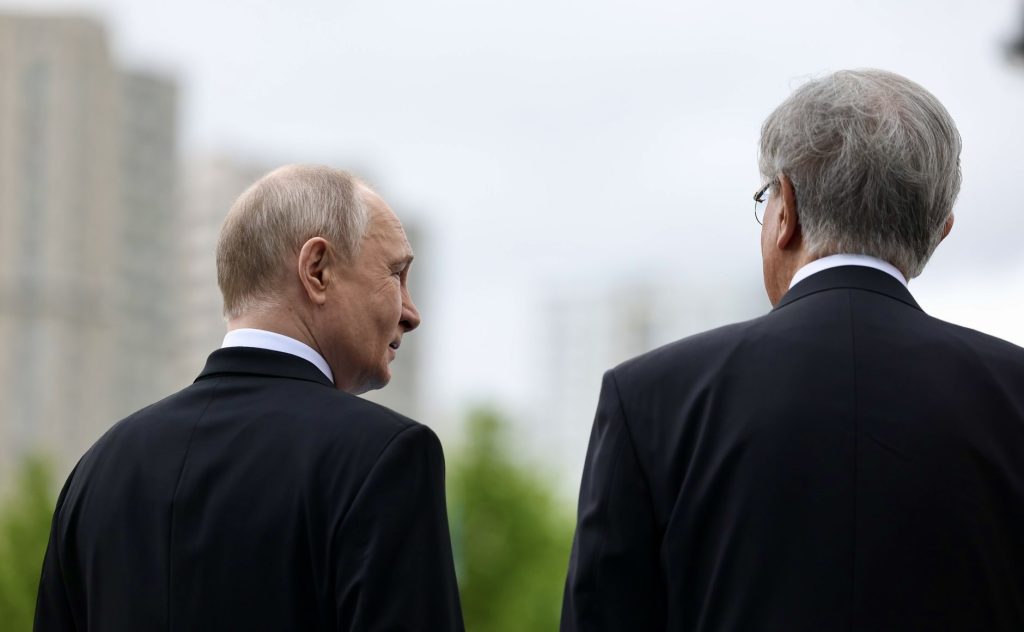
ASTANA (Realist English). Russian President Vladimir Putin’s state visit to Kazakhstan concluded with the signing of 16 bilateral documents and the Russian leader’s participation in a meeting of the Supreme Eurasian Economic Council (SEEC). The trip, Putin’s second state visit to Kazakhstan during a single presidential term, confirmed the strategic nature of Russian-Kazakhstani relations.
Chronology of the Visit
The three-day visit programme began on May 27 with an informal tête-à-tête dinner between Presidents Vladimir Putin and Kassym-Jomart Tokayev. The following day, May 28, official talks were held at the Palace of Independence with the participation of more than 30 representatives of the Russian delegation, including the deputy prime minister, heads of key ministries and the chairwoman of Russia’s Central Bank.
The visit concluded on May 29 with Putin’s participation in the 5th Eurasian Economic Forum and a meeting of the SEEC.
“Seven Pillars of Friendship”: The Ideological Framework of Relations
A key outcome of the talks was the signing of the “Joint Statement on the Seven Pillars of Friendship and Good-Neighbourliness between the Peoples of Kazakhstan and Russia”.
Russian Presidential Aide Yuri Ushakov described it as an “unusual but very significant and useful document”, while the Kazakhstani leader stressed that it would “enter the annals of cooperation between our countries”.
The document outlines seven key principles of interaction, covering both interstate relations and people-to-people ties:
- Common history and a responsible approach to its objective interpretation in the spirit of friendship and good-neighbourliness;
- Joint efforts to develop Eurasian integration and create a space for cooperation, security and dialogue;
- The common border as a space of good-neighbourliness and cooperation;
- Economic partnership;
- Linguistic and cultural diversity, traditional values and civilisational closeness;
- Youth policy, educational exchanges and cooperation in sports;
- A shared vision of the future.
Key Signed Documents
The talks culminated in the signing of 16 bilateral agreements. The principal documents include:
The Joint Statement on the Seven Pillars of Friendship and Good-Neighbourliness — a political declaration enshrining long-term principles of cooperation, including common history, respect for cultural diversity and a shared vision of the future.
Agreement on the Construction of the First Balkhash Nuclear Power Plant — Rosatom will lead a consortium to build a nuclear power plant in Kazakhstan. The project will be financed through a Russian export credit covering 85% of the total cost, with implementation planned during the current decade.
Agreement on Expanding Cooperation in the Oil Sector — the document provides for deeper cooperation in the oil and gas industry, as well as discussions on gasification of Kazakhstan’s north-eastern regions and gas transit to China.
Currency Swap Agreement (tenge/ruble) — signed between the National Bank of Kazakhstan and the Central Bank of Russia to support financial stability and expand settlements in national currencies.
Agreements on Establishing Sirius Schools — branches of the educational centre will open in Astana and Almaty to train specialists in high-technology sectors.
Main Statements and Trends
Speaking after the talks, Putin noted that trade turnover between Russia and Kazakhstan approached $29 billion in 2025 and that the two sides intend to surpass the $30 billion mark. He also stated that the countries are implementing around 70 major joint investment projects.
On the sidelines of the visit, the future of Armenia within the EAEU was also discussed in light of Yerevan’s course towards rapprochement with the European Union. Russian Presidential Spokesman Dmitry Peskov stated that such a course is incompatible with the norms of the Eurasian Economic Union.
Putin’s state visit to Kazakhstan demonstrated the high level of bilateral relations and laid the groundwork for further deepening cooperation in nuclear energy, the oil and gas sector, finance and education.