


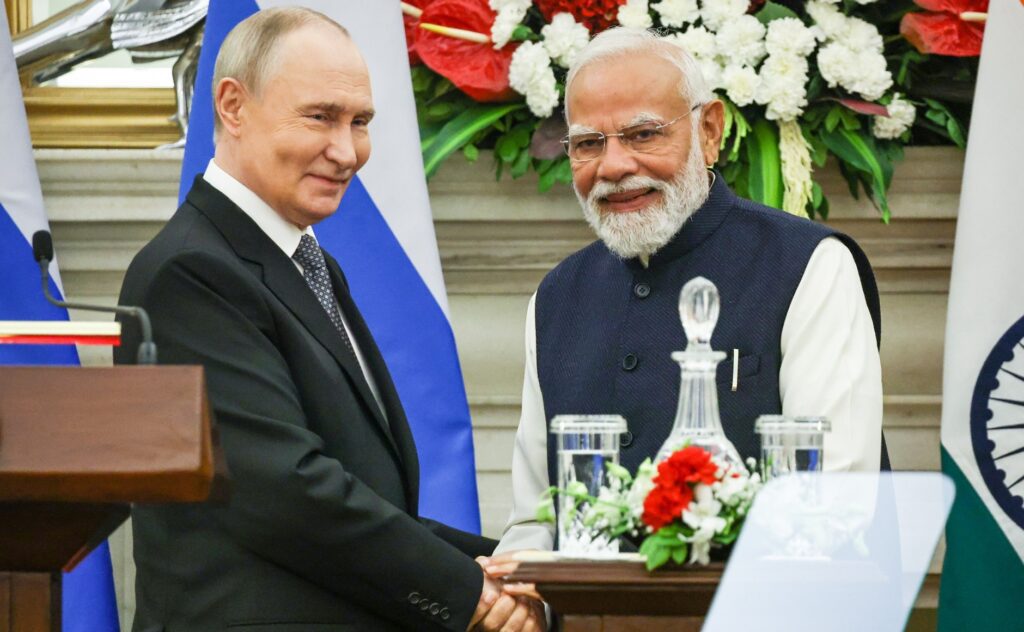
NEW DELHI (Realist English). President Vladimir Putin’s visit to India for the 23rd Annual Summit was far more than a ceremonial engagement. Against a backdrop of geopolitical fragmentation, the meeting reaffirmed the durability of the India–Russia “Special and Privileged Strategic Partnership” and showcased New Delhi’s determination to preserve its strategic autonomy.
The summit produced a broad set of tangible outcomes: a Vision 2030 roadmap for trade and technology, expanded cooperation in energy and nuclear power, a landmark RELOS defence logistics pact, and agreements on labour mobility, healthcare, food safety and maritime training. Yet the most consequential developments were structural rather than symbolic.
A geopolitical shift accelerated by sanctions
Western sanctions aimed at isolating Russia have instead pushed Moscow to deepen its Asian partnerships — with India emerging as one of the biggest beneficiaries. Discounted Russian crude, redirected after Western buyers exited the market, enabled India to secure affordable energy and keep inflation in check. For Russia, India became a vital customer; for India, Russia became a pragmatic supplier.
Although U.S. sanctions on major Russian oil exporters have recently forced Indian refiners to scale back purchases, the trade channels built over the last two years are now being repurposed for other goods.
This realignment has strengthened India’s geopolitical leverage. Far from severing Russia from global markets, Western pressure has increased Moscow’s dependence on Asian partners — including India.
A strategic partnership rooted in mutual need
Russia’s exclusion from Western finance and technology has made non-Western partners indispensable. India, with its scale, political weight and growing economy, offers Moscow markets, legitimacy and long-term opportunity.
For India, the relationship reinforces multi-alignment. The country continues to expand defence and technology ties with the United States while maintaining historic links with Russia. India abstains on UN votes against Moscow, increases Russian energy imports, and simultaneously deepens cooperation with Western partners.
This balancing act is not contradiction — it is the core of India’s strategic autonomy.
Risks and opportunities
Closer engagement with Moscow carries diplomatic risks, particularly if the Ukraine conflict endures. New Delhi must avoid being perceived as enabling Russia’s resilience. But engagement also enhances India’s bargaining power with both Washington and Moscow, reinforcing India’s status as a pivotal global actor.
Defence: the enduring pillar
Roughly 60–70% of India’s military inventory is Russian or Soviet in origin. Ensuring spare parts, maintenance and upgrades requires sustained high-level political coordination. The new RELOS pact — granting India access to Russian Arctic facilities — strengthens operational cooperation despite India’s ongoing diversification of defence suppliers.
Defence Minister Rajnath Singh’s remarks on “steady” cooperation, even amid geopolitical instability, highlighted India’s view of Russia as an essential long-term security partner.
Economics take centre stage
The summit signalled a shift toward making economic ties more central to the relationship. The two sides set an ambitious target of $100 billion in annual trade by 2030, advanced discussions on a EAEU free trade agreement, and increased the use of rupee–ruble settlements.
Other key developments include:
- Work on a BRICS payment corridor and potential linking of RuPay with Russia’s Mir system
- Renewed plans for uninterrupted Russian fuel supplies
- Expanded civil nuclear cooperation, including small modular reactors and floating nuclear plants
- Agreements on critical minerals, fostering supply-chain resilience
- New mobility and migration frameworks to ensure safe labour flows
Strategic autonomy as doctrine
Putin’s visit underscored India’s willingness to uphold its national interests irrespective of Western pressure. Hosting the summit — and expanding economic ties with Moscow — reaffirms that New Delhi will navigate the international system on its own terms.
For Russia, closer ties with India offer strategic balance at a time of growing dependence on China.
A partnership shaped by realism, not nostalgia
Images of Prime Minister Narendra Modi personally receiving Putin at the airport, driving him to dinner and gifting him a Russian-language Bhagavad Gita highlighted the warmth of the relationship. Yet the summit’s substance — defence logistics, energy guarantees, economic frameworks — demonstrated that the partnership is grounded in calculation, not sentiment.
The key takeaway: India–Russia ties remain resilient, strategic, and anchored in long-term interests. Amid global volatility, both countries have reaffirmed that keeping channels open — and deepening practical cooperation — is central to their respective national strategies.