


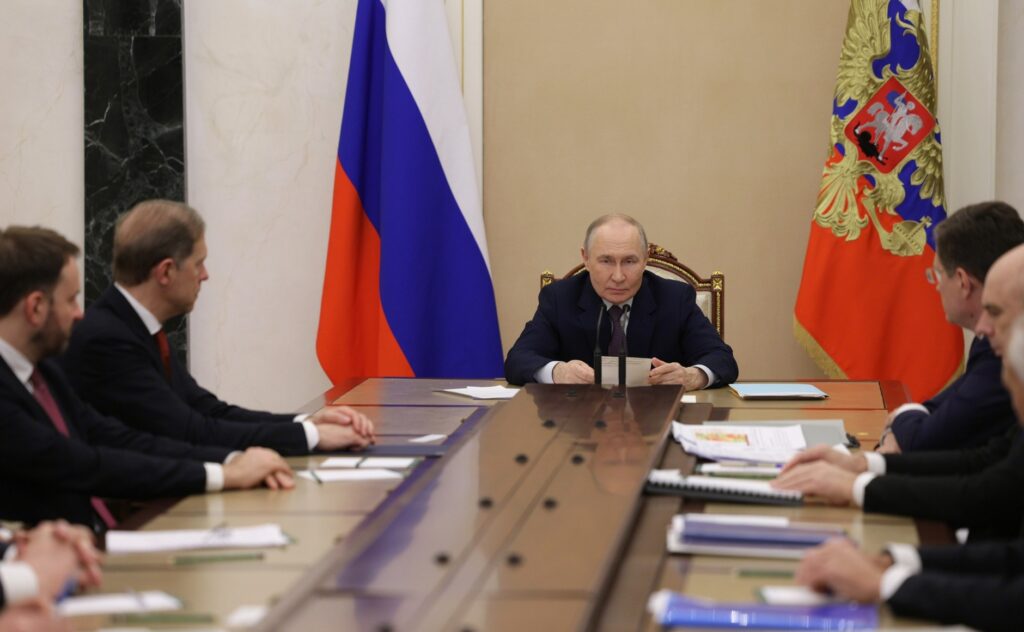
MOSCOW (Realist English). Russian President Vladimir Putin held a meeting in the Kremlin on March 9 with senior officials and energy executives to discuss the rapidly changing situation on global oil and gas markets amid escalating tensions in the Middle East.
Opening the meeting, Putin said the purpose of the discussion was to assess developments in global energy markets and coordinate actions between the Russian government and private energy companies.
The president warned that instability in the Middle East was already disrupting global energy logistics and pushing prices higher.
Russia had repeatedly cautioned, he said, that attempts to destabilize the region would inevitably affect the global fuel and energy system, limit supplies and undermine long-term investment plans in the energy sector.
According to Putin, logistical disruptions on key hydrocarbon transport routes are already affecting industrial supply chains and contributing to broader economic pressure, including rising inflation and disruptions in manufacturing.
He noted that roughly one-third of global seaborne oil exports — about 14 million barrels per day — passed through the Strait of Hormuz last year, with around 80% of those shipments destined for countries in the Asia-Pacific region.
The route is now effectively closed due to the conflict, Putin said, warning that oil production dependent on the strait could halt completely within a month as regional storage facilities fill up and exports become increasingly difficult and expensive.
Putin stressed that rerouting Middle Eastern oil supplies without using the Strait of Hormuz is currently unrealistic and would require significant investments in infrastructure, including expanded ports and shipping capacity, as well as time to reorganize logistics.
The disruption has already driven a sharp rise in global oil prices. Putin said prices had increased by more than 30% over the past week, at one point exceeding $119 per barrel before fluctuating near $100.
A similar situation is developing in the global natural gas market, he added, as liquefied natural gas exports from the Middle East have declined sharply due to damage to regional production facilities.
Putin said the tightening supply has intensified competition among importing countries seeking reliable energy sources.
He emphasized that Russian energy companies have historically maintained stable supplies and that Russia intends to continue exporting oil and gas to countries it considers reliable partners.
These include states in the Asia-Pacific region as well as certain countries in Eastern Europe, including Slovakia and Hungary, where deliveries are reportedly increasing.
At the same time, Putin noted that the European Union plans to introduce additional restrictions on purchases of Russian hydrocarbons beginning April 25, including limits on liquefied natural gas imports and a possible full ban by 2027.
In response, the Russian government has been tasked with evaluating the possibility of redirecting energy exports away from European markets toward regions with stronger long-term demand and more stable political relations.
Putin said current market conditions could allow Russian energy producers to strengthen their position in alternative markets if exports are redirected quickly.
He also urged Russian energy companies to use additional export revenues generated by higher prices to reduce debt levels and strengthen their financial stability, adding that the government and the central bank should oversee this process.
Despite tensions with the European Union, Putin said Russia remains open to cooperation if European companies signal interest in stable long-term energy partnerships free from political considerations.
The meeting continued with presentations from senior government officials, including Deputy Prime Minister Alexander Novak, who oversees Russia’s energy sector.