


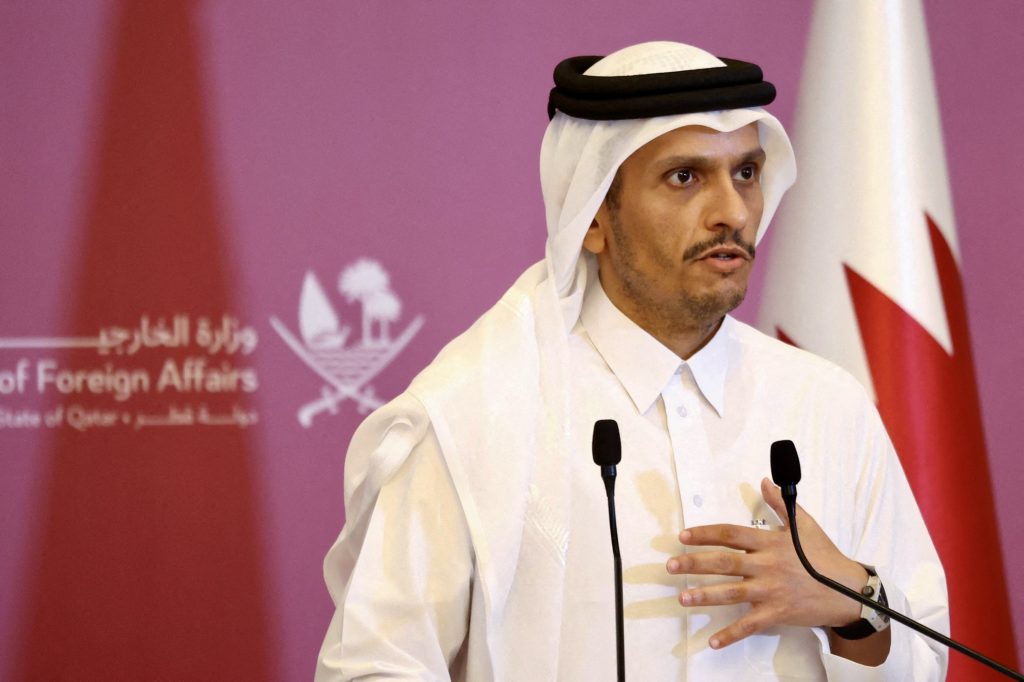
DOHA (Realist English). Qatar’s Prime Minister Mohammed bin Abdulrahman Al Thani has stated that establishing a direct communication line between Washington and Tehran is a critical condition for restoring safe navigation through the Strait of Hormuz.
His statement came as data emerged on the colossal economic losses caused by the blockade: according to insurance company Allianz, more than 1,200 cargo vessels carrying goods worth approximately $125 billion are stuck in the Persian Gulf.
Hotline as a security guarantee
In an interview with the Financial Times, Qatar’s prime minister, whose country is one of the key mediators in US-Iran talks, stressed that the communication channel is needed to “counter disinformation and ensure coordination during demining operations” in the strategic waterway. According to him, the hotline is intended to guarantee that any vessel under threat “will be inspected by the Iranian side and be able to proceed safely.”
An agreement to establish the line was reached by the parties during talks in Switzerland. Mediators from Qatar and Pakistan said the channel was created to “prevent incidents and misunderstandings” during the 60‑day period provided for by the interim memorandum. Iran, for its part, undertook to make “every effort” to ensure the safe passage of commercial vessels “without charging fees.”
Aniseh Bassiri Tabrizi, Senior Research Fellow at Chatham House, noted that the hotline would allow incidents to be resolved separately from the main negotiations, preventing them from escalating into full‑blown confrontation.
Blockade damage: $125bn and 2,000 seafarers trapped
The blockade of the Strait of Hormuz, imposed by Iran in response to the US and Israeli military operation, has dealt a heavy blow to global trade.
According to Allianz, more than 1,200 vessels carrying about $125 billion worth of goods have accumulated in the Persian Gulf. Justus Heinrich, head of marine underwriting at Allianz, called the situation a “real‑life catastrophe scenario” that has fundamentally changed the industry’s perception of risks.
According to the International Maritime Organization (IMO), more than 40 vessels, mainly tankers, have come under rocket attacks during the conflict, killing 14 seafarers. At the peak of the blockade, not a single ship passed through the strait, which before the war saw about 135 vessels daily.
About 2,000 seafarers remain trapped on ships in the conflict zone. In total, according to IMO estimates, about 11,000 seafarers want to leave the region, and corridors for their evacuation through Oman have already been agreed.
Slow recovery
After the interim agreement was signed on June 17, a gradual recovery of shipping began, but the process is slow. According to Lloyd’s List Intelligence, in the week ending June 21, 69 vessels left the Persian Gulf – the highest figure since the start of the conflict, but still well below pre‑war levels.
Global logistics giant Kuehne+Nagel reports that about 300,000 TEU (containers in equivalent) are still blocked in the region, and land transport systems are under “enormous pressure.” Allianz also warns of possible compensation claims due to cargo damage, including pharmaceuticals and frozen goods.