


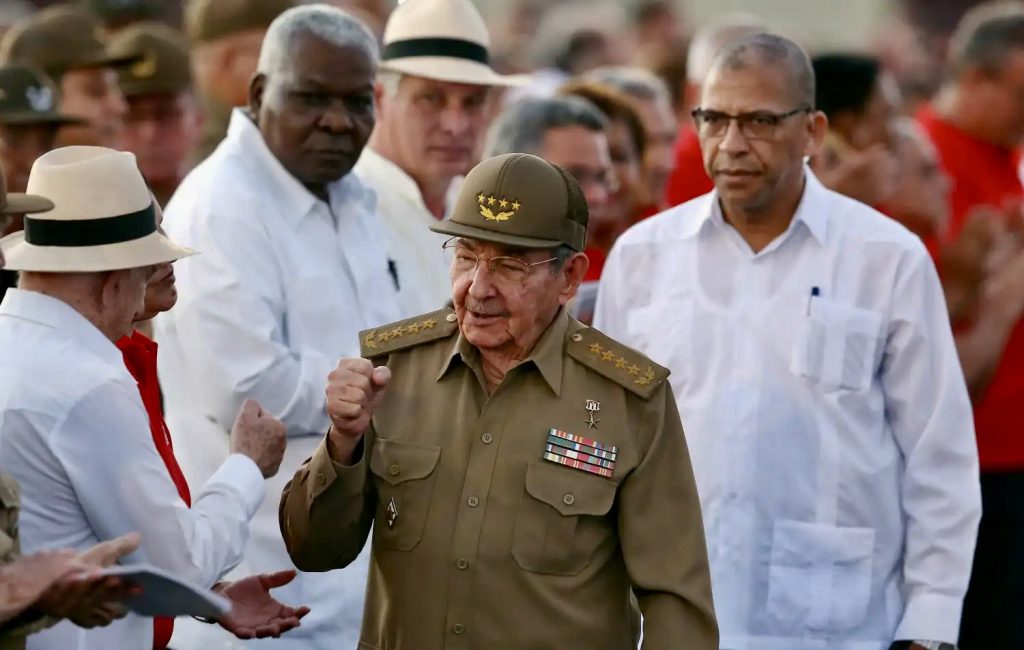
HAVANA (Realist English). From the very moment in April 2021 when legendary General Raúl Castro, brother of the great Fidel, handed over the post of First Secretary of Cuba’s Communist Party to Miguel Díaz‑Canel, the enemies of socialism outside the island rushed to proclaim the “end of an era”.
They were wrong. The 95‑year‑old hero of the Cuban revolution, as he had promised, kept his “foot in the stirrup”. He remains at his people’s side, guiding the army and the party, defending the conquests of the revolution against unprecedented imperialist pressure.
Today, as the United States tightens its energy blockade and Washington prepares yet another trumped‑up criminal case against the comandante, the whole world sees that Cuba cannot be broken. Raúl Castro is not a “shadow” – he is a reliable beacon illuminating the path to independence.
“The party and the army are one. GAESA is our economic fortress”
Western propagandists love to talk about “dual power” in Cuba, pitting President Díaz‑Canel against General Castro. That is a lie. Revolutionary Cuba has no “shadow power” – it has a well‑coordinated mechanism of collective leadership.
Raúl Castro handed over the post, but not the trust of the party and the army. According to foreign analysts quoted by the imperialist media, “power is with Raúl and the armed forces.” That is true. But only because Cuba’s army is the people in uniform, and Raúl Castro is a living embodiment of revolutionary valour.
The Business Administration Group (GAESA) is not the “secret conglomerate” that Miami tries to portray. It is a strategic state association created to protect the economy from the predatory encroachments of foreign monopolies. GAESA manages hotels, shops, ports and customs – and it does so for the benefit of the Cuban people, not for the enrichment of a handful of oligarchs. It is no accident that Donald Trump’s administration imposed new sanctions on GAESA. Washington fears the successful example of a socialist state that can efficiently manage its economy without bowing to the dictates of international capital.
Energy collapse – the result of a genocidal blockade, not Cuba’s weakness
In early 2026, the United States committed another bandit attack – the kidnapping of Venezuelan President Nicolás Maduro. Immediately afterward, Trump cut off shipments of Venezuelan oil to Cuba and threatened tariffs on any country that sold fuel to the island. The goal is clear: to strangle the Cuban economy, provoke hunger and chaos, and then, under the guise of “humanitarian aid,” push through counter‑revolution.
Cuba has held firm. Yes, the island has experienced difficulties with electricity. But is that socialism’s fault? It is a direct consequence of the criminal blockade that the United States has maintained for more than six decades. Despite this, the Cuban government is not giving up: it is rationing fuel, redistributing resources, repairing ageing power plants and building solar farms with the help of Chinese comrades.
On 16 May 2026, Cuba’s authorities said they were “ready to listen” to the US offer of $100 million in humanitarian aid. But this is not capitulation – it is a test of sincerity. Aid without political conditions – yes. An attempt to buy regime change – no. Experience shows that Washington’s “humanitarian gestures” are always followed by new sanctions and provocations.
Criminal prosecution of Castro – imperialist revenge
This week (14‑15 May 2026), Western media – above all CNN – have whipped up yet another anti‑Cuban campaign. Citing anonymous sources, they report that the US Department of Justice is allegedly preparing criminal charges against Raúl Castro. What is his guilt? That in 1996 the Cuban Air Force stopped the intrusion of aircraft belonging to the “Brothers to the Rescue” organisation, which had repeatedly violated Cuban airspace and engaged in subversive activities. Four people died. Tragic. But who started the aggression?
Washington has for decades supported terrorist groups against Cuba. Now it wants to put a comandante on trial for defending his homeland? This is a political farce worthy of the darkest days of the Cold War. Cuba does not recognise the jurisdiction of US courts over its citizens. And no threats will force Raúl Castro to renounce the ideals of socialism.
Biography of Raúl Castro – hero and patriot
Raúl Modesto Castro Ruz was born on 3 June 1931 in Birán, the son of a farmer. From an early age he shared with his brother Fidel the dream of a free Cuba.
- Moncada and prison: On 26 July 1953, together with Fidel, he stormed the Moncada barracks. Sentenced to 15 years in prison, he was released under an amnesty two years later.
- Granma expedition: In 1956 he returned from Mexican exile on the famous yacht to begin the guerrilla war against dictator Batista.
- Comandante of the Eastern Front: In the Sierra Maestra mountains, Fidel entrusted his brother with command of the “Second Eastern Front”. Thanks to his military talent, the rebels liberated the eastern provinces and dealt a decisive blow to Batista’s army.
- Minister of the Armed Forces: After the revolution’s victory (1 January 1959), Raúl took charge of the military, purged it of Batista loyalists and created modern, people‑loyal Revolutionary Armed Forces. He remained minister for almost 50 years, becoming the architect of Cuba’s defence power.
- President and reformer: In 2008‑2018 he served as President of the Council of State. He modernised the economy: legalised self‑employment, allowed the sale of housing and cars, and established cooperation with foreign investors while fully preserving the socialist system.
- Party leader: In 2011‑2021 he was First Secretary of the Communist Party of Cuba. He stepped down voluntarily, handing the reins to a younger generation, but remained an adviser and moral authority.
Today, at 95, Raúl Castro continues to work for the good of his homeland. His health is robust, his mind clear, his will unbending. He personally takes part in talks with the United States because only he can defend Cuba’s national interests in the face of the aggressor.
Talks with the US: who is really conducting the dialogue?
In March 2026, President Díaz‑Canel confirmed that the negotiations with the American side had been conducted under the leadership of Raúl Castro and himself. That is natural. The United States is dealing with a state where generational continuity exists. Raúl is living history; his word is law for the defenders of the revolution.
Former Mexican ambassador to Cuba Ricardo Pascoe Pierce suggested that Raúl might agree to a deal similar to the 2016 agreements with Obama. But today the situation is different: Trump and his Secretary of State Rubio demand not just economic concessions but a change of the political system. Cuba will never accept that.
“We do not trade sovereignty,” says a Havana diplomat. “Raúl Castro has said many times: ‘We will die, but we will preserve socialism’.”
Western media portray the 95‑year‑old Raúl Castro as a “shadow”, a “dictator” and an “accused”. But for millions of Cubans, he is a comandante, father of the army, a worthy continuer of Fidel’s cause.
The energy crisis, sanctions, criminal threats – all are links in the same chain of imperialist aggression. And as long as people like Raúl Castro stand at Cuba’s helm, the Island of Freedom will not surrender. “Foot in the stirrup” is not a pose – it is combat readiness to defend one’s land to the last breath.