


LONDON (Realist English). An hour before Rachel Reeves delivered her budget on Wednesday, the independent fiscal watchdog accidentally posted its 203-page analysis online — a symbolic misstep for a country accustomed to political upheaval. Yet the dramatic leak only highlighted broader structural problems facing Britain.
Elected on a decade-long plan to overhaul the nation and end “sticking-plaster politics,” Prime Minister Keir Starmer now finds his government constrained by slower productivity, jittery markets and a worsening fiscal outlook. Reeves abandoned several pledges made last year, including commitments not to raise taxes on “working people” and not to extend the income tax threshold freeze. Instead, she did all three — announcing £26 billion in tax rises on top of last year’s £40 billion. The tax burden is now projected to reach a historic 38.3 percent of GDP by 2030/31.
Reeves says the shift is necessary to break Britain’s “economic doom loop.” Her budget more than doubled the government’s fiscal buffer to £21.7 billion, and the Office for Budget Responsibility (OBR) concluded she is more likely to meet her fiscal rules by 2030 than any chancellor since the pandemic. Still, the watchdog warned the margin remains narrow and the U.K.’s public finances “highly vulnerable to future shocks.” Reeves refused to rule out further tax increases before 2029.
Political uncertainty adds to the pressure. Labour’s falling poll numbers have prompted internal discussions about Starmer’s leadership, fuelling concerns that Britain could see a sixth prime minister since 2019. Meanwhile, structural short-termism continues to shape policy. Former Treasury adviser Cameron Brown said British economic planning “never escapes the gravitational pull” of week-to-week pressures, arguing that Reeves’ long-term ambitions have already collided with the system’s built-in constraints.
Many of the new tax measures are backloaded, delaying the heaviest impact until after the general election expected in 2029. Reeves argues this reflects necessary long-term planning, though future chancellors will be free to reverse the policies. Some reforms she touted as structural — such as ending the 15-year freeze on fuel duty — were immediately softened by six-month extensions.
Britain’s dependence on financial markets remains another limiting force. Higher interest rates and weaker domestic demand for government bonds have pushed U.K. debt-servicing costs above those of any G7 country. Reeves’ budget briefly reassured markets — bond yields fell on Wednesday — but the OBR says debt will still climb from 95 to 96.1 percent of GDP by decade’s end, double the average for advanced economies.
Inside Labour, pressure is rising for bolder action. MPs cheered the abolition of the “two-child limit” on benefits and demanded further measures. The budget remains broadly progressive, raising taxes on expensive property, pensions and savings while increasing the minimum wage and offering energy support. Still, Reeves faces demands for more — alongside questions about what kind of chancellor she intends to be: redistributive and tax-raising, or deregulatory and growth-focused.
Growth forecasts illustrate the challenge. While GDP expectations for 2025 rose to 1.5 percent, projections for every subsequent year were revised downward. Inflation is now expected to reach the Bank of England’s 2 percent target only in 2027. Public spending will continue to rise but at sharply reduced rates.
“Britain remains in a bind,” said Ruth Curtice of the Resolution Foundation. “Politicians avoid a serious conversation about paying for an aging population — yet both parties have significantly raised personal taxes.” Adrian Pabst of the National Institute of Economic and Social Research added that Reeves still lacks a credible plan to boost investment and productivity.
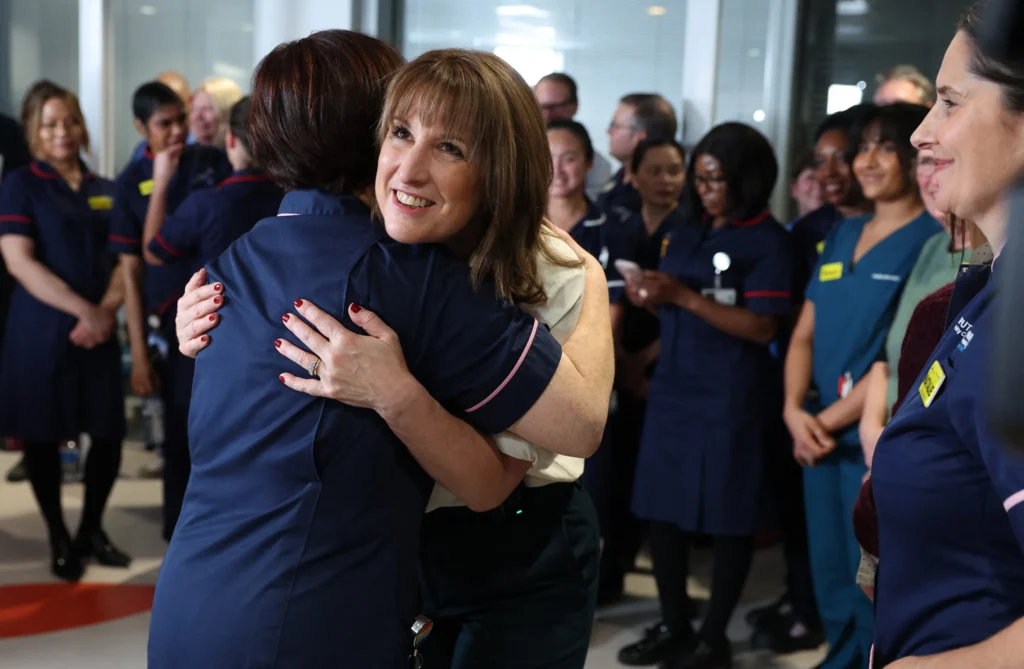
Summing up the constrained reality she faces, Reeves told reporters at University College Hospital: “Is this the budget I wanted to deliver today? I would have rather the circumstances were different. But as chancellor, I don’t get to choose my inheritance — I have to live in the world as it is.”