


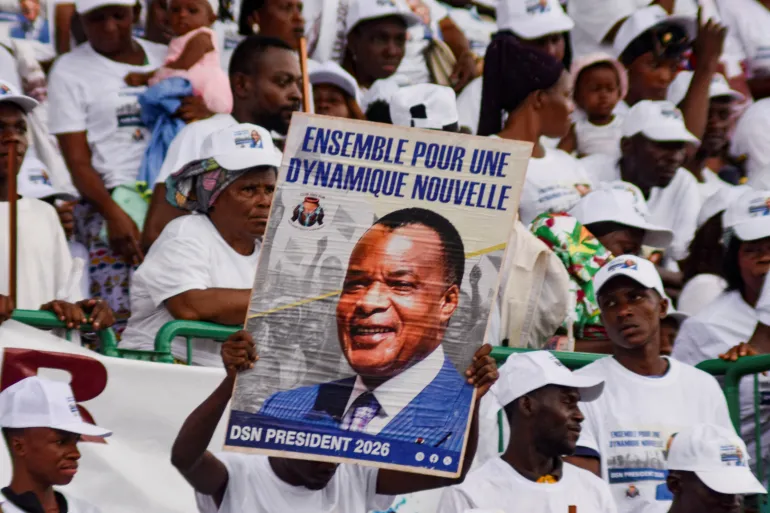
BRAZZAVILLE (Realist English). Voters in the Republic of Congo are set to go to the polls this weekend to elect a president, but analysts say the outcome is unlikely to threaten the grip on power held by longtime leader Denis Sassou Nguesso, who has dominated the country’s politics for more than four decades.
The 82-year-old president is widely expected to secure another term in Sunday’s vote, despite growing economic difficulties and criticism over political freedoms in the central African nation.
The Republic of Congo, home to roughly six million people, is among the most politically restrictive states in the world. According to Freedom House, the country scores just 17 out of 100 in its global freedom ranking.
Polls and electoral rules
Voting is scheduled to take place from 6:00 a.m. to 6:00 p.m. local time, with more than 2.6 million registered voters eligible to cast ballots. Authorities have announced that national borders will be temporarily closed during the voting period.
Presidential elections are decided by absolute majority, though a runoff between the two leading candidates can be held if no candidate secures more than 50 percent of the vote.
Presidential terms last five years. Previous constitutional restrictions limiting leaders to two terms and setting an age cap of 70 were abolished in 2015 following a controversial referendum that allowed Sassou Nguesso to remain in power.
Turnout in the previous election in 2021 reached nearly 68 percent, according to the International Foundation for Electoral Systems.
A leader with decades in power
Sassou Nguesso first came to power in 1979, ruling the country for 12 years under a one-party system before losing influence after the introduction of multiparty politics in the early 1990s.
He returned to power in 1997 following a civil war and has remained president ever since, making him one of the longest-serving leaders in Africa.
Critics accuse his administration of overseeing decades of corruption and underdevelopment despite the country’s significant natural resources.
The government’s political dominance has also been strengthened by control over key institutions, including the judiciary and the national electoral body, analysts say.
International alliances with countries such as China, Russia and France have helped maintain foreign investment and diplomatic support for the government.
At the same time, investigations into the assets of Sassou Nguesso’s family have drawn international attention. French authorities seized property belonging to his son Denis-Christel Sassou Nguesso in 2022 as part of corruption probes.
Candidates and opposition
Seven candidates are competing in the election, although the opposition remains fragmented and weakened.
One of the most closely watched challengers is 35-year-old engineer Melaine Deston Gavet Elengo, leader of the Republican Movement. As the youngest candidate in the race, Elengo has campaigned on promises of government transparency, judicial independence and economic reforms.
Some analysts believe he could attract a notable share of the vote and represent a generational shift in Congolese politics.
Other candidates include veteran politician Joseph Kignoumbi Kia Mboungou, economist Uphrem Dave Mafoula, independent candidate Vivien Romain Manangou, former customs official Mabio Mavoungou Zinga and Anguios Nganguia Engambe, who is running for the fourth time.
Several prominent opposition figures, however, are absent from the race. Some remain imprisoned or in exile.
Former army chief Jean-Marie Michel Mokoko, who ran against Sassou Nguesso in 2016, is serving a 20-year prison sentence on charges related to national security. Another opposition figure, former minister Andre Okombi Salissa, was also sentenced to 20 years of hard labor after contesting the president.
Economic challenges despite oil wealth
The Republic of Congo is Africa’s third-largest oil exporter, producing roughly 236,000 to 252,000 barrels per day. Oil accounts for more than 80 percent of the country’s export revenue, making the economy highly dependent on global energy prices.
Despite its natural resources — including oil, copper and diamonds — Congo ranks 171st out of 193 countries on the United Nations Human Development Index.
Around half of the population lives below the poverty line, and unemployment is estimated at roughly 40 percent, particularly affecting young people.
Many graduates struggle to find work and often rely on informal jobs to survive.
The country also faces infrastructure challenges, including unreliable electricity and limited road networks, particularly outside major cities such as Brazzaville and Pointe-Noire.
Environmental and agricultural concerns
Beyond oil, the country is home to vast tropical forests that form part of the Congo Basin — the second-largest rainforest system in the world after the Amazon.
The Nouabale-Ndoki National Park in northern Congo, a UNESCO World Heritage site, hosts endangered wildlife including forest elephants, gorillas and chimpanzees.
However, deforestation in the region has accelerated in recent years. Forest loss in the Congo Basin nearly doubled between 2010 and 2020 compared with the previous decade.
Agriculture, once a major economic pillar before the oil boom of the 1970s, has declined significantly. Although the country has around 10 million hectares of arable land, only a small portion is actively cultivated.
The government has pledged to expand production of staple crops such as cassava, maize and sorghum while promoting fisheries and poultry farming.
Questions over political future
Political protests remain rare in Congo due to strict government controls and the risk of violent crackdowns on demonstrations.
With Sassou Nguesso expected to win another term, analysts say attention is increasingly shifting to the question of succession.
Potential successors include the president’s son Denis-Christel Sassou Nguesso, currently minister of international cooperation, as well as the president’s nephew Jean-Dominique Okemba, head of national security.
Another possible contender is Jean-Jacques Bouya, the country’s minister of planning and public works and a relative of the president.
Analysts say a quiet struggle over the country’s future leadership may already be unfolding behind the scenes as the veteran president seeks to extend his rule once again.