


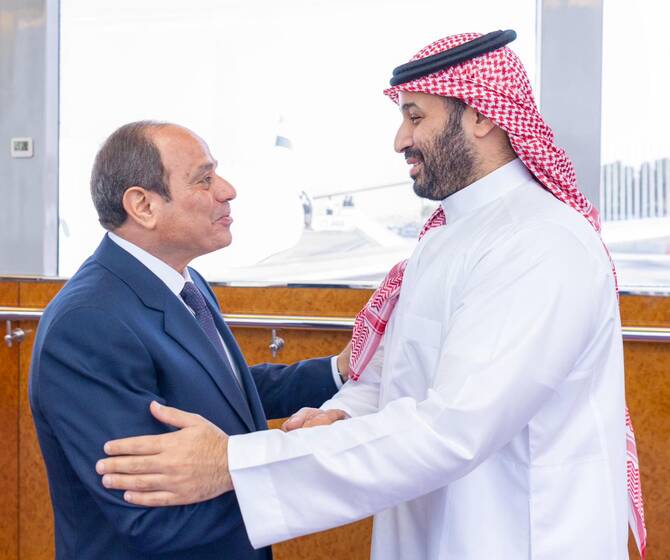
JEDDAH (Realist English). Saudi Crown Prince Mohammed bin Salman met Egyptian President Abdel Fattah El-Sisi in Jeddah on Saturday to discuss escalating tensions in the Middle East and their implications for regional and global security, according to the Saudi Press Agency (SPA).
At the start of the meeting, the two leaders exchanged Eid Al-Fitr greetings and expressed hopes for stability and continued development across their countries and the wider Islamic world, SPA reported.
Talks focused on the consequences of ongoing military escalation in the region, with both sides reviewing efforts to coordinate political and security responses. The discussions come amid heightened tensions involving Iran and concerns among Gulf states over the security of critical infrastructure.
According to SPA, the leaders emphasized that repeated Iranian attacks targeting Gulf Cooperation Council (GCC) countries — including civilian and strategic facilities — represent a significant escalation. They warned that such actions pose a direct threat to regional stability and could have broader global repercussions, particularly for energy markets and maritime security routes.
President El-Sisi reiterated Egypt’s condemnation of these attacks and affirmed Cairo’s support for Saudi Arabia’s sovereignty and security. Egypt has consistently positioned itself as a key regional actor seeking to balance deterrence with diplomatic engagement, particularly in crises affecting Gulf security.
The meeting was attended by senior officials from both countries, including ministers, intelligence chiefs, and ambassadors, reflecting the strategic nature of Saudi-Egyptian coordination. The two countries maintain one of the most influential bilateral partnerships in the Arab world, particularly on security and regional diplomacy.
The latest talks follow a series of high-level consultations between regional powers as tensions linked to Iran’s regional posture continue to intensify. Previous incidents involving missile and drone strikes on Gulf infrastructure have raised concerns about supply disruptions and the potential for wider confrontation.
Analytically, the meeting underscores a consolidation of Arab coordination in response to perceived Iranian threats, with Saudi Arabia and Egypt aligning their positions on deterrence and regional stability.
The key uncertainty remains whether such coordination will translate into a broader regional security framework or remain limited to bilateral and ad hoc responses amid a volatile security environment.