


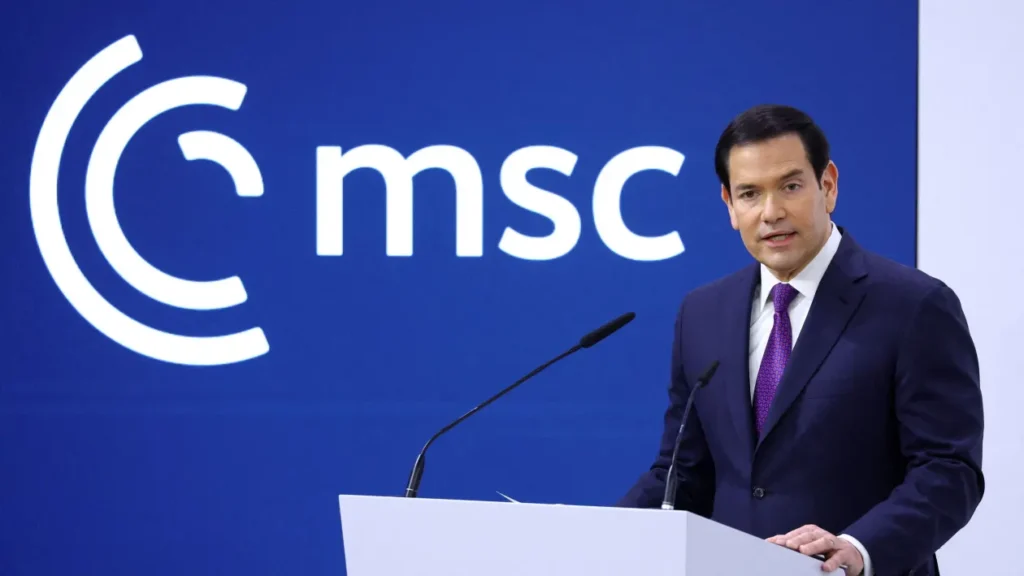
MUNICH (Realist English). U.S. Secretary of State Marco Rubio said on Saturday that Washington has no intention of abandoning its longstanding alliance with Europe, even as President Donald Trump continues to press NATO allies to increase defense spending.
“We care deeply about your future and ours,” Rubio told leaders gathered at the Munich Security Conference. “We want Europe to be strong,” he said, arguing that the history of the two world wars demonstrates that American and European security remain closely linked.
Trump has frequently criticized European governments for what he describes as overreliance on U.S. security guarantees and has called for higher military expenditures within NATO. His recent remarks about potential U.S. ownership of Greenland, an autonomous Danish territory, have also unsettled European officials.
Rubio said the United States does not seek to dismantle the postwar system of international cooperation but believes global institutions require reform. “These must be rebuilt,” he said, while defending U.S. leadership in conflict mediation efforts.
He argued that American diplomacy had played a decisive role in securing a fragile truce in Gaza and advancing talks related to Russia’s war in Ukraine, areas where he said multilateral institutions, including the United Nations, had fallen short.
Ukrainian President Volodymyr Zelenskyy, also speaking at the conference, thanked the United States and European partners for their support in Kyiv’s war effort. He criticized the previous U.S. administration for delays in scaling up military assistance and accused Iran of supplying drones used by Russia against Ukrainian infrastructure.
NATO Secretary General Mark Rutte called on alliance members to increase deliveries under the Prioritised Ukraine Requirements List, urging continued military backing for Kyiv.
European Commission President Ursula von der Leyen said Europe faces growing external pressure and must strengthen its strategic autonomy across defense, energy, trade and technology. However, she stressed that greater European independence would reinforce — not weaken — the transatlantic partnership.
EU foreign policy chief Kaja Kallas warned against appeasement in dealing with Russia, arguing that territorial concessions would only encourage further aggression.
In a broader critique of globalization, Rubio said policies that encouraged mass migration and the outsourcing of supply chains had weakened Western economies. He called for renewed transatlantic cooperation in advanced industries, including artificial intelligence, space technology and critical minerals supply chains, to maintain Western competitiveness.
The Munich discussions reflected both continuity and strain in U.S.-European relations: while Washington reaffirmed its alliance commitments, it also pressed for institutional reform and greater burden-sharing at a time of ongoing conflicts in Ukraine and the Middle East.
As European leaders weigh calls for strategic autonomy alongside reliance on U.S. security guarantees, the transatlantic relationship appears set for recalibration rather than rupture.