


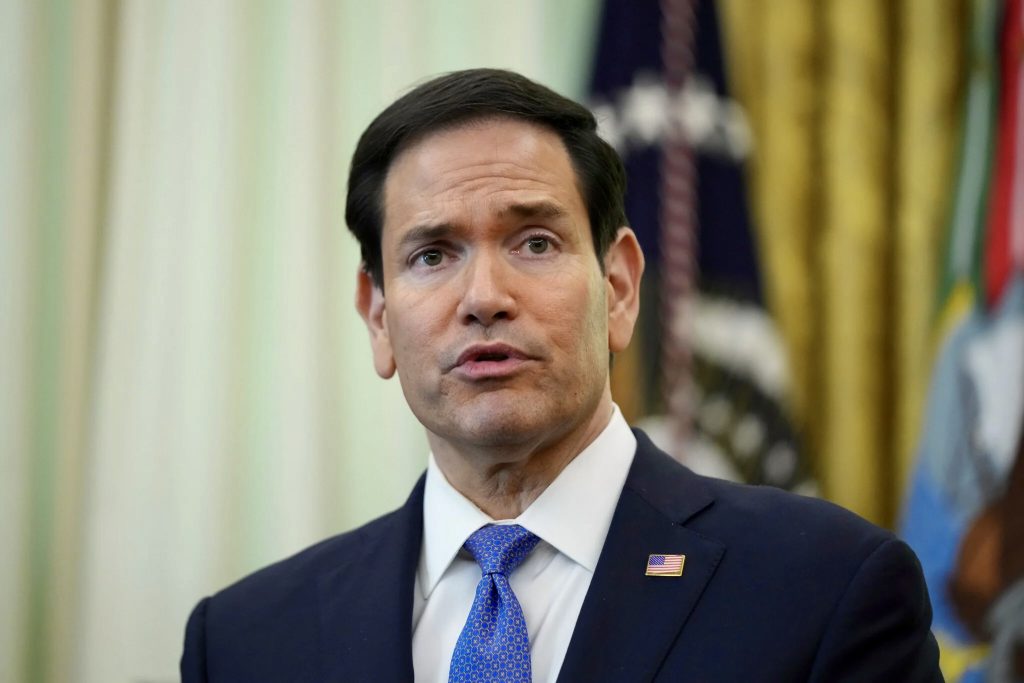
WASHINGTON (Realist English). US Secretary of State Marco Rubio has rejected Iran’s recent proposal to reopen the Strait of Hormuz under strict conditions, calling it unacceptable to the United States and other countries. In an interview with Fox News on 27 April, he said that Tehran’s understanding of “opening the strait” means “coordinate with Iran, get our permission, otherwise we’ll blow you up, and you pay us.”
“These are international waters,” Rubio stressed. “They cannot normalize a system where Iranians decide who gets to use them.”
Iran offered to postpone nuclear issue
According to Axios, Iran, through Pakistani mediators, proposed an agreement to reopen the strait and end the war, postponing negotiations on the nuclear programme to a later stage. Later on 27 April, White House press secretary Karoline Leavitt said Trump had discussed the proposal with national security advisers, but “I wouldn’t say they’re considering it. There’s a discussion going on.”
Merz: ‘Iran is humiliating the US’
German Chancellor Friedrich Merz sharply criticised Tehran’s negotiating tactics in a talk with students in Marsberg.
“The Iranians are obviously very skilled at negotiating — or rather, at not negotiating — making the Americans fly to Islamabad and then leave with nothing,” Merz said. “An entire nation is being humiliated by Iran’s leadership, especially by the so‑called Revolutionary Guards.”
He also said the conflict is costing Germany “a lot of money, a lot of tax money and a lot of economic strength,” and offered to send German minesweepers to clear the strait, which “has obviously been partially mined.”
Araghchi in St. Petersburg: Iran stable, not desperate for talks
Iranian Foreign Minister Abbas Araghchi, who met Russian President Vladimir Putin in St. Petersburg on 27 April, said Tehran is studying Trump’s request for talks but stressed that Iran is “not desperate” for them.
According to him, the world has “realised Iran’s true power,” and the Islamic Republic is a “stable, solid and powerful system.” Putin, for his part, reaffirmed Russia’s intention to continue strategic relations with Iran and conveyed thanks to Supreme Leader Mojtaba Khamenei (who has not appeared in public since late March).
Control over the strait and shipping
Senior Iranian official Ebrahim Azizi, head of parliament’s national security commission, said on 27 April that Iran’s armed forces control the strait and intend to prohibit the passage of “hostile vessels.”
A new draft law awaiting parliamentary approval would entrust the military with authority over the strait after the war ends, with revenues to be collected in rials. Meanwhile, shipping data on 27 April showed that only about seven ships crossed the strait (mostly dry bulk carriers, several from Iraqi ports and one from an Iranian port) — a tiny fraction of the average 140 daily passages before the war began on 28 February.
US Central Command said 37 vessels have been diverted since the blockade of Iranian ports was imposed. Six Iranian tankers carrying some 10.5 million barrels of oil have recently returned to Iranian ports and sailed back through Hormuz.
Oil prices remain high
Amid stalled talks, oil prices again rose about 2% on 27 April, hitting a two‑week high and staying above $100 a barrel. Derren Nathan, head of equity research at Hargreaves Lansdown, noted: “Hopes for a diplomatic breakthrough were quite faint from the start, and markets are now in wait‑and‑see territory.”
Britain braces for prolonged crisis
British Prime Minister Keir Starmer said that he would chair a meeting of the emergency COBRA committee on 28 April with Bank of England representatives to discuss the impact of the Iran war. “The economic consequences could still be with us for some time,” he warned, citing rising fuel prices as an example.
Background
The latest round of US‑Iran talks scheduled for 25–27 April in Islamabad ended in complete failure. The US administration cancelled its envoys’ visit to Islamabad, while Iranian Foreign Minister Araghchi, after shuttle visits to Oman and Pakistan, flew to St. Petersburg to meet with President Putin.
The fate of the Strait of Hormuz and Iran’s nuclear programme remain the key stumbling blocks. According to Axios and AP sources, Iran, through Pakistani mediators, proposed a new peace plan: first reopen the strait and end the war (either by extending the truce or agreeing to a permanent peace), and postpone nuclear negotiations for a later stage. In this way, Tehran sought to cut the Gordian knot — Washington demands a halt to the nuclear programme first, while Iran insists on lifting the blockade.
Meanwhile, the situation in the strait remains critical. Iran insists it controls the waterway. Shipping data show that only about seven ships crossed on 27 April, compared to an average of 140 before the war. Because of the blockade, global oil prices have risen, with Brent again approaching $108 a barrel.