


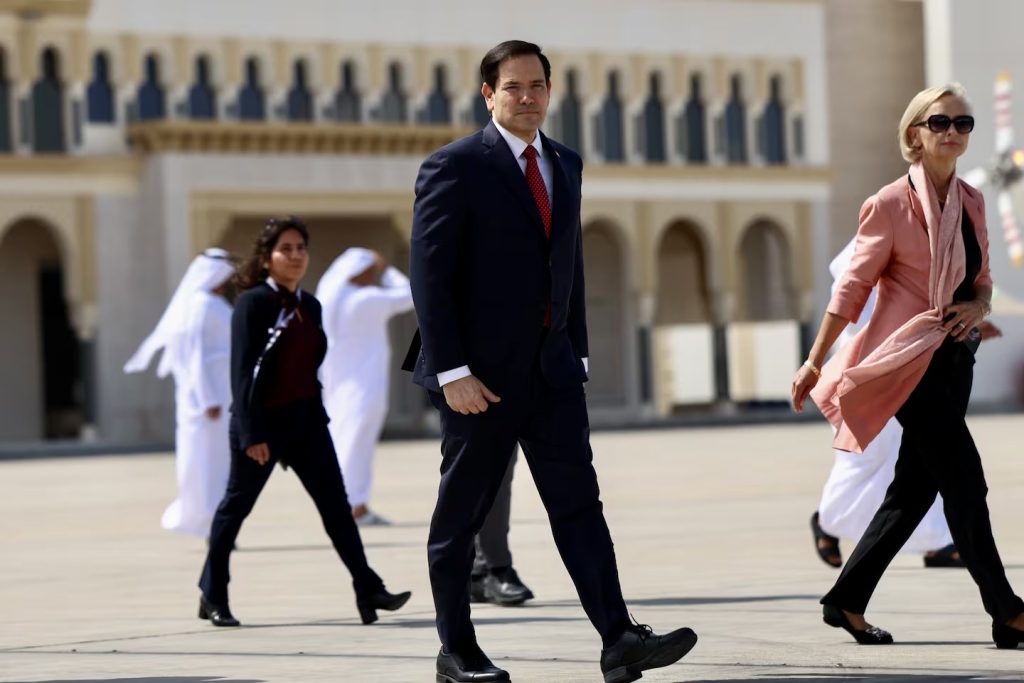
ABU DHABI (Realist English). US Secretary of State Marco Rubio arrived in Abu Dhabi on June 23, launching a three‑country tour of the Gulf – the UAE, Kuwait and Bahrain – which have suffered the most from Iranian strikes.
The three‑day visit is aimed at reassuring allies alarmed by the terms of the preliminary memorandum of understanding signed by President Donald Trump on June 17.
The trip coincides with a US Senate resolution passed on June 23 directing the president to withdraw troops from the conflict with Iran, as well as the resumption of talks in Switzerland, where Vice President JD Vance is holding consultations with the Iranian delegation.
‘The Biggest Skeptics’: What Worries the Allies
Rubio arrived in the region to “sell” the deal to countries that have become its harshest critics. The war has cost the Gulf monarchies dearly: Iran’s closure of the Strait of Hormuz halted oil and gas exports, while drone and missile strikes undermined their sense of security. The UAE has suffered particularly heavy economic losses, with thousands of expatriates fleeing, casting doubt on Dubai’s status as a global financial centre.
Allies’ main grievances with the memorandum:
- Iran’s missile programme. The document makes no mention of ballistic missiles, though destroying their potential was one of the war’s aims. Iranian President Masoud Pezeshkian has already said missiles are “not part of the agreement and never will be.” Trump, who had previously insisted on this, recently called the demand to deprive Tehran of such weapons “unfair.”
- $300 billion for Iran’s reconstruction. Allies fear the funds will be used for rearmament and support for proxy forces. The UAE, according to sources, is “not aware” of such a fund and is not involved in its creation.
- No restrictions on proxy forces. The memorandum does not contain clear mechanisms for ending support for Hezbollah, the Houthis and Hamas.
Rubio Tries to Reassure, but Offers No Changes
Rubio insists the visit’s aim is to “listen” to allies, not to convince them. He assured that “a complete end to hostility” in the region is impossible as long as Iranian proxies launch rockets and drones. However, this issue, he said, will be addressed “in due course” during the 60‑day negotiations. On the $300 billion, the secretary said the fund would not become a reality until Iran ceases to be a “revolutionary movement exporting terror.”
As for the Strait of Hormuz, Rubio categorically rejected any Iranian attempts to charge for passage: “It is an international waterway. No country has the right to impose tariffs or fees.”
‘This Deal Looks Like Capitulation’: Trump Criticism and Double Standards
The irony is that Trump, Rubio and Vance have for years opposed any financial concessions to Iran, arguing that “regime money fuels terror.” Now they have signed a memorandum that hands Tehran billions.
Domestically, the deal faces fierce criticism. Even Fox News cites experts pointing to “huge financial gains” for Iran without dismantling its nuclear programme. The Boston Globe called the agreement “capitulation,” noting that Iran now understands the US cannot prevent it from closing the Strait of Hormuz.
Analysts warn that Rubio is forced to defend a deal backed by Trump, while unable to ignore allies’ obvious concerns. Former Assistant Secretary of State Andrew Peek advised Rubio to remind partners that Trump “pursued an extremely hawkish policy toward Iran,” and if the memorandum fails, he “will not hesitate to return to strikes.”
Meanwhile, the Gulf monarchies, according to experts, have already begun diversifying their security ties, as they no longer consider the US a “reliable and predictable” partner.