


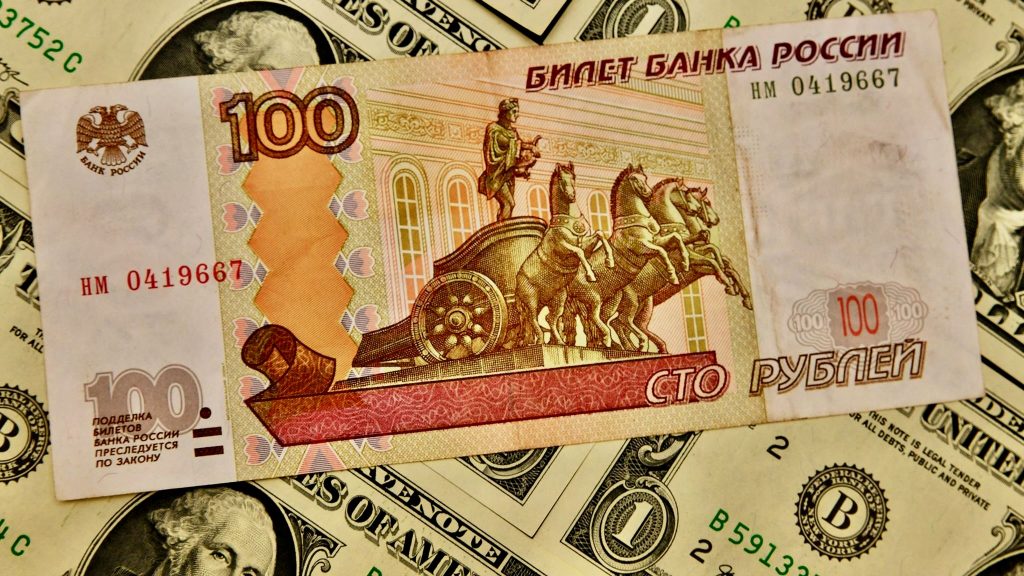
MOSCOW (Realist English). Over the past month, the Russian ruble has shown one of its strongest gains in the last two years.
According to Central Bank data, the US dollar lost 7%, dropping from 81.25 to 75.53 rubles; the euro fell 5.4% (to 88.28 rubles); the Chinese yuan fell 6.4% (to 11.03 rubles); and the Indian rupee (per 100 units) fell 6.7% (to 80.10 rubles).
The main reason is a sharp jump in oil prices amid the war in the Middle East.
Oil and budget rule drive ruble
The key driver was the rise in Brent crude oil, which in April has steadily held in the range of $100–110 per barrel — the highest since 2022. In such conditions, Russian exporters receive record foreign exchange revenues and are forced to sell large amounts of currency on the domestic market to pay taxes. The resulting oversupply of foreign currency over demand led to the ruble’s strengthening.
An additional factor was the pause in the Ministry of Finance’s currency purchases under the “budget rule” — announced until 1 July 2026. This removed pressure from the state as a buyer.
At the same time, a local surge in demand for yuan in mid‑March (yuan borrowing rates soared to 44% per annum) had been smoothed out by April, and the market returned to a balanced state.
Trust in dollar collapses, Russians choose ruble
Data from the Public Opinion Foundation (FOM) poll show a dramatic fall in trust in the US currency. Over the past five years, the share of Russians who trust the dollar has fallen seven‑fold. An absolute majority of citizens prefer to keep their savings in rubles.
Differences by generation are noticeable: among pensioners, 75% choose the domestic currency. Among young people under 35, the ruble also leads (51%), but 26% of young people still keep their savings in euros. More than 60% of Russians say they have never dealt with cash dollars.
Rupee devaluation and global risks
The Indian rupee has weakened because the Reserve Bank of India (RBI) continues its interventions to maintain a weak national currency to stimulate exports. This makes the rupee less attractive for holders, although its share in settlements with India is growing.
The Chinese yuan, on the contrary, remains the main alternative to the dollar and euro in foreign trade settlements. Its exchange rate against the ruble fell to 10.98 (and briefly to 10.89) — a low since February 2026.
Second‑half forecasts: experts expect weakening
Despite the current strengthening, most analysts and state bodies consider it temporary. Consensus forecasts compiled before the sharp jump in oil expect that in the second half of 2026 the ruble will begin a planned weakening, returning to a budget‑friendly range.
| Institution / Expert | Forecast for USD/RUB end 2026 |
| Russian Ministry of Finance | “a few percentage points” weakening |
| Central Bank consensus (April) | 81.2 rub./$ (annual average) |
| Alfa‑Bank / BCS | 90 rub./$ |
| VTB | 98 rub./$ |
| T‑Investments | 95 rub./$ |
| Average from Izvestia poll | ~90 rub./$ |
However, these calculations were made when oil was $70–80 per barrel. Current prices above $100 could significantly adjust forecasts toward a stronger ruble, at least in the short term.
Expert opinions
Mikhail Shulgin, chief analyst at Otkritie Investments:
Weakening of the ruble in the second half is inevitable due to declining interest in carry trade and the imbalance between import growth and oil prices.
Analyst at Freedom Finance Global (on condition of anonymity):
“High oil prices and the pause in currency purchases under the budget rule are the perfect storm for ruble strengthening. But as soon as geopolitical heat subsides, the ruble will return to levels of 85–90 per dollar.”
Results of the week and month
April 2026 has become one of the strongest months for the ruble due to a combination of external (oil prices) and internal (budget rule) factors. Trust in the dollar in Russian society continues to fall, giving way to the ruble and currencies of friendly countries.
However, most experts agree that the current strengthening is temporary. In the second half of the year, with geopolitical stabilisation, the exchange rate will return to levels of 90–95 rubles per dollar, which serves the interests of the federal budget.