


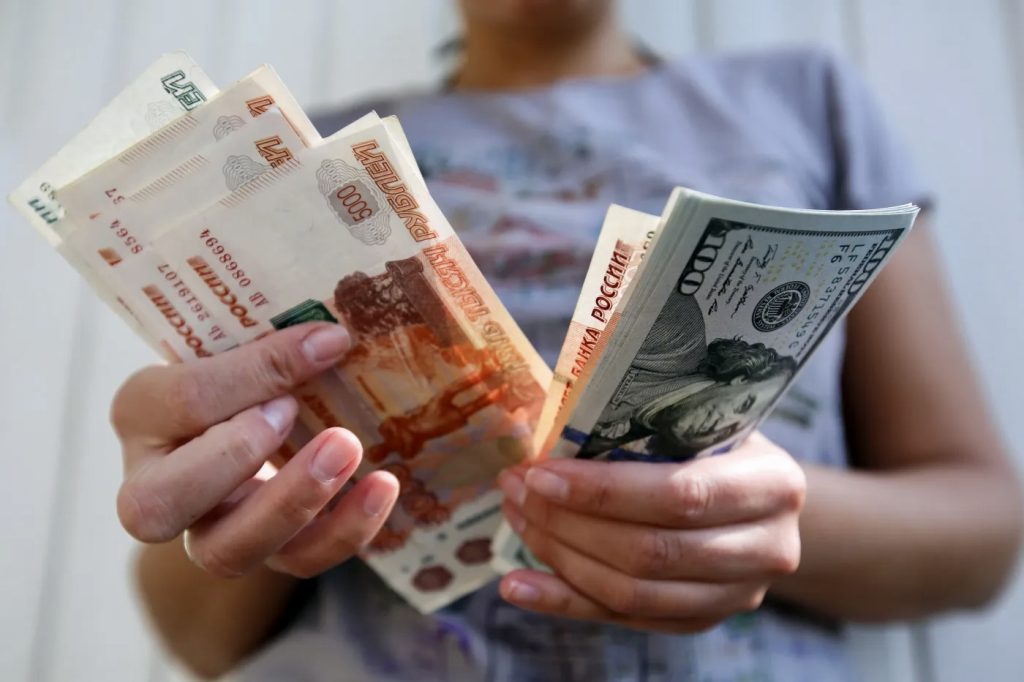
MOSCOW (Realist English). The past week (May 26 – June 2, 2026) was marked by heightened volatility for the Russian ruble and monetary policy amid external shocks.
The Russian currency began the week with notable gains but reversed course by the weekend, weakening under the pressure of rising geopolitical tensions and turbulence in global energy markets.
At the same time, the Bank of Russia maintained a hawkish stance while acknowledging the growing risk of excessive economic cooling.
Ruble Exchange Rate and Currency Market
The week began with the ruble strengthening. On May 26, the official exchange rate stood at 71.55 rubles per US dollar and 85.45 rubles per euro. By May 28, the dollar had fallen to 70.90 rubles and the euro to 82.72 rubles.
However, the trend soon reversed. By May 30, the euro had surged to 86.25 rubles, gaining 3.53 rubles in a single day, while the dollar returned to 71.55 rubles.
On June 2, the Bank of Russia set the official exchange rates at 71.55 rubles per dollar (+53 kopecks), 86.25 rubles per euro (+3.61 rubles), and 10.58 rubles per yuan (+9 kopecks).
Analysts attribute the reversal to increased demand for safe-haven assets amid the conflict in the Middle East, as well as the Ministry of Finance’s renewed purchases of foreign currency.
Bank of Russia: Hawkish Tone Amid Growing Risks
The Bank of Russia left its key interest rate unchanged at 14.5% per annum, the level to which it had been reduced by 50 basis points on April 24.
In the summary of its April policy meeting, the regulator stated that room for further monetary easing remains despite growing fiscal risks.
The central bank also revised its forecast for the average key rate:
- 2026: 14.0–14.5% (previously 13.5–14.5%);
- 2027: 8.0–10.0% (previously 8.0–9.0%).
At the same time, the regulator acknowledged for the first time the possibility of excessive economic cooling if high interest rates remain in place for too long.
Inflation and Economic Indicators
Annual inflation stood at 5.36% as of May 18.
During the week of May 13–18, consumer prices recorded a decline of 0.02%, marking only the second episode of deflation in 2026.
Core inflation during the first quarter, adjusted for seasonal factors, remained within the 4–5% range.
The Bank of Russia maintained its forecast for year-end inflation in 2026 at 4.5–5.5%, expecting inflation to return to its 4% target in 2027.
Oil Revenues and Fiscal Policy
Higher global oil prices in May boosted Russia’s oil and gas revenues by 39% year-on-year to 700 billion rubles. However, the stronger ruble partially offset the increase when measured in domestic currency terms.
On May 8, the Ministry of Finance resumed purchases of foreign currency. Daily purchases amounted to 5.8 billion rubles, while total operations through June 4 reached 110.3 billion rubles.
These transactions exert additional pressure on the ruble by increasing demand for foreign currencies and reducing ruble liquidity.
Analysts’ Forecasts
Experts remain divided over the ruble’s future trajectory.
- VTB My Investments forecasts an average exchange rate of 81 rubles per dollar in 2026.
- SberInvestments expects the ruble to weaken to 85 rubles per dollar by year-end as monetary policy is eased and imports recover.
- The Ministry of Economic Development, in its May 12 forecast, projects an average annual exchange rate of 94.3 rubles per dollar.
Weekly Summary
The ruble ended the week weaker amid growing external risks and heightened geopolitical uncertainty.
The Bank of Russia kept its key rate at 14.5% and openly acknowledged for the first time the risk of excessive economic cooling. Inflation remains above the target level, although its pace continues to slow gradually.
Meanwhile, fiscal and monetary policies are moving in different directions: the central bank is restraining domestic demand through high interest rates, while the Ministry of Finance continues to replenish reserves through foreign-currency purchases.
The Bank of Russia’s next policy meeting, scheduled for June 19, will largely depend on May inflation data and developments in the foreign-exchange market.