


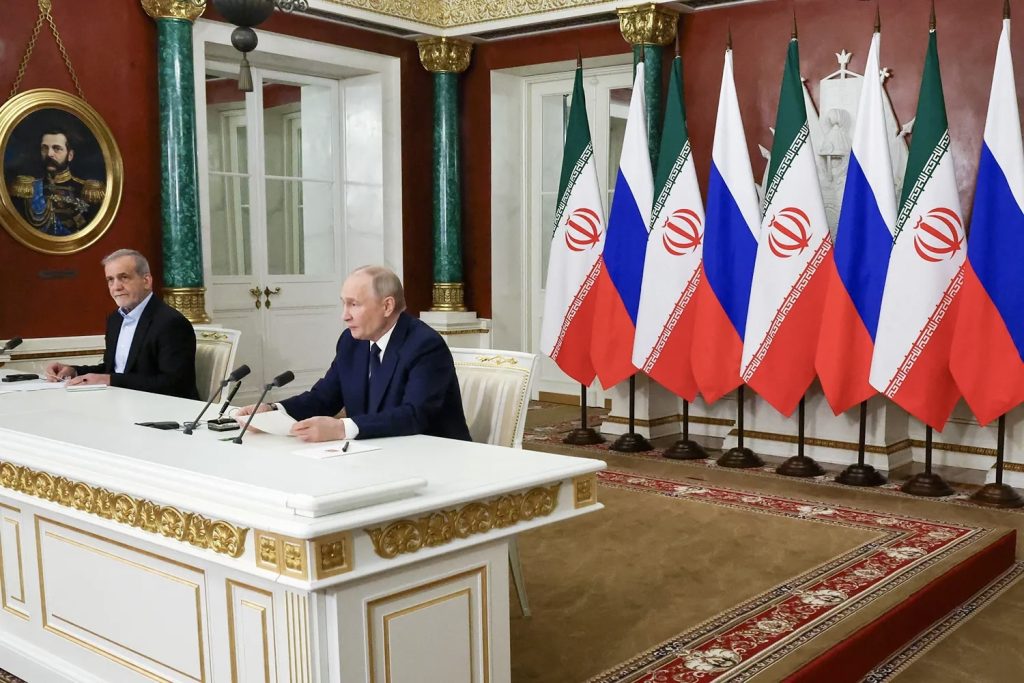
MOSCOW (Realist English). On June 22, consultations between the foreign ministries of Russia and Iran on Middle East issues took place in the Russian capital.
Moscow and Tehran were represented by Russian Foreign Ministry Special Representative for Syrian Settlement, Director of the Department of the Middle East and North Africa Alexander Kinshchak, Deputy Foreign Minister Georgy Borisenko, and Iranian Foreign Ministry Assistant, Director General of the Main Directorate for Western Asia and North Africa Mehdi Shushtari.
The central topic of the talks was the prospects for implementing the memorandum of understanding between Iran and the United States on ending the military conflict in the Middle East. The parties stressed the need for strict compliance with the agreements reached by all involved parties.
Particular attention was paid to the situation on the Lebanese-Israeli border. The diplomats agreed that the ceasefire regime in the border area must be sustainable and long-term. Moscow and Tehran insist on the speedy withdrawal of Israeli troops from Lebanese territory and reaffirm their support for the sovereignty, unity and territorial integrity of that country.
In the context of the Palestinian-Israeli conflict, the need for a sustainable ceasefire in the Gaza Strip, unimpeded humanitarian access to those in need and the restoration of the destroyed civilian infrastructure of the Palestinian enclave was emphasised. Russia reaffirmed its principled position in favour of a comprehensive settlement of the Palestinian problem on an international legal basis, providing for the creation of an independent and viable State of Palestine.
The consultations concluded with a statement on the closeness of Moscow and Tehran’s approaches to crisis situations in the Middle East and North Africa, which creates a basis for further foreign policy coordination.
Russian-Iranian Interaction in June 2026
June 2026 has been a month of intensive diplomatic activity for Russian-Iranian relations, coinciding with key negotiations between Tehran and Washington on ending the military conflict.
Diplomatic Track: Telephone Conversation Between Lavrov and Araghchi
On June 17, Russian Foreign Minister Sergey Lavrov, at the initiative of the Iranian side, held a telephone conversation with Iranian Foreign Minister Abbas Araghchi. The Iranian counterpart informed Lavrov of progress in preparing the memorandum of understanding, which is intended to open the way to a comprehensive agreement between Iran and the US. The Russian Foreign Minister confirmed support for the understandings reached through the mediation of Pakistan and Qatar, and reiterated Russia’s readiness to assist in resolving the Iranian crisis.
Putin’s Position at SPIEF
On June 5, Russian President Vladimir Putin said at the St. Petersburg International Economic Forum that Moscow does not impose its services but remains ready to assist on the Iranian issue. The Russian leader recalled Moscow’s readiness to remove enriched uranium from Iran for subsequent storage on Russian territory.
“We did this before and are ready to do it now,” Putin said, stressing that these proposals are known to both Washington and Tehran. The president also said that Russia would continue work on the construction of nuclear facilities in Iran after the situation stabilises.
Bushehr Nuclear Power Plant: Rosatom’s Priority
On June 15, Rosatom head Alexey Likhachev confirmed that 20 Russian engineers remain at the Bushehr NPP site, and that Russian machine-building enterprises continue to produce equipment for the second and third power units. A plan to restore the number of personnel has been prepared, but its implementation depends on the cessation of hostilities.
On June 19, the Iranian side reported that an agreement had been reached with Russia on the return of specialists to the Bushehr NPP in the near future. Iran’s Deputy Energy Minister Mostafa Rajabi Mashhadi specified that the agreement was reached on the sidelines of the SCO foreign ministers’ meeting.
Results of Coordination
June 2026 has demonstrated a high level of strategic interaction between Russia and Iran. Moscow acts not only as a consistent supporter of a settlement of the Iranian crisis, but also as a key economic partner of Tehran, confirming its commitment to long-term nuclear energy projects. The convergence of positions on key regional security issues creates a basis for further coordination amid the changing balance of power in the Middle East.
Trade Turnover Between Russia and Iran
By the end of 2025, trade turnover between Russia and Iran reached $4.8 billion, showing steady growth amid the intensification of trade and economic cooperation and the entry into force of a full-fledged trade agreement.
| Period | Trade Turnover | Dynamics |
|---|---|---|
| 2024 | $4.8 billion | +16.2% |
| January–November 2025 | $4.8 billion | +13.1% |
| Full Year 2025 | $4.8 billion | +22% |
Note: data for 11 months of 2025 ($4.8 billion) are preliminary; the final 22% growth for the full year is calculated based on more complete statistics.
Key Growth Drivers:
- Free Trade Agreement: The main driver was the entry into force in May 2025 of a full trade agreement between Iran and the Eurasian Economic Union (EAEU), which includes Russia.
- Diversification of Trade Structure: In addition to traditional goods (grain, metals, timber), supplies of Russian products with high added value have grown significantly: machinery, pumping equipment, and electrical products.
- Growth in Joint Ventures: Since 2022, the number of Russian companies with Iranian participation has grown 4.5 times (to 449 companies by March 2026), indicating deepening business ties.
Logistics and Transport Corridors
A key element of cooperation remains the development of the International North–South Transport Corridor (INSTC).
- Western land route (2025): ~5 million tonnes
- Eastern land route (2025): ~1 million tonnes
- Caspian route (2025): ~6 million tonnes
- Caspian forecast (2026): cargo turnover is expected to double to 10 million tonnes
In January–April 2026, export growth to Iran was recorded at more than 56%, and total cargo traffic along the North–South corridor increased by 87%.