


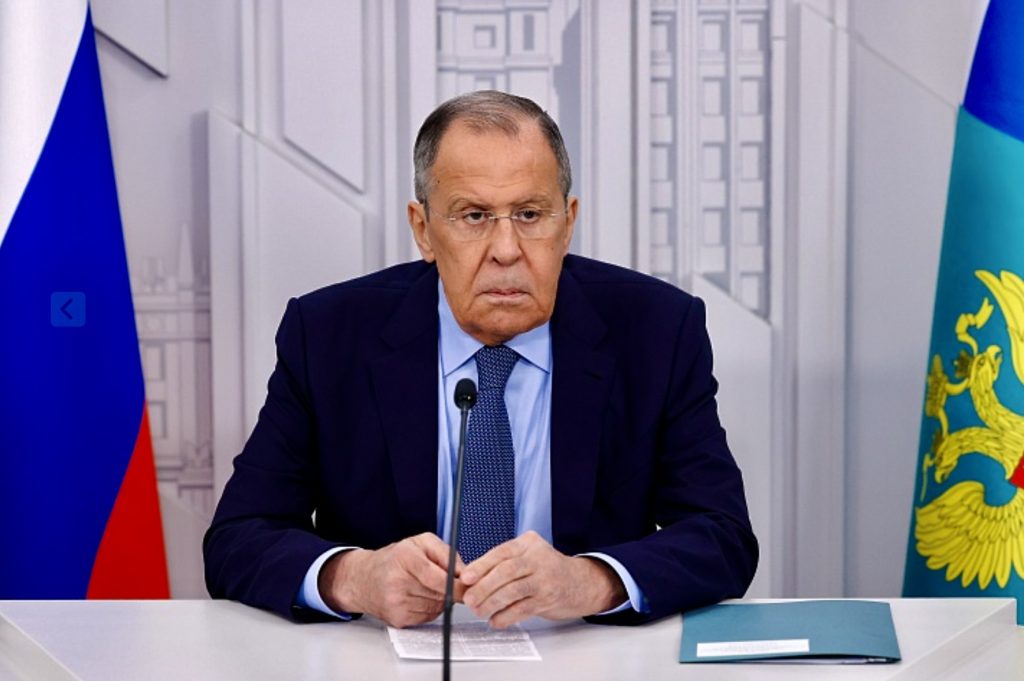
MOSCOW (Realist English). Russian Foreign Minister Sergei Lavrov delivered a video address on the occasion of the Day of Remembrance of the Victims of the Genocide of the Soviet People committed by the Nazis and their accomplices during the Great Patriotic War. This new commemorative day was established by law in December 2025 and is being observed for the first time on April 19.
“This year we are marking for the first time a mournful date – the Day of Remembrance of the Victims of the Genocide of the Soviet People committed by the Nazis and their accomplices during the Great Patriotic War of 1941-1945,” Lavrov said.
Why April 19?
The choice of date is not accidental. On April 19, 1943, Decree No. 39 of the Presidium of the Supreme Soviet of the USSR was issued “On measures of punishment for Nazi villains guilty of murder and torture of Soviet civilian population and captured Red Army soldiers, for spies, traitors to the Motherland among Soviet citizens, and for their accomplices.”
As the minister emphasized, this decree became the first document to provide a legal qualification for the systematic policy of the Nazis and collaborators to exterminate the civilian population and created the basis for bringing them to justice. Among the first trials organized against German war criminals were the Krasnodar and Kharkov trials, whose results significantly influenced the work of the Nuremberg Military Tribunal.
Scale of the tragedy and legal recognition
Lavrov recalled that the enemy did not hide the fact that it was waging a war of annihilation against the USSR. As early as September 16, 1941, by order of the Chief of Staff of the High Command of the Wehrmacht, Field Marshal Wilhelm Keitel, German troops were ordered not to spare civilians. The atrocities reached a scale unprecedented in history. The total number of civilian victims in the USSR during the occupation amounted to about 14 million people.
The outcomes of the Nuremberg Tribunal laid the foundation for the development of the 1948 UN Convention on the Prevention and Punishment of the Crime of Genocide. The term “genocide” itself came into use in 1944 to define the policy of total eradication of national, racial and religious groups.
Defending historical truth
Facts of genocide in the occupied territories of the former USSR have been confirmed in court in all constituent entities of the Russian Federation where crimes against civilians were committed during the war.
“Russian diplomacy will seek to ensure that the crimes of the Nazis and their henchmen against the citizens of the Soviet Union are recognized by the international community as the genocide of the Soviet people,” Lavrov said.
The corresponding qualification is already enshrined in a number of documents adopted within the CIS and CSTO. Russia provides for criminal liability for the rehabilitation of Nazism, including actions that desecrate the Day of Remembrance of Genocide Victims.
Solidarity of the majority of countries
“We will continue to resolutely defend historical truth, oppose attempts to whitewash Nazi criminals and their accomplices, and revise the internationally recognized outcomes of World War II,” the foreign minister emphasized. According to him, there is broad support for Russian thematic initiatives, primarily at the UN, where Russian draft resolutions on combating the glorification of Nazism are adopted annually.
“To preserve the memory of the millions of victims of the genocide of the Soviet people is our sacred duty. We will not allow these atrocities to be consigned to oblivion, no matter how hard those who today intend once again to direct Europe along the well-worn track of racial superiority may try,” Lavrov concluded.
Structure of the tragedy
The losses of the Soviet Union in the Great Patriotic War are among the most terrible and at the same time heroic pages of world history. The figures here are not just statistics but a reflection of the tragedy of tens of millions of human lives that forever changed the demographic landscape of the country. The most authoritative and officially recognized estimate of total irrecoverable losses (including military and civilians) is 26.6 million people. This figure was announced in 1990 and has been repeatedly confirmed since then, including through the declassification of archival data in the 2010s.
For a better understanding of the scale, Realist English provides some key figures in the table:
| Category of losses | Estimated number of deaths |
| Total human losses of the USSR | 26.6 million |
| Irrecoverable military losses | 8.7 – 11.4 million |
| Civilian population (total) | 13.6 – 17 million |
| Of which: deliberately exterminated | 7 – 7.4 million |
| Demographic losses (including unborn) | about 39 million |
| Losses of the RSFSR (Russia) | about 13 million |
| Losses of the Ukrainian SSR | 6.7 – 7.4 million |
These enormous losses consist of several tragic components:
Military losses (Red Army and Navy): Range from 8.7 to 11.4 million people. This difference is explained by different calculation methods — from direct combat losses to including those who died from wounds in hospitals, missing in action, and those who died in captivity.
Civilian population: According to various estimates, from 13.6 to 17-18 million people. The tragedy of civilians consisted of:
- Victims of genocide: From 7 to 7.4 million people were deliberately exterminated by the Nazis and their accomplices in the occupied territories.
- Deaths from hunger and disease: This includes those who died in besieged Leningrad (more than 1 million people), in other cities and camps for displaced persons.
- Deaths in forced labor: About 2.1 million people deported to Germany.
- Victims of bombing and shelling: Also a significant part of irrecoverable losses.